
AI search is moving from "emerging trend" to "material impact on business" faster than most marketing teams can adapt. The challenge isn't lack of tactics - it's lack of clarity about what matters and what doesn't.
We gathered insights from 12 leading practitioners to answer the questions that actually affect strategy:
Where should budget go?
What's overrated?
What are the metrics that connect to business outcomes?
The report organizes expert consensus around the decisions you need to make now - not speculative futures, but practical realities about citation frequency, measurement, and the shift from optimization tactics to genuine brand building.
These are people managing real budgets and seeing real results. Their perspective gives you a foundation for making smart decisions rather than guessing or following the loudest voice on LinkedIn.
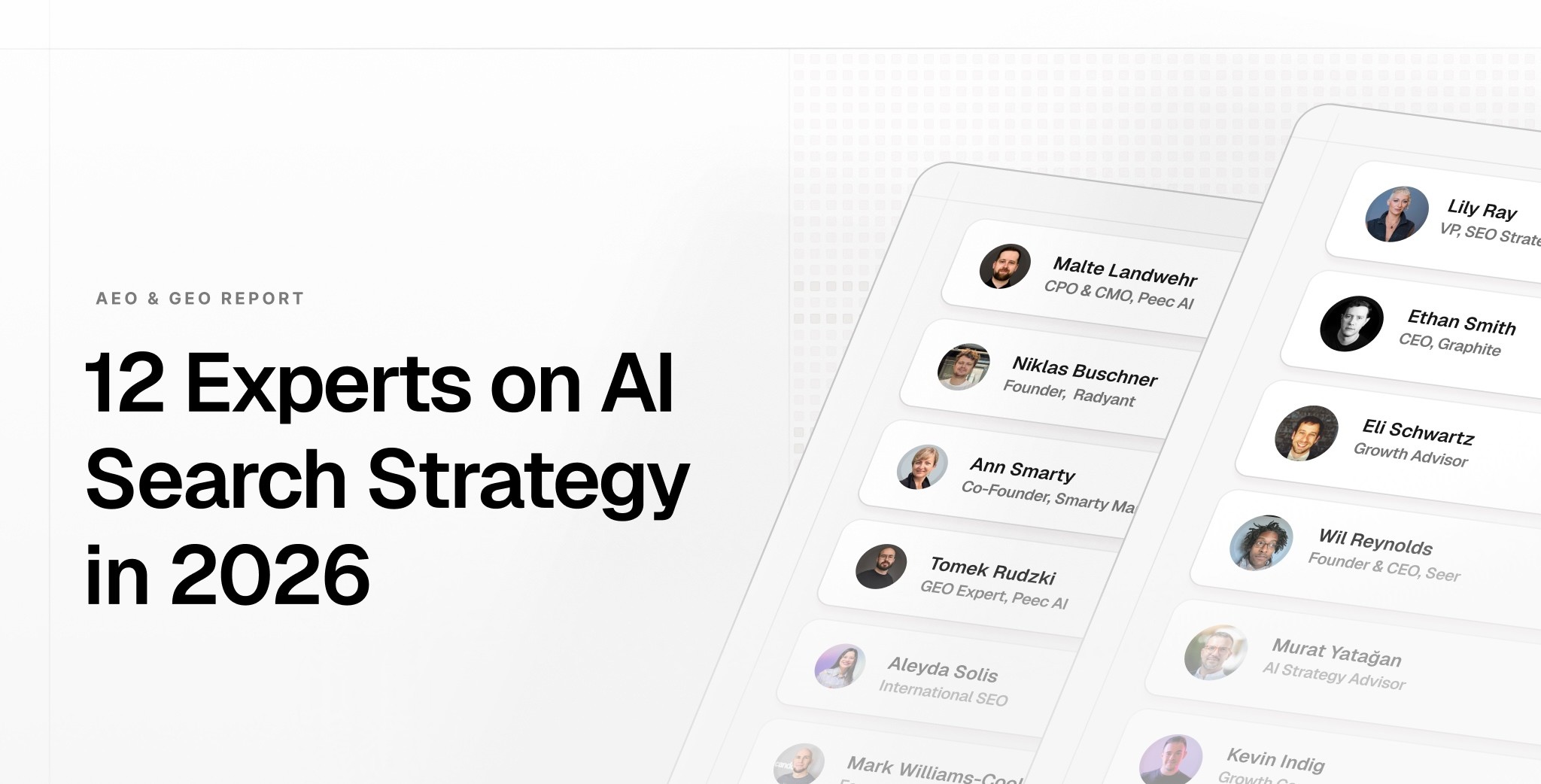
The Expert Panel
Lily Ray | VP, SEO Strategy & Research, Amsive.
NYC-based SEO leader named the #1 most influential SEO expert in 2022 by USA Today.Ethan Smith | CEO, Graphite.
SEO growth leader with 18+ years of experience and a go-to expert on AEO.Eli Schwartz | Growth Advisor
Author of 'Product-Led SEO' and strategic advisor to enterprise teams.Kevin Indig | Growth Consultant
Specialist in search growth ecosystems andformer Shopify Head of SEO.Murat Yatağan | AI Strategy Advisor
Previously at Google, Microsoft, Brainly, and GSG (Rocket Internet venture)Aleyda Solis | International SEO
Award-winning consultant, speaker, and author with 18+ years of experience.Mark Williams-Cook | Founder, Candour
Veteran SEO with 20 years of experience and founder of AlsoAskedNiklas Buschner | Founder, Radyant
SEO & AI Search Growth Partner, Host @Masters of SearchWil Reynolds | Founder & CEO, Seer
One of the world’s top speakers on SEO & digital marketing.Malte Landwehr | CPO & CMO, Peec AI
20+ year SEO expert recognized for enterprise SEO and AEOTomek Rudzki | GEO Expert, Peec AI
Technical SEO specialist focusing on AI - powered search paradigms.Ann Smarty | Co-Founder, Smarty Marketing
AI and search strategist specializing in SEO, AEO, and community-led growth.
What's the one AI search trend you're betting your 2026 strategy on?
Experts are pivoting away from traditional SEO tactics toward brand-building strategies centered on original content, third-party citations, video, and conversation influence. The consensus points to a "citation economy" where being mentioned authentically across trusted platforms matters more than ranking first, with a strategic shift from top-funnel traffic to mid-funnel engagement and multi-platform brand presence.
Lily Ray: "Original research and data and also like user generated content... authentic conversations... not just repurposing what everybody else has already said... The sites that are doing a good job of really housing like something completely unique... are the ones that are going to succeed"
Ethan Smith: "The biggest winner is potentially video sites... there's so much dense information and diversity of thought in videos that is still locked away largely. So I think eventually that'll open up."
Eli Schwartz: "I am assuming that AI visibility on top of funnel search terms, and I am counting on a further decrease of search traffic. For that reason, I am encouraging my clients to think about where their search efforts might be best focused at the mid-funnel of the journey."
Kevin Indig: "One trend is the fact that LLMs pull a lot of citations and mentions from 3rd party sites, especially as purchase intent gets stronger. So, the strategy is to publish thought leadership and research to get more mentions on other sites."
Murat Yatağan: "The citation economy. More specifically YouTube and self listicles. In 2026, ranking #1 on SERP is secondary to being the primary citation or mention in an AI's response. I'm betting on brand first content environments. This means dominating the listicles that LLMs use as training data (the "best of" guides) and doubling down on YouTube. As Gemini 3.0 and GPT-5 move toward true multimodality, a video demonstrating expertise is worth more than ten articles. If the AI can't see you doing the work on video or find you in a trusted 3rd party list, you don't exist."
Aleyda Solis: "Brand recognition and authority: From ensuring on-site crawlability and indexability of key on-brand content that targets the full customer journey queries, that establishes a clear USP, to aligning community management, digital PR and link building efforts in those third-party platforms where citations are coming from, addressing negative or conflicting brand related mentions, that facilitate entity recognition and establish "on-brand" authority."
Mark Williams-Cook: "I think we'll slowly see more brand discovery driven through LLMs, rather than traditional search. The summarisation capability of LLMs will mean a multi-site focus is more important than ever."
Niklas Buschner: "The one AI search trend I'm betting my 2026 strategy on is optimizing for conversation influence rather than just traffic quantity. The shift means that the absolute amount of traffic is a vanity metric; what truly matters is being part of the conversation users are having within AI platforms like Google AI Overviews, ChatGPT, Perplexity, Gemini, or Copilot."
Wil Reynolds: "The one search trend I am betting on is UX, both with UX folks and synthetic "users" -I think as long as keyword selection sits in SEO you are allowing the people who rarely talk to the humans on the other side of the prompt to make the calls on which prompts get put into your tracking systems. It wasn't until I watches real people, try to solve their real problems was I like...man I was thinking about this stuff with some major biases."
Malte Landwehr: "Google & ChatGPT are the search and answer engines to focus on. No other comes close."
If you had to allocate $100K for AI search in 2026, where would it go?
PR and brand building take the largest share, followed by measurement tools to track visibility and citations, and customer research to understand authentic language and pain points. Budget allocation depends on starting point: established companies need cross-team coordination and executive buy-in, while newer brands should allocate most budget to building mentions on sites LLMs trust.
Eli Schwartz: "The best place to invest in AI search right now is in PR campaigns to let the world know how good your products and services are. Before AI search, you could have been a quiet success by just incorporating better SEO efforts than your competitors. Now, many of those tactics have fallen by the wayside as LLMs seek to replicate real-world popularity contests. To win in that realm, you actually need to be popular."
Kevin Indig: "I'd split it three ways: 25% Measurement & monitoring to track where and how a brand shows up in AI answers. 25% User research: panels, groups, interviews and surveys to deeply understand the target audience, their problems and jobs-to-be-done. 50% Content automation: infrastructure to automate content creation, research and updates."
Murat Yatağan: "I'd split my budget to focus on substance over syntax. AI search engines are now smart enough to detect SEO fillers. $50,000 Scaled personalized content: Creating hyper specific persona first hubs that solve 1:1 user/ICP problems. $30,000 Subject matter expert (SME)partnerships: Buying the time of real experts to co-author, review, and stress-test content. $20,000 Dataset & partnership building: Securing mentions on the niche, high authority sites that AI models prioritize for truth."
Mark Williams-Cook: "Digital PR, with an extended emphasis on being visible on sites we know are fetching during RAG for topics we are interested in."
Niklas Buschner: "If I had to allocate $100K for AI search in 2026, it would primarily go into a few key areas: Deep Customer Research: It's about consistently conducting expert interviews and talking directly to actual customers to understand their research journey, pain points, and how they phrase their queries. Content Engineering: Developing unique, valuable content that is designed to be heavily cited across the research journey. Crucially, this content must embed our brand and services as a natural solution to user queries, rather than being generic. Conversion Rate Optimization: Ensuring that our landing pages are meticulously optimized for conversion. With less, but higher-intent traffic, every visitor counts. AI Search Analytics & Prompt Monitoring Tools: Investing in tools like Peec AI to continuously track our brand's visibility, citation share, and how AI answers evolve over time. This helps us understand if our content strategy is effectively influencing the conversation."
Wil Reynolds: "100k for AI search? It would be engineering, I would be pulling together all my transcripts, trying to understand how customers talk about their problems so I could better understand how they describe their own problems, in their own voice, which would then allow me to make the content to connect with them."
Malte Landwehr: "Assuming that all the typical brand, SEO, and PR activities are already taken care of? As someone coming from an Enterprise and Management Consulting background: 20k for a good AI search analytics set-up, 20k for a slide deck that convinces my CEO, CFO, and CMO that AI search matters, 60k to support digital PR, social media, community management, communications, editorial, product, and engineering teams in their work to get my wishes implemented. As an SEO at a company that has no brand to speak of: 5k for a solid AI search analytics set-up, 20k on listicles, 75k on brand mentions on reputable websites."
What should brands STOP doing in 2026 when it comes to AI visibility?
Generic upper-funnel content without unique insights, data, or opinions doesn't work anymore. Traffic volume is a vanity metric that misses the point. Manipulative listicles, Reddit spam, and over-engineered schema without quality content are getting shut down. If your content doesn't explicitly tie your brand to the solution, LLMs won't cite it.
Lily Ray: "The days of writing a lot of upper funnel content that's already been written about many times - without providing unique insights, data, opinions or value above and beyond what others have already said - those days are extra over now."
Eli Schwartz: "Stop creating a "sea of sameness" where you are just "rewriting each other's articles."
Kevin Indig: "Track prompts without clarifying personas."
Aleyda Solis: "Those manipulative "best of" lists that are not genuinely a useful resource for the audience... I expect some updates/shifts happening to avoid giving weight to the spam/manipulation that has been going on."
Niklas Buschner: "Brands should STOP doing a few things in 2026 when it comes to AI visibility. Obsessing over traffic quantity as the primary KPI:This is a major one. Traffic quantity is often "vanity" and doesn't directly correlate with business outcomes in the AI search era. Focus on quality and conversion instead. Creating generic, interchangeable content: If your content is so generic that it could be pasted onto a competitor's website, it won't stand out or get cited by LLMs. You need to explicitly tie your brand and services into the solutions you provide."
Tomek Rudzki: "Following SEO / GEO myths"
What's the most overrated AI search tactic right now?
Reddit manipulation, over-engineered schema markup, and generic listicles are getting too much attention. The common thread: technical optimization without substance doesn't work when LLMs can understand content quality and context. If nobody else is organically talking about you, no amount of technical tricks will change that.
Lily Ray: "Spamming Reddit... I think the only inevitable outcome of this is that they crack down on it in a really big way."
Murat Yatağan: "Over-engineering Schema for entity stuffing. Many brands are still treating Schema markup like a magic spell, spending a lot of resources on technical entity optimization, while the actual content on the page remains thin or generic. LLMs in 2026 are highly semantic, they understand your entity through the quality of your plain text and the company you keep online (partnerships), not just your JSON-LD code. Also, doubling down on on-site SEO while ignoring off-site partnerships is a losing game. If nobody else is talking about you, the AI won't either."
Wil Reynolds: "Most overrated: Listicles."
What's one specific optimization you've seen drive best results in AI search?
Verified expertise makes a measurable difference - content with real, credentialed authors gets significantly more citations than anonymous posts. Reciprocal brand mentions (genuine partnerships between companies) create authority signals. Treating AI visibility as a top-of-funnel brand channel that qualifies users before traditional search also shows strong conversion results. Even small changes like footer text can update ChatGPT descriptions within 36 hours.
Ethan Smith: "Reciprocal mentions is the new reciprocal backlink." Example: "What's the best meeting note transcription tool that integrates with Zoom? And the answer is Otter. And that's because there's an Otter page [about Zoom] and there's a Zoom page [about Otter]."
Eli Schwartz: "The results I care most about in AI search are those that drive users to a point in a funnel where they are likely to make a purchase. This might mean they aren't going to convert directly off the AI search result, but it could be that they are going to do a follow-up traditional search and then click on a result. In that sense, I am seeing the most success with companies that explore AI visibility as a new brand channel, higher in the funnel rather than just a new set of search terms to "rank" on. When I work with my clients to develop this funnel approach, they see higher conversion rates from their traditional search visibility because those users are more qualified."
Murat Yatağan: "The expertise trinity: Verified authors + accredited reviewers + credible references. The best hack for AI search isn't a hack at all. It's digital trust. We've seen significant jumps in citation frequency when we move away from anonymous Staff posts to content backed by a Person schema that links to a real and credential human. Both LLMs and Search Engines are looking for signals that the information is safe to repeat. Showing your work via credible citations and expert bios is the highest ROI move right now."
Wil Reynolds: "Everything I try to do is a guess, so best results...no idea. My most surprising test was when we changed our footer and the statements we put in our footer changed our answer about our brand in ChatGPT in 36 hours."
What's one thing about GEO that most brands still don't understand?
AI search is about helping people make decisions, not driving clicks to your site. Prompts are significantly more specific than keywords (5x longer on average), but most content is still written too broadly to match. The real shift isn't which platform wins—it's that AI-powered search behavior is fundamentally different from traditional search, regardless of whether it's Google or ChatGPT.
Kevin Indig: "There's a marketplace gap between search / prompts and content. Prompts are on average 5x longer than keywords, but most existing content isn't as specific."
Mark Williams-Cook: "A lot of it is built on top of traditional IR done by search engines, and the part that isn't is not as "intelligent" as it first appears."
Malte Landwehr: "GEO is about facilitating decisions - not clicks."
Tomek Rudzki: "People often frame this as Google vs ChatGPT. But the real battle is AI-powered search vs traditional searching. Regardless of who wins -Google or ChatGPT (or any other company that rises to power) -AI answers will keep moving forward. That's why SEOs, brand managers, and business owners need to learn how to optimize for AI answers. That's the exact reason why tools like Peec AI exist. It's like the 1990s, when people debated Microsoft vs Apple. The real winners were businesses that learned to use computers to their advantage, regardless of which company dominated. Today, it's the same: the businesses that learn to optimize for AI answers will have the advantage."
Which AI platform deserves more attention in 2026 and why?
Google's AI Mode is underestimated despite integration across Chrome, Maps, and Android—essentially embedding itself into daily digital behavior. Currently under 5% market share, but features are gradually moving into standard Google search, making it "the new front door to the internet." Perplexity also deserves attention for its multi-model approach and hybrid capabilities between traditional search and LLM functionality.
Murat Yatağan: "Gemini. While OpenAI has the mindshare, Google's aggressive push into AI Mode and the Nano Banana ecosystem (their lightweight, high speed multimodal models) is a perfect fit for brands. Google is effectively weaving Gemini into the operating system of our lives. Because it has the most direct pipe into the consumer's purchase journey via Chrome, Maps, and Android, Gemini isn't just a chatbot. Google is the new front door to the internet."
Mark Williams-Cook: "Perplexity. Their growth has been slower, but solid. They have a smart multi-model approach, and a bunch of other features that make them good competitors in both the traditional search and LLM space."
Malte Landwehr: "Google AI Mode. It has a relatively low share, currently below 5%. But more and more aspects of AI Mode will find their way into Google search."
What are you seeing in the data that others are missing?
Trust is the most important ingredient for success. Traditional SEO still drives 90% of business visibility and feeds directly into AI results. Citation sources vary dramatically by topic - not just the usual suspects like Wikipedia and Reddit. The most valuable brand mentions often happen in unmeasurable spaces like private communities, which breaks the attribution obsession.
Kevin Indig: "Trust is the most important ingredient for success in organic and AI Search."
Malte Landwehr: "Just because Wikipedia, Youtube, and reddit are top LLM sources, does not mean they are relevant for your topics. I have seen everything from Facebook, Tiktok, and Instagram to obscure niche websites dominate the citations for some of our clients. Run a few prompts. Look at the sources. Try to be present there."
Ann Smarty: "At this point, SEO still drives 90% of visibility for businesses (this is what I see with my clients). Organic visibility also translates into AI visibility (directly through LLMs searching Google and indirectly because visibility builds cross-channel visibility), so I'd focus on tactics that help both instead of allocating separate budgets. Relevant, meaningful digital PR is one of those tactics that builds both organic search visibility through backlinks and AI visibility through fresh brand mentions. If done right, it's also building Reddit and social media presence."
Wil Reynolds: "A few weeks ago I had 30+SaaS CMOs follow me on Linkedin over 2 days. I hadn't done anything recently or spoke at a conference but my spidey senses were up, way up. Later on I found out some private group of SaaS CMOs mentioned me in their call that week, and 3-4 others were like "yup wil's worth a follow" that mention will bring me 0 attributable revenue. I don't know the group, how many people are in it, and i can't track traffic from it to my site, but it was BIG. That is why I'm over attribution."
What's the first thing a brand should do in January to improve their AI search visibility?
Establish your baseline: measure current performance, understand where you appear and how you're cited, identify which prompts trigger real-time searches. Talk directly to customers to learn their authentic language and research behavior. Measurement and understanding come before optimization - figure out where you stand before deciding where to go.
Mark Williams-Cook: "Figure out which prompts you want to appear for are triggering background searches, and which are not. If you're getting in-model answers, you're not going to be able to quickly impact the results."
Niklas Buschner: "The first thing a brand should do in January to improve their AI search visibility is to deeply understand the research journey of their future customers. This means moving beyond just looking at SEO tools and actively engaging in expert interviews and conversations with actual users. You need to uncover their real problems, the language they use, and how they seek information."
Malte Landwehr: "Understand their current performance."
Controversial take: What will matter LESS in 2026 than people think?
Raw prompt visibility without performance context will matter less as the industry matures toward measuring actual business impact. Attribution won't capture everything - some valuable mentions happen in private spaces - but that makes tracking what you can even more important.
Eli Schwartz: "Right now prompt visibility is viewed as a KPI on its own, but I think this KPI on its own will matter a lot less by the end of 2026. Companies and products will arise that help brands measure performance of AI results and not just the visibility that is the focus now."
Aleyda Solis: "Being included in specific prompts due to answers personalization. Instead, look at the share of inclusions in those product or service relevant topics as a whole, from answers that tend to be grounded."
Tomek Rudzki: "Producing low quality content. This is a plague these days, but unfortunately, as of December 2024, in many cases it's still working in AI search. I expect they'll eventually implement stricter quality standards - starting with more "sentitive" prompts, such as Your Money or Your Life (YMYL)queries and gradually expanding to other categories. We may come full circle with technical SEO, where search engines will be more selective about indexing URLs, only adding pages that provide substantial value on a given topic."
Wil Reynolds: "Less in 2026? Hmmmm - anything dealing with attribution. There is no "webmaster tools" for AI platforms. I'm so over it."
Conclusion
AI search in 2026 demands a complete strategic reset. The expert consensus reveals three core truths:
First, the competitive advantage has shifted from technical optimization to substance- original research, verified expertise, and authentic brand mentions now determine who gets cited.
Second, what you measure needs to change. Citation frequency, competitive positioning in AI responses, and conversation influence matter more than traffic volume. Brands can no longer guess where they stand in AI search. As Niklas Buschner emphasized, tracking your brand's visibility and citation share with tools like Peec AI is now foundational.
Third, investment priorities must shift dramatically toward digital PR, customer research, and building trust signals that LLMs can detect and repeat.
The urgency is real - while low-quality tactics may still work today, Tomek Rudzki expects "stricter quality standards" to emerge, and those who wait to adapt will find themselves invisible in an AI-mediated discovery landscape where, as Eli Schwartz notes, "you actually need to be popular" to win.
At Peec AI, we are working hard to support marketers through these interesting times. To give you a better outlook on what to expect in 2026, we are lucky to get the opinions of the most respected voices in the space. We share a lot of their opinions and will continue to provide the right tools to win in your category.