Part 1: Source gap analysis
Part 2: Brand mention gap analysis (this guide)
TL;DR
In part one, we looked at source gap analysis. Today, we focus on finding gaps in your brand mentions, meaning prompts where competitors appear but you don't.
While a citation-first strategy cares about getting your URLs cited, a mention-first strategy focuses on getting your brand name mentioned in AI answers. You can typically achieve this by increasing mentions across external sources.
This guide gives you a framework for identifying the most promising opportunities for brand mentions:
Set up prompt tracking with tags and competitor monitoring
Filter for high-intent prompts where your brand isn't mentioned
Identify the sources driving those AI answers (sorted by usage and competitor mentions)
Prioritize sources that appear across multiple AI models
Execute outreach (organic or paid) to close the gap
Track improvements over time
We designed this guide for agencies and brand managers who are getting started with AI search optimization. You don’t need anytechnical experience, and the techniques work with most AI tracking platforms.
Citation-first vs. mention-first strategies
While a citation-first strategy focuses on getting a specific domain or URL cited in AI answers, a mention-first strategy is about increasing how often your brand name appears in those answers.
Why does this matter? Even if AI doesn't link directly to your site, being named alongside competitors builds brand awareness. Users who see your brand recommended by ChatGPT or other large language models (LLMs) are more likely to search for you directly afterward.
A mention-first strategy typically involves two approaches:
Increasing the number of times your brand is mentioned across external sources (the focus of this guide)
Ranking your own branded content for relevant queries
This guide gives you a framework for identifying the most promising opportunities. I'll use Peec AI to illustrate examples, but this framework works with any visibility tracking tool.
We focus specifically on brand mention gaps (prompts where your brand isn't mentioned at all) rather than improving existing mentions or measuring ROI - we'll cover those topics in future guides.
Our example: Online therapy providers
For this guide, we'll use Headspace as an example. It’s mainly known for its meditation and sleep app, but it also offers online therapy services and wants to improve their presence in AI answers for therapy-related queries.
We'll break down brand mention visibility into four buckets:
Your brand is mentioned in many sources and appears in the AI answer: You're doing well here.
Your brand is mentioned in some sources and appears in a lower position: Room for improvement.
Your brand is mentioned in a few sources and doesn't appear in the AI answer: High potential for quick wins.
Your brand isn't mentioned anywhere, but competitors are: This is where brand mention gap analysis becomes most valuable. Especially, if competitors similar to your brand are already getting mentioned.
Today we’ll focus on bucket four which contains prompts where your competitors are getting visibility but you’re not. In just five steps, we’ll show you how to close this gap and gain visibility for your brand.
Step 1: Set up prompt tracking and brand monitoring
If you’ve read our source gap analysis guide, you'll already know the importance of tagging your prompts. Tags allow us to filter prompts by intent, product segment, or any other categories that matters to your business. They also make it much easier to surface high-potential prompts to optimize for.
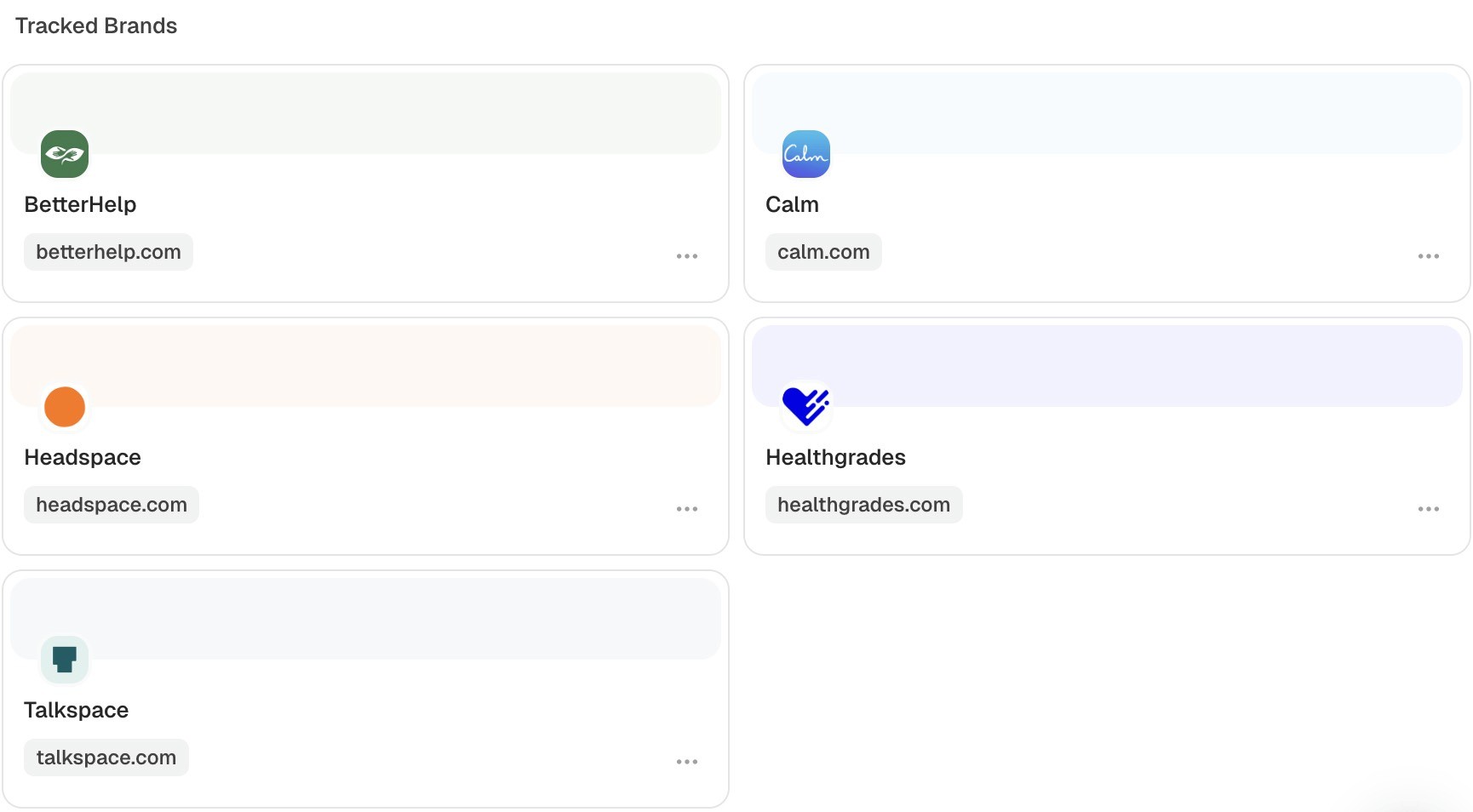
The other essential setup step is adding competitor tracking. In Peec AI, we automatically suggest which brands to track based on your industry, but every niche is different. You can also add name aliases to capture visibility more accurately (for example, tracking both "BetterHelp" and "Better Help").
For this simplified demo, we're tracking just a few online therapy brands.
Screenshot: Brand monitoring setup in Peec AI showing tracked competitors.
Step 2: Identify prompts with low or no brand mentions
The next step is to find prompts where competitors are mentioned but your brand isn't. To do this, use your AI tracking platform to:
Filter by your tags (we used "commercial" and "therapy" for our Headspace example)
Filter for prompts where your brand is not mentioned
With this method you start with the prompts that matter, then work backward to find the sources driving those answers. In our example, filtering for therapy and commercial intent surfaces prompts where users are actively researching options, which is where brand visibility matters most.
Screenshot: Filtered prompt list showing commercial therapy queries where Headspace isn't mentioned.
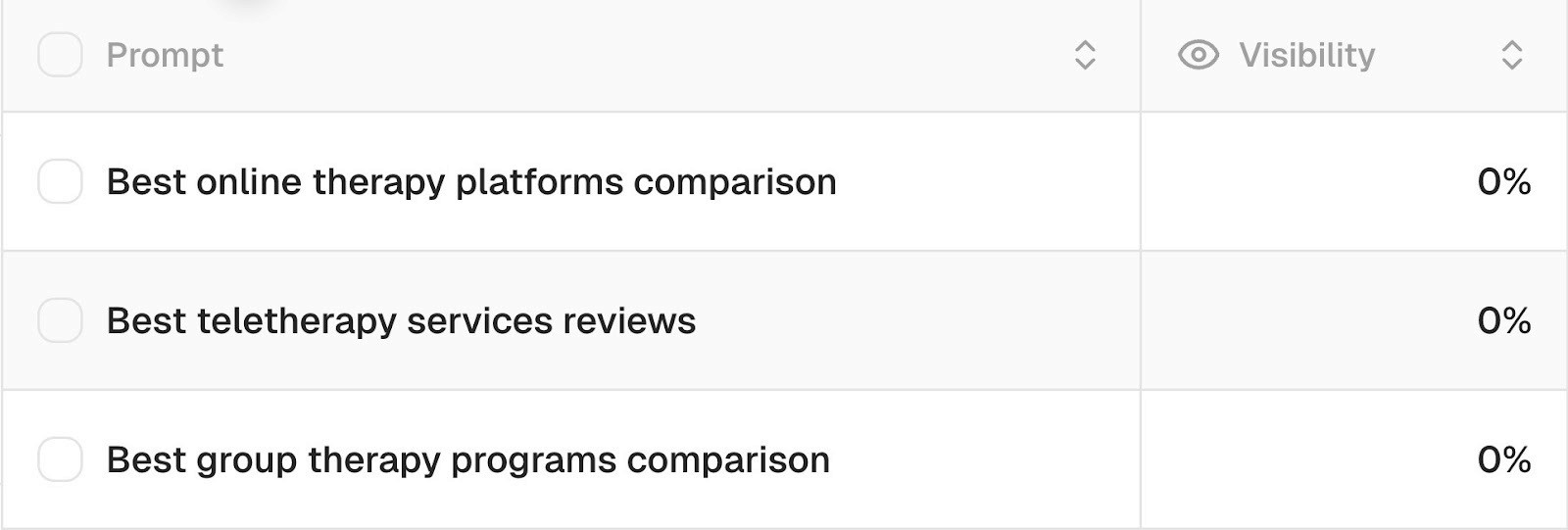
Here we found three valuable prompts, but we'll focus on the first, "Best online therapy platforms comparison."
Step 3: Find high-value sources that influence the prompt
We identified "Best online therapy platforms comparison" as high potential for Headspace because the brand isn't mentioned, but competitors are. Now, we want to see all sources used for this prompt, ranked by how frequently AI models retrieve them. For consistency, I keep the same filters applied throughout this workflow (“therapy” and “commercial,” Headspace not mentioned).
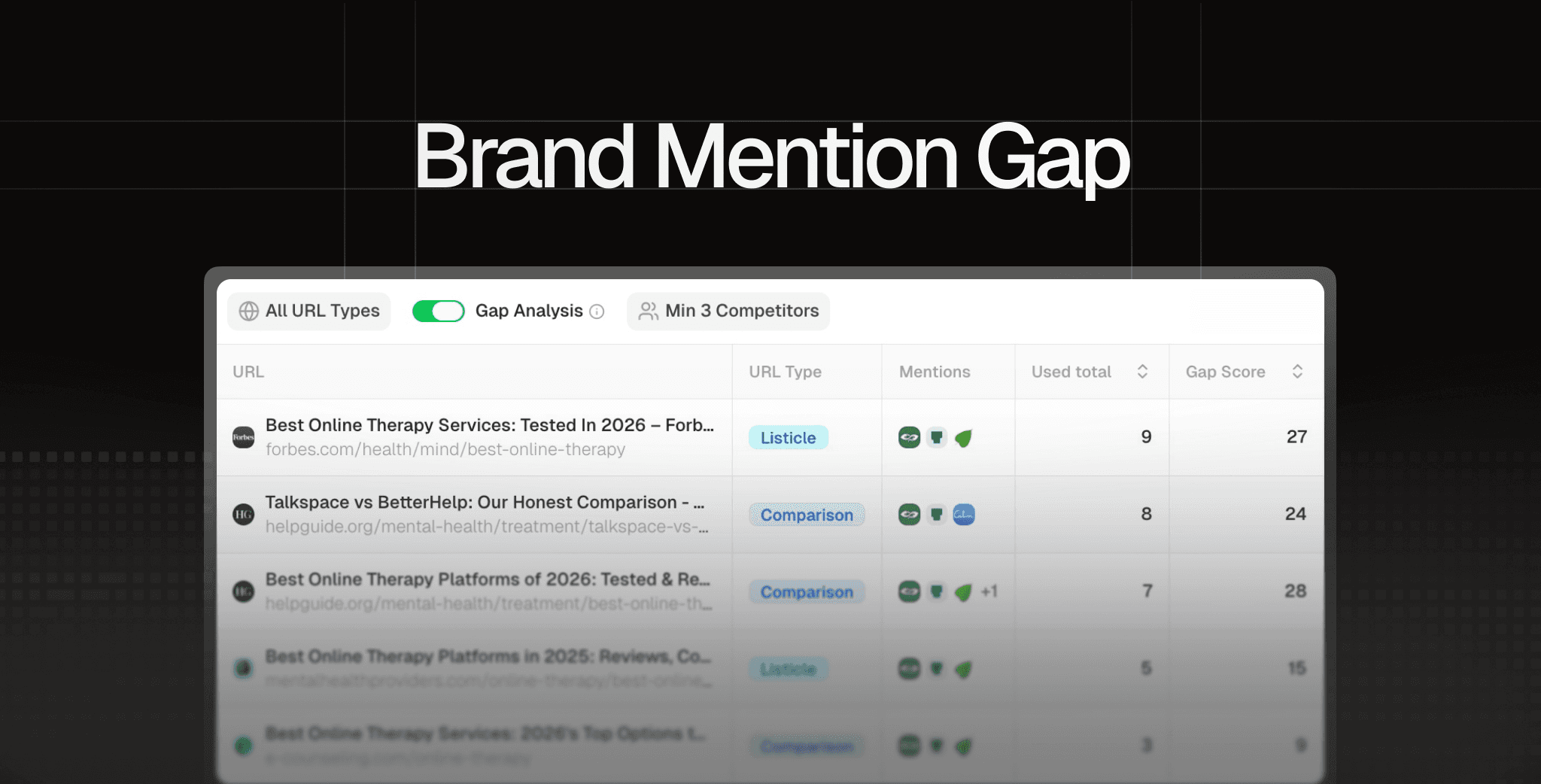
To narrow down to the most promising opportunities, I also filter by minimum competitor mentions. In Peec AI, this shows sources with high usage where three or more competitors are mentioned.
Screenshot: Source analysis showing top URLs for the target prompt, filtered by competitor mention count.
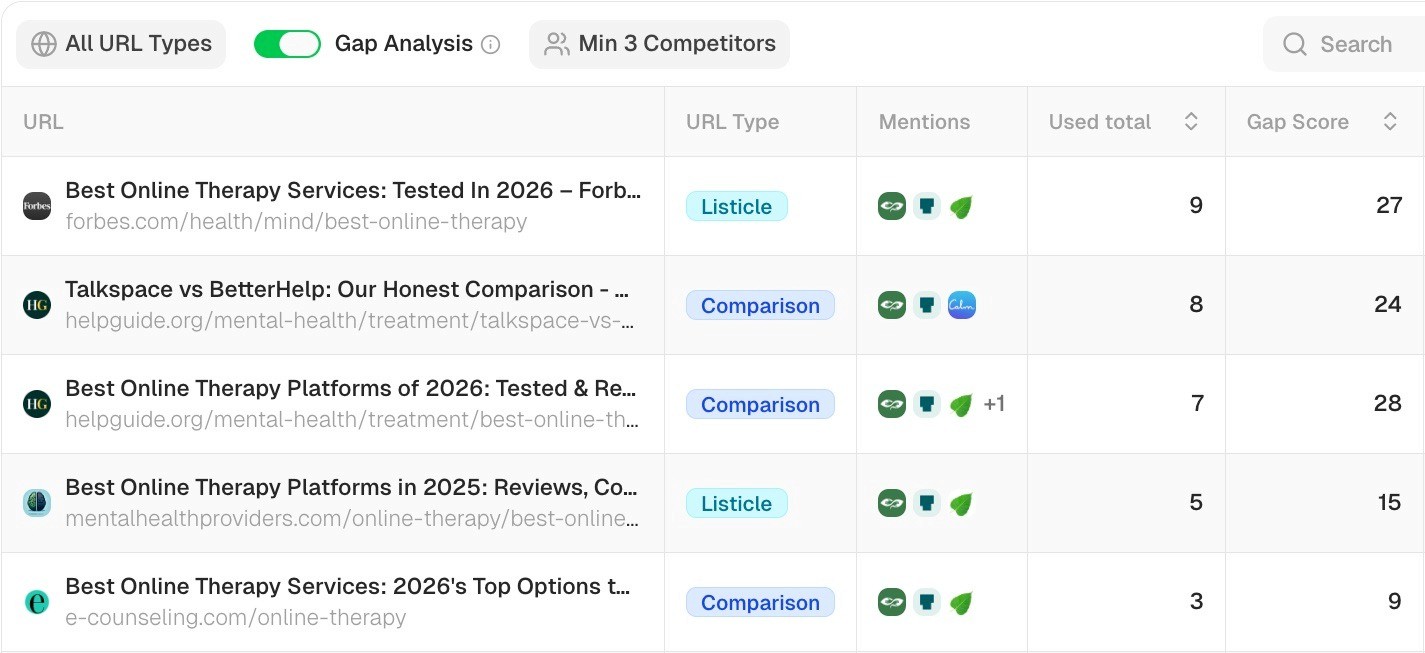
For this prompt, I check sources across all AI models (ChatGPT, Google AI Mode, and Perplexity). The top source is a Forbes article.
Looking at the data, we can see a high-intent article that mentions three or more of Headspace's competitors, but not Headspace itself. That's exactly the gap we're looking for.
Understanding the gap score
You'll notice a metric called "gap score" in Peec AI. This shows how many of your tracked competitors are mentioned in each source, multiplied by how often AI uses that source. Higher gap scores indicate higher-priority targets.
This technique is powerful because it directly informs your outreach and brand reputation campaigns. At this stage, we have a shortlist of URLs that:
Don't mention the target brand
Are frequently cited by AI models
Already mention multiple competitors
Note: Not all AI tracking platforms offer this automated scoring, but you can manually assess sources by checking competitor mentions and usage frequency.
Step 4: Find the highest-intent URLs across multiple models
We already have a solid shortlist of URLs, but how do we know which will be most effective to target?
One strategy is to identify which top sources appear across multiple AI models. Content that ChatGPT, Perplexity, and Google AI Mode all rely on is likely to have the biggest impact on your overall visibility.
Earlier, we looked at top sources across all models. Now let's filter by model and compare the results.
For simplicity, we'll compare just ChatGPT and Perplexity, but you could include more models:
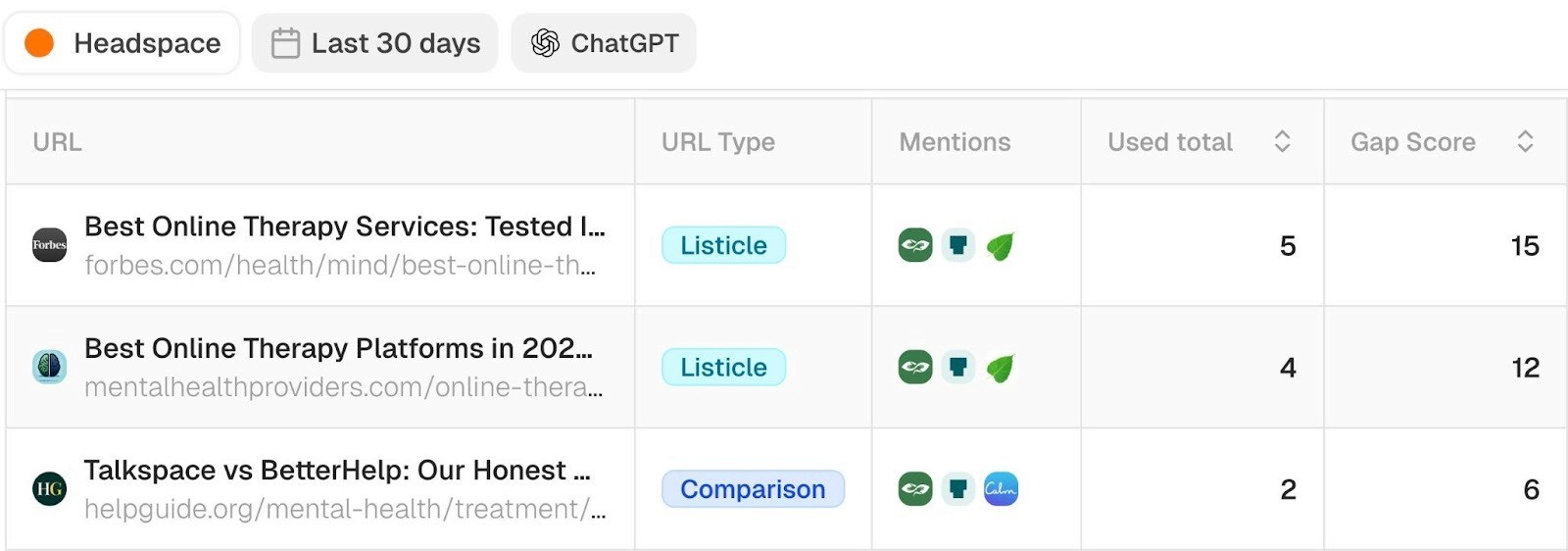
ChatGPT top sources:
Screenshot: Top sources for ChatGPT showing Forbes article ranked highly.
Perplexity top sources:
Screenshot: Top sources for Perplexity showing Forbes article ranked highly.
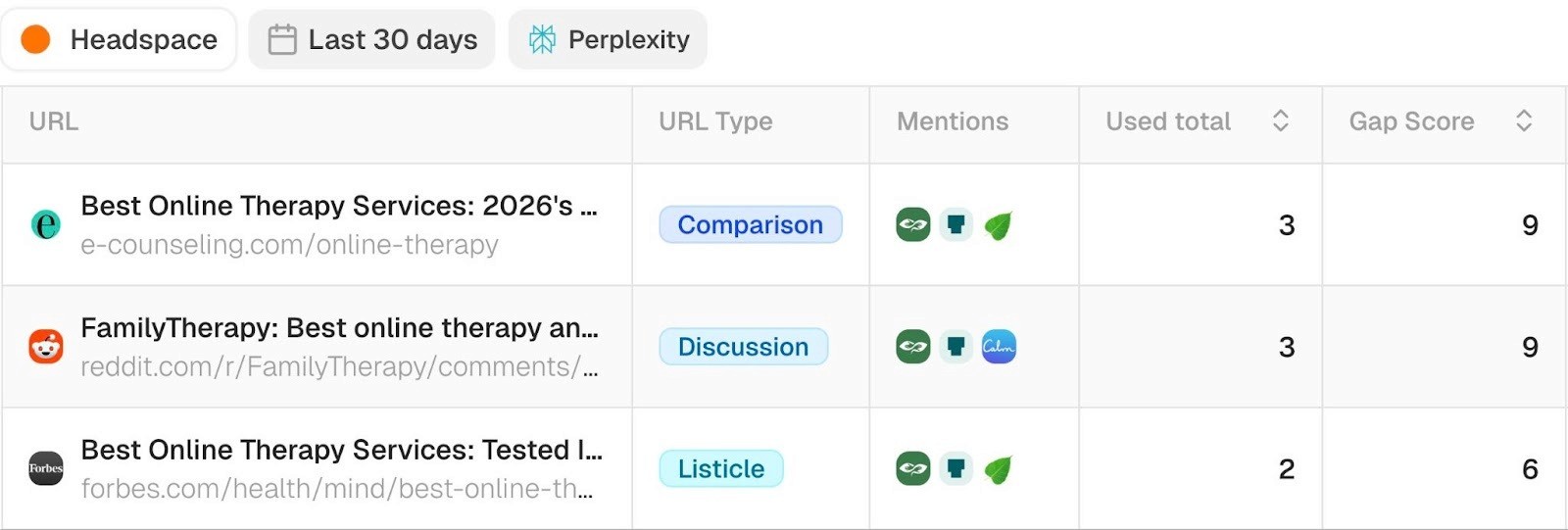
The Forbes article appears in both models and is the most-used source overall. Before moving forward, let's verify that Headspace isn't already mentioned. You can do this by checking the article's table of contents or searching the page.
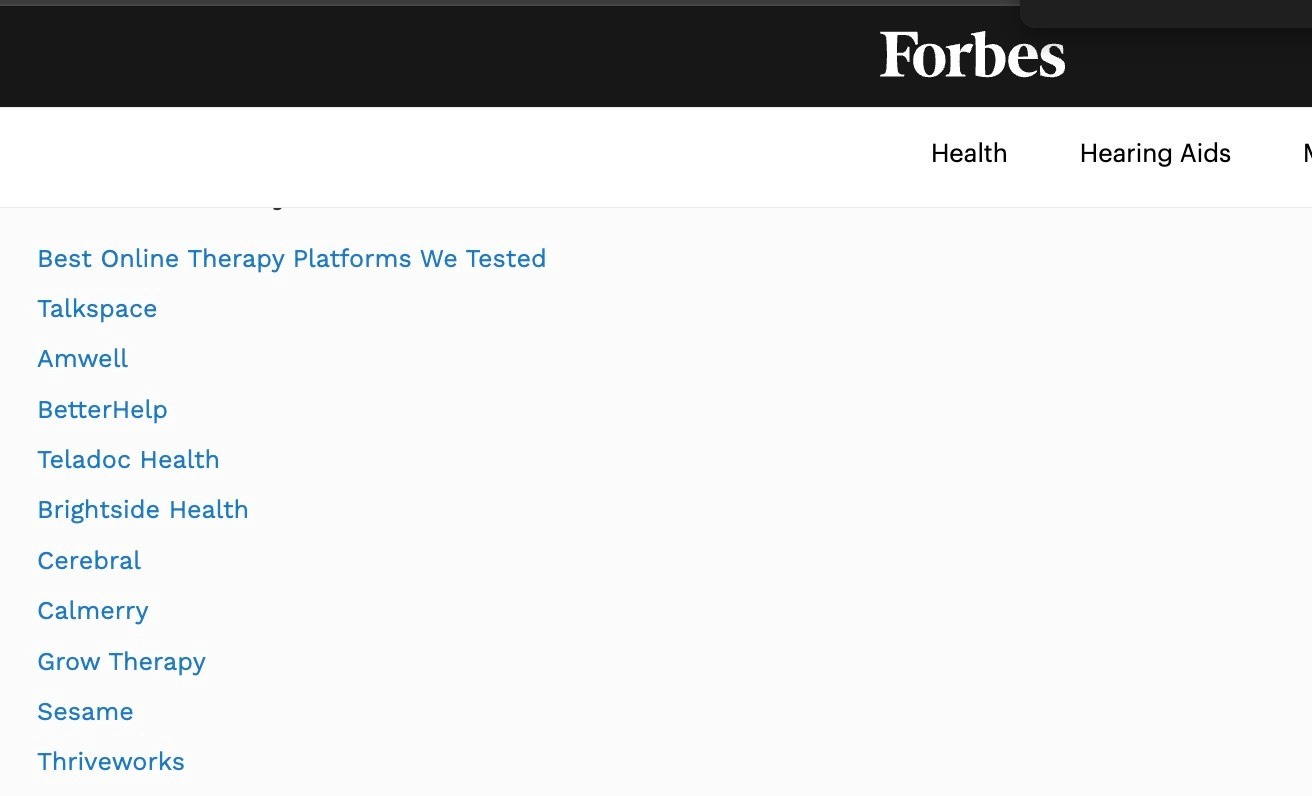
Now let's see how our tracked competitors are positioned within this article:
Screenshot: Competitor placement within the Forbes article showing featured positions.
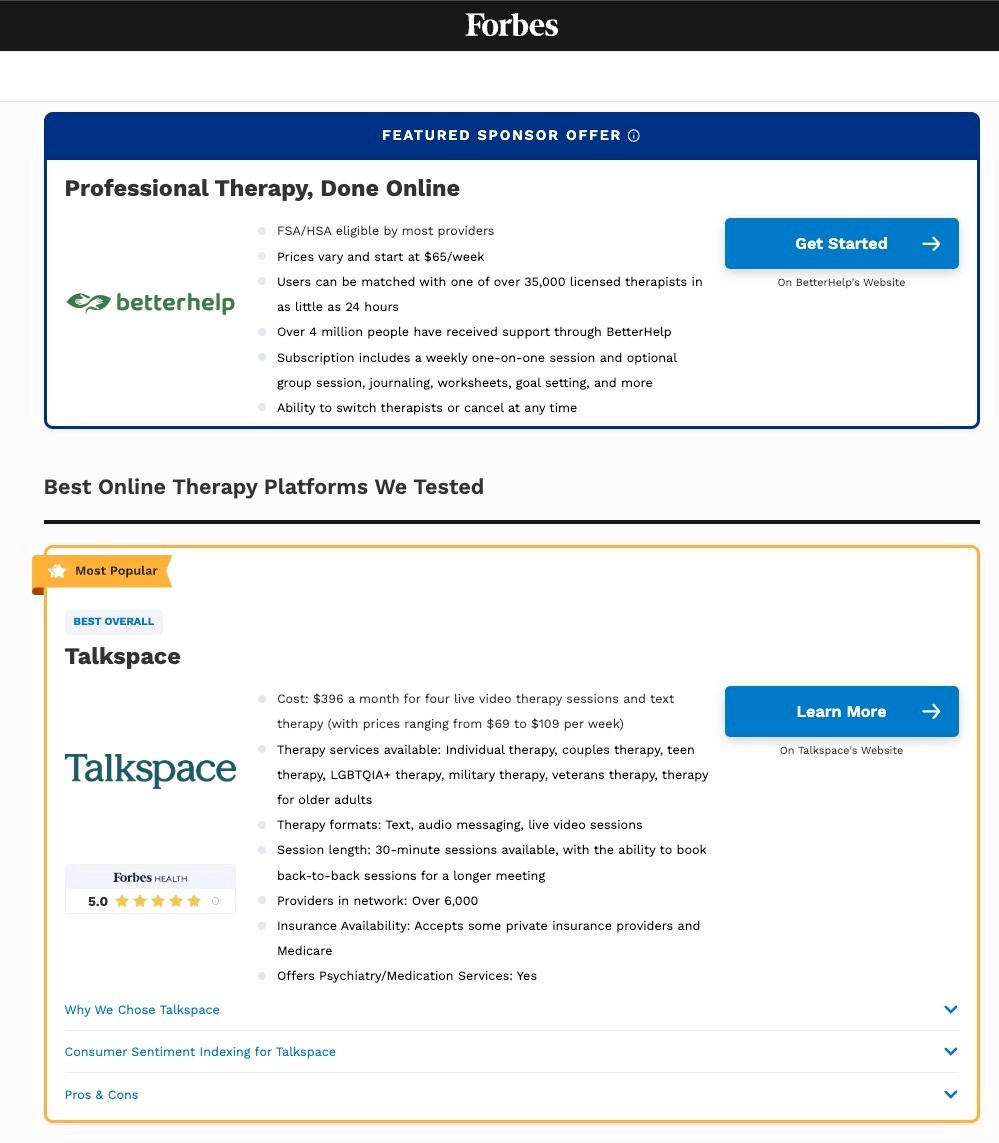
With this research complete, we can now develop our outreach strategy.
Step 5: Decide on an outreach strategy
Now that we've identified a high-value target, the competitor positioning analysis helps us determine the best approach.
Looking at the Forbes article, we can see that one of Headspace's top competitors secured a prominent paid placement. This tells us competitors are actively investing in this space and gives us insight into what's working.
Your outreach options typically include:
Organic outreach: Contact the publication with updated information, a compelling angle, or an offer to contribute expertise.
Paid placement: Explore sponsored content or advertising opportunities.
PR campaign: Generate newsworthy content that publications want to cover and reach out to journalists in your industry.
Review solicitation: If the article relies on user reviews or ratings, encourage satisfied customers to leave reviews on platforms like Trustpilot, G2, or industry-specific review sites that the publication references.
The right approach depends on your budget, timeline, and the specific publication's policies.
Step 6: Repeat this process for other high-value prompts
This technique allows you to quickly identify high-value source URLs to target with either organic or paid placements.
As you secure more placements for your brand, your AI visibility tracking platform will automatically pick these up. Over time, you should see your AI visibility increase across your target prompts.
Key takeaways
We learned how to use brand mention tracking to identify prompts where competitors appear but you don't. This brand mention gap analysis shows exactly where to focus your outreach efforts and helps inform your AI visibility strategy.
The core workflow includes these steps:
Set up prompt tracking with relevant tags and competitor monitoring
Filter for high-intent prompts where your brand isn't mentioned
Identify the sources driving those AI answers
Prioritize sources that appear across multiple models
Execute your outreach strategy
Track improvements over time
Coming next: We’ll look at advanced techniques to prioritize outreach targets and measure the impact of your brand mention campaigns.