In traditional SEO, you had SEO tools telling you keywords, such as "project management software," get, let's say, 10,000 searches per month. You knew exactly what to do next because the strategy was right in front of you. All you had to do was to invest in building your content around the chosen keywords and tracking your rankings to see how it performs. It was data-driven, predictable.
But that approach doesn't work in AI search. Prompt volume alone won't cut it.
Why? Because even if you had perfect volume data, one buying decision involves multiple prompts at different stages: awareness, consideration, evaluation and purchase.
High-volume prompts matter, but so do the customer-specific variations that reveal positioning gaps. If you miss the journey stages, you will be invisible at critical decision moments which can cost you sales.
I hear this constantly from marketing managers: "I don't know which prompts to track." They want simple answers, like “Give me the top 50 prompts by volume and I'll optimize those.” But that's not how AI search works. People default to the obvious and most intuitive - they track only "best [category]" prompts, assume that covers it, and call it done.
But they're missing awareness-stage prompts, customer-specific variations, and brand evaluation queries where the real positioning battles happen.
This article walks you through a framework for building your prompt strategy based on your customer journey and business context, not just chasing volume numbers.
By the end, you'll know which prompts to track, why they matter, and how to spot the gaps that are costing you deals.
Let's start with why tracking a single prompt doesn't cut it for AI search.
The three aspects of complete prompt coverage for AI search
Many agencies and brands only track "list of best [category]" prompts because those prompts seem popular. That's incomplete.
This approach misses two important things. First, you're not tracking whether AI mentions your brand when people are still exploring their options and figuring out if they need what you offer. Second, you're overlooking how AI search results are becoming increasingly personalized. Two people asking the exact same question can get completely different answers because AI learns from each user's unique context. For example, Gemini recently launched Personal Intelligence, which lets users opt in to have the AI analyze their emails and Google Drive files to personalize responses.
If prompt volume is a misleading North Star, we need a new map. That map consists of three aspects that ensure you are visible not just regularly, but also at the right time.
Here's what you need to cover:
Consumer journey stages: Focus on the key decision points in AI search (awareness, consideration, evaluation).
Customer context: Understand who your buyers are, what problems they're solving, what they value, and what constraints they have. This is crucial to deal with the personalization layer used by AI search engines.
Geographic markets: Track multiple regions or cities if you operate there.
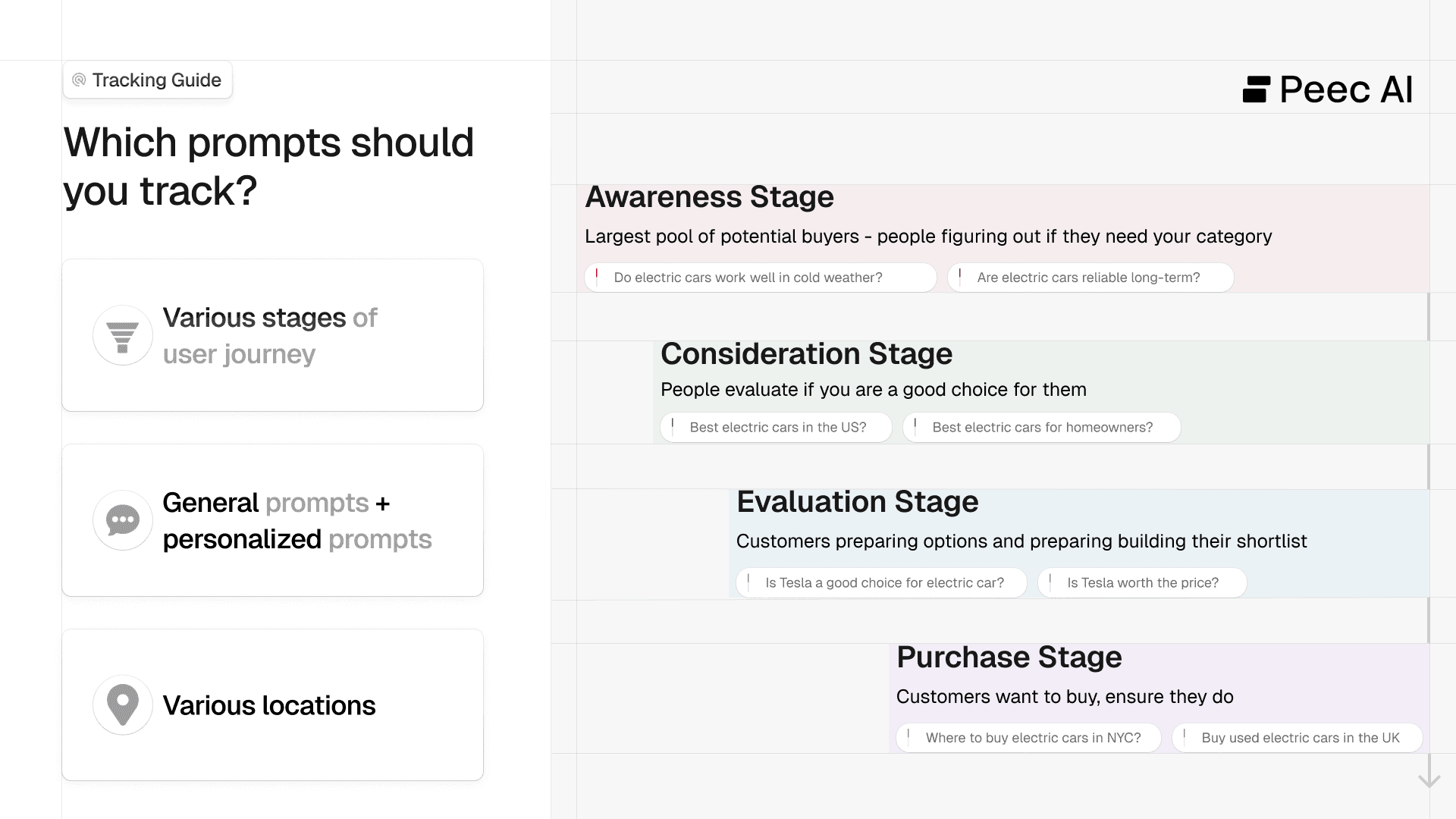
Mapping prompts to the path your customer takes before they ever click 'buy' is the most critical aspect in this whole process, so let's start with that.
Consumer journey stages
Stage 1: Awareness
Most people track prompts where customers are already comparing brands. That's valuable, but there's untapped potential earlier in the customer journey.
Generally, customers don't jump straight from "Should I buy an electric car?" to "Which Tesla should I buy?"
Instead, they move through stages. First by asking "Should I buy an electric car?" or similar, then "Which electric car should I buy?" and in the end, comparing Tesla vs Rivian vs VW.
If you're invisible at the awareness stage, you're missing the largest pool of potential buyers. While some people will discover you through other channels - ads, word of mouth, direct search - awareness prompts capture people before they've formed opinions or shortlisted their choices.
Let's look at a real example. Someone considering electric vehicles asks: "Will electric vehicles hold their value?” This is early-stage research. They're worried about depreciation, not asking about Tesla specifically.
When AI answers this prompt, it acknowledges the concern, “Yes, EVs do lose value over time.” But then it adds: "Newer models with longer ranges and strong brands like Tesla are retaining value better."
Perfect positioning! Tesla gets introduced as the exception to the rule, right when a potential buyer has concerns.
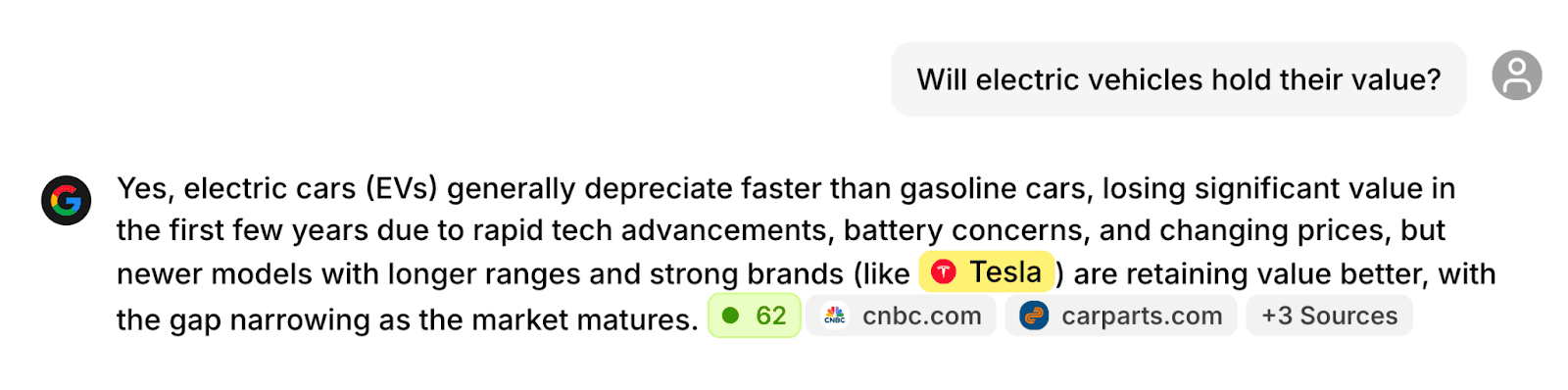
The person was worried about EV depreciation and left thinking: "Tesla holds value better than other EVs."
How to build awareness prompts for AI search
Awareness prompts capture the largest audience - people still figuring out if they even want your product or service category. They have a problem or a desired outcome but haven't yet realized they need what your brand offers. If you're visible at this stage while also positioned favorably, you're catching buyers at the right moment.
Start by identifying what concerns people have about your category. Think about the fears and doubts that stop someone from buying.
How to find these concerns:
Talk to your sales team. What objections do they hear? This includes having recordings from sales and discovery calls (this is a goldmine!).
Use common sense and intuition about your market.
Check Reddit threads where people ask questions related to what you offer.
Ask ChatGPT: "What concerns do people have about [category]?"
Here's how you'd apply this strategy for Tesla:
First, identify common concerns (depreciation, maintenance costs, cold weather, reliability), then turn them into prompts:
"Will electric vehicles hold their value?"
"Are electric cars expensive to maintain?"
"Do electric cars work well in cold weather?"
"Are electric cars reliable long-term?”
“Will electric cars work for families with young children?”
“Will electric cars work fine for people who commute every day in busy areas?”
Some prompts address concerns every potential customer has, while others speak to specific situations (families, commuters, etc.). Tracking both ensures you're visible early in their research before they start comparing you to competitors.
Stage 2: Consideration
At this stage, potential customers are building their shortlists. They're searching for terms like "electric cars" or asking for recommendations like "What are the best electric cars?" Your job: figure out if AI actually mentions you when people ask these questions.
Consideration prompt examples for Tesla:
"What are the best electric cars?"
“Electric cars” (still a valid prompt!)
"Which EVs have the longest range?"
"Best electric cars under $50k"
"Best electric car for tech enthusiasts"
"Best electric car for homeowners"
"Best luxury electric car for professionals"
Notice how some prompts include specific situations or audiences (“for tech enthusiasts”, “for homeowners”, “for professionals”). If you’re not sure which customer types you’re targeting yet, don't worry - I'll show you how to reverse-engineer them from your website at the end of this guide.
Track both broad consideration prompts and ones tailored to specific customer types. This reveals whether AI includes you when people are comparing options and whether it recommends you to actual target customers.
Stage 3: Purchase
This stage matters most for ecommerce stores, retail brands, and service providers who sell directly to consumers. After people decide what they want, they need to figure out where to get it.
When someone searches "Where can I buy iPhone 17?" or "Where can I find Nike Air Max in stock?" they're past the research phase. They've made their decision and need a vendor.
If AI doesn't mention your store or platform at this crucial moment, you lose the sale to competitors, even if you won the earlier awareness and consideration stages.
Purchase stage prompt examples:
"Where can I buy [specific product]?"
"Where's the best place to buy [product] online?"
"Where can I find [product] in stock near me?"
"Where can I buy [product] with free shipping?"
"Which stores carry [brand]?"
"Where is the authorized [brand] dealer?"
For service businesses, these become location-focused:
"Where can I get [service] near me?"
"How do I book [service] online?"
"Where's the closest [service provider]?"
Track purchase prompts separately. Tools like Peec AI let you tag these separately from consideration and evaluation prompts, so you can see where competitors dominate the "ready to buy" moment.
If you're a B2B company or don't sell directly to consumers, skip purchase stage tracking. Focus your efforts on awareness, consideration, and brand evaluation instead (covered in the next section).
Advanced tracking methods: Brand evaluation and geographic variations
Once you’ve covered the core journey stages (awareness, consideration, and purchase), there are two more areas that can help you:
Brand evaluation: Track direct competitor comparisons and when people evaluate hesitations about your brand.
Geographic targeting: Monitor how your visibility changes by location if you operate in multiple regions.
Let's cover each:
Track brand comparisons separately
Brand evaluation happens when someone compares you directly to competitors ("Tesla vs Rivian") or evaluates purchase hesitations ("Is Tesla worth it?"). While this is still part of the consideration stage, it requires separate tracking.
Track brand evaluation prompts separately from your main tracking to keep your visibility metrics clean. In Peec AI, you can create a dedicated project for this.
Why track separately? When someone asks "Tesla vs Rivian", Tesla's visibility is guaranteed at 100% since it's in the prompt. If you mix these with brand evaluation prompts where visibility might be 60%, your overall metrics get skewed.
For detailed guidance on brand evaluation prompts and sentiment tracking, see my Ultimate Guide to tracking brand sentiment in AI search.
Add geographic targeting if needed
Don't assume your brand performs equally across different regions. AI search results can vary dramatically by location, even for identical prompts.
"Best electric cars" might feature Tesla prominently in the US but favor VW in Germany, where that brand is particularly strong. Track the same core prompts across different regions to spot these gaps.
Example: Revolut shows 60% visibility in the UK but only 40% in the US for consideration prompts. In AI Overviews, Revolut ranks #1 in the UK but #3 in the US. Same brand, same prompts, completely different visibility by region.
Local businesses: If you operate in specific cities, add location names to your prompts. When people ask for local recommendations, AI surfaces location-specific results even without the city name in the prompt. Track prompts like:
"Best [category] in [city]"
"Top [category] near [neighborhood]"
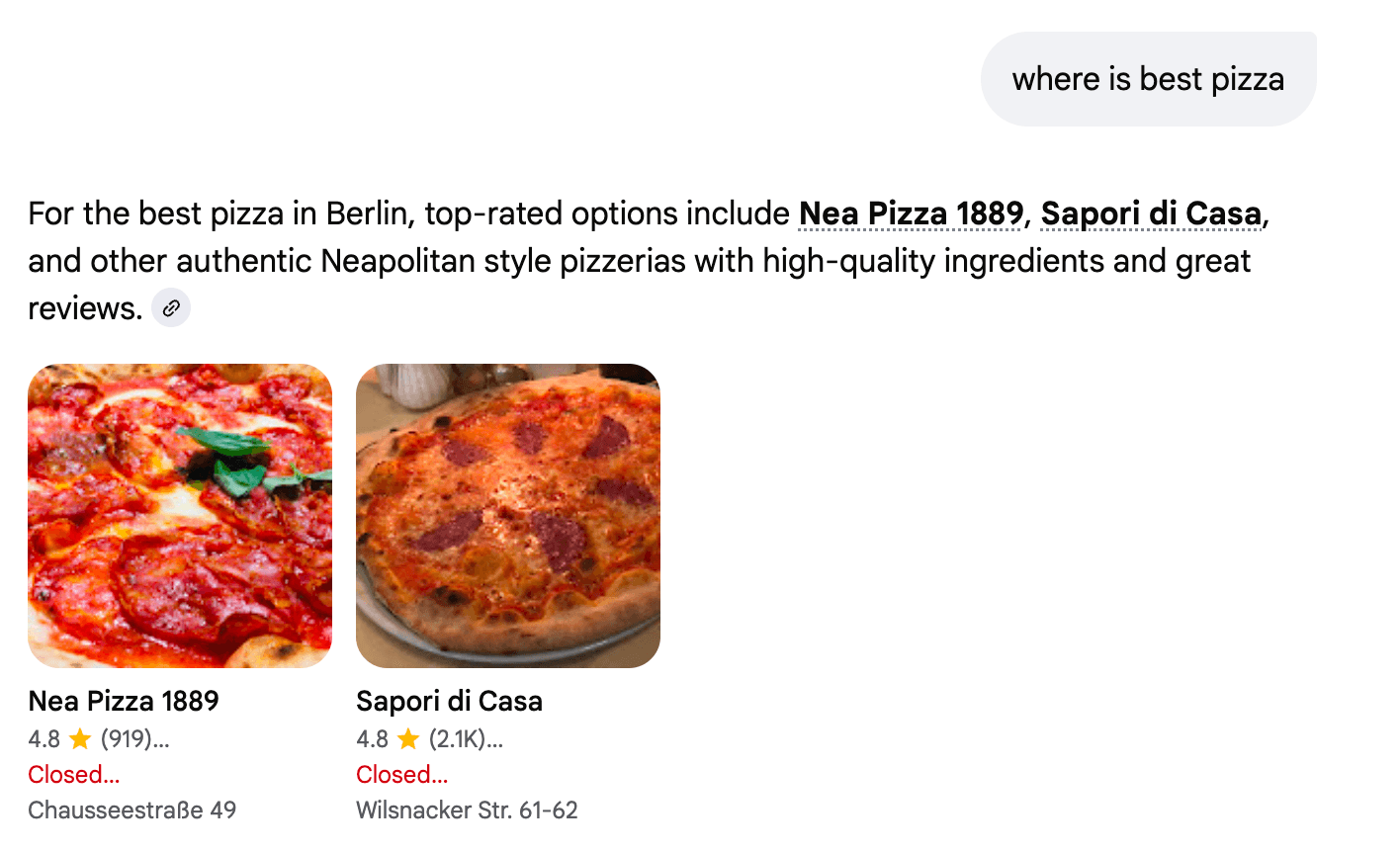
Example: If I'm in Berlin and ask "Where is the best pizza?" AI automatically shows Berlin-specific results.
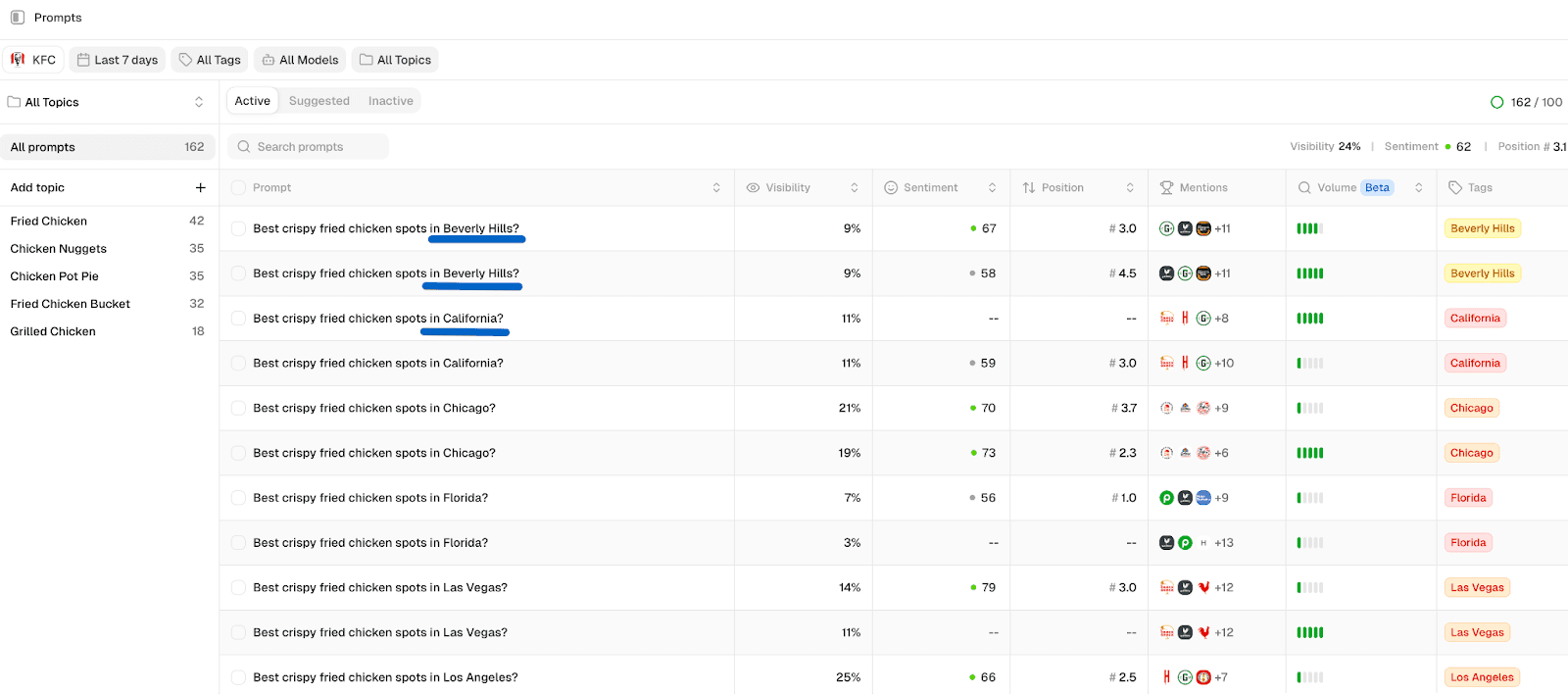
Below is an example of how to monitor location-specific performance in Peec AI. For a query like "best crispy fried chicken spots," you can track different cities to see exactly where your brand (in this example, KFC) performs well and where it needs improvement.
If AI recommends your competitors when people are ready to buy, you're losing sales at the finish line, even if you won the earlier stages. Make sure that your strategy also includes the purchase stage.
How to build prompts without deep business knowledge
The consumer journey approach works perfectly when you know your customer inside out. But if you’re an agency walking into a new niche on Monday morning, you don't have time for a three-month discovery phase.
Here is how to reverse-engineer these prompts in 15 minutes.
Option 1: Use your existing SEO data
Here's the fastest way to build your initial prompt list. Pull your top-performing keywords from Google Search Console and convert them into natural questions.
Many traditional search queries translate almost 1:1 into AI prompts:
Google Search: "best iPhone for photography"
AI Prompt: "Which iPhone is best for photography?"Google Search: "iPhone vs Samsung Galaxy"
AI Prompt: "Should I buy an iPhone or Samsung Galaxy?"
This gives you a solid foundation because you're tracking prompts based on proven user demand, not just guessing what people might ask.
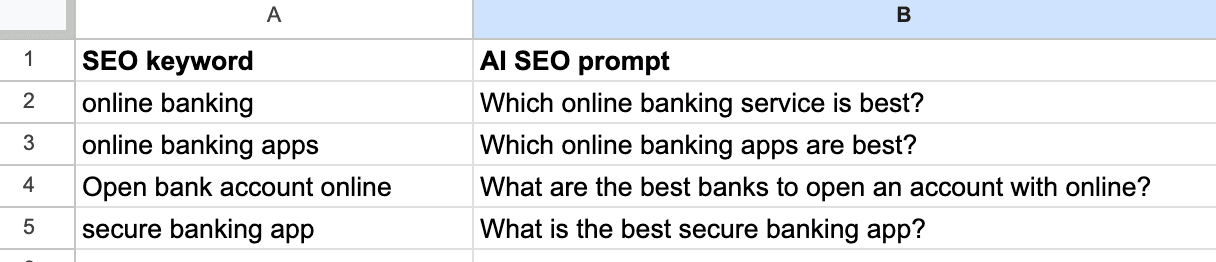
You can convert the queries in Google Sheets using this formula:
=ai("Transform this keyword into a user question in basic form for the consideration stage. Users want to buy but are looking for the best options. Ideal format: 'What are the best [category name]' ",A2)
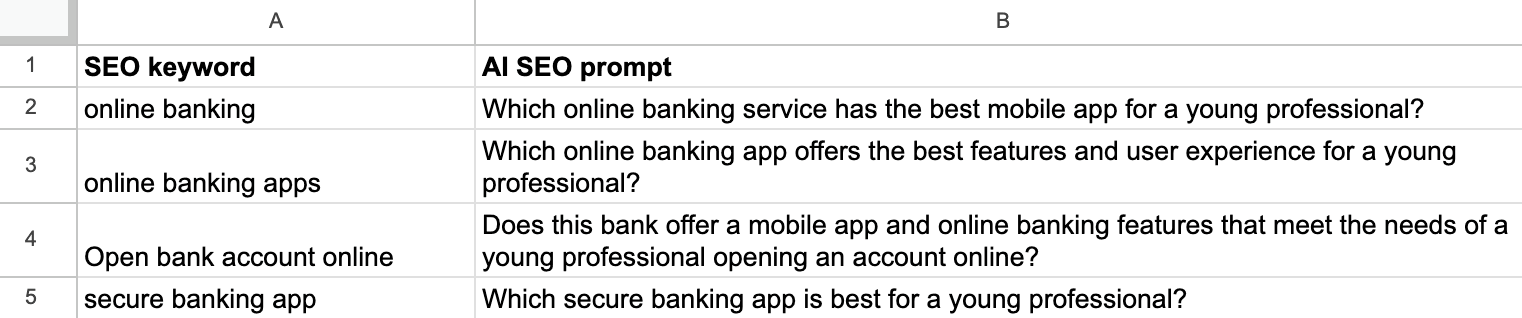
You can then tweak this to add a targeted persona:
=ai("Transform this keyword into a user question in basic form for the consideration stage. Users want to buy but are looking for the best options. Target persona: young professional who needs good mobile app. Ideal format: 'What are the best [category name]' ",A2)
Pull your top 50-100 non-branded keywords from GSC, convert them into conversational questions, then fill in the gaps with awareness prompts, customer-specific variations, objections, and use cases from the framework above.
Option 2: Quickly analyze the website
The best approach is simply to talk to the marketing team. Ask: "What's our ICP? Who are our main customer segments?" This makes prompt selection much easier.
If that's not possible, spend 15 minutes analyzing the website. You're looking for two things:
1. How they segment customers
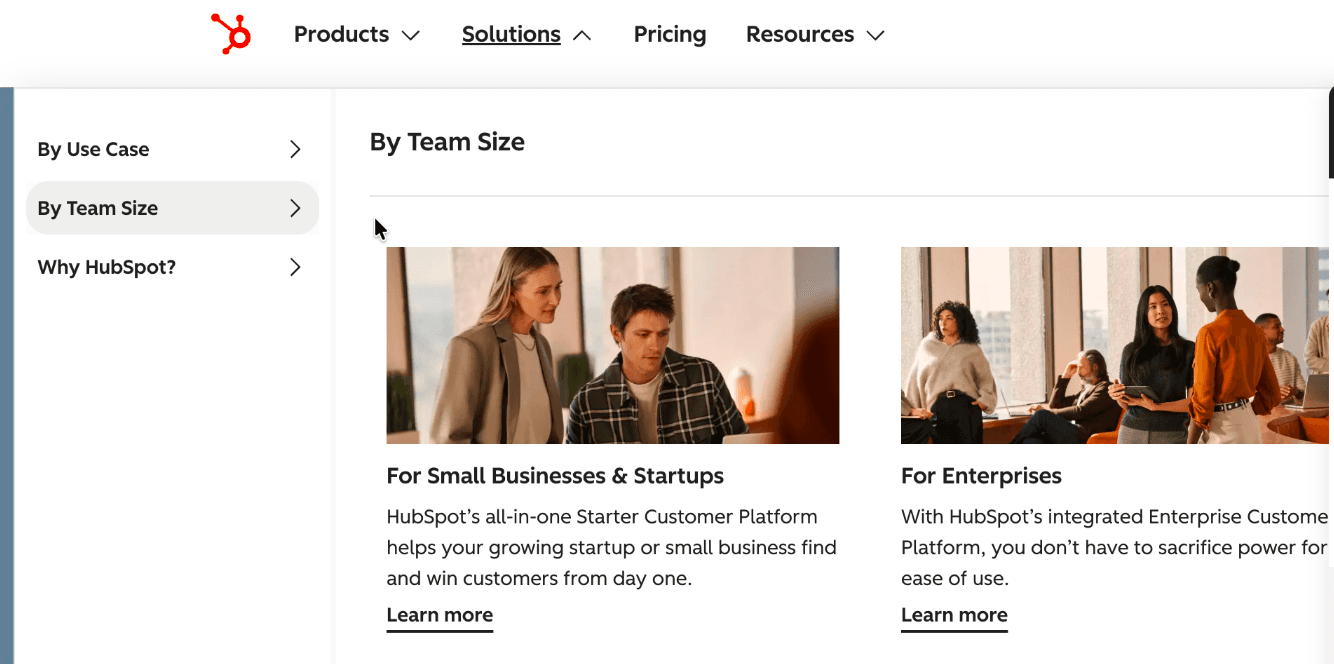
Check the navigation, product pages, and pricing tiers. Companies usually organize by:
Team size: Small teams, mid-market, enterprise (HubSpot does this)
Use case: Marketing, sales, service, operations
Customer type: Personal, business, enterprise (Revolut does this)
HubSpot example: Their website divides everything by team size and use case. This immediately tells you their customer segments and relevant prompts:
"Best CRM for small businesses"
"Best marketing automation for mid-market companies"
"HubSpot for sales teams vs marketing teams"
2. What problems they solve
Revolut example:
The homepage says: "Home or away, local or global - move freely between countries and currencies." This tells you their positioning (international flexibility and frictionless onboarding) and customer segments (personal, business, kids’ accounts).
Now think like a user. What would each segment care about?
Personal banking customers need:
Low fees for sending money abroad
Multiple currency support
Instant transfers
A trustworthy bank
Turn those needs into prompts:
"Best online banks for sending money abroad"
"Online banks with minimal fees for international transfers"
"Best online banks for multiple currencies"
"Most trustworthy online banks for personal use"
Business customers need:
"Best online banking for small businesses with international clients"
"Business banks with multi-currency accounts"
Parents need:
"Online banks that let parents create accounts for their children"
"Best banking apps for teaching kids about money"
You don't need deep business knowledge. Look at how the brand segments customers on its website, identify what each segment needs, and turn those needs into prompts.
Takes 15 minutes, gives you 20-30 solid starting prompts.
Key takeaways: Complete prompt coverage
Many people track only "best [category]" prompts and wonder why they're not seeing results. They're missing two-thirds of the buyer journey.
The framework gives you complete coverage:
Stage 1: Awareness - Catch users when they have a problem but haven't looked for a product yet.
Stage 2: Consideration - Get mentioned when people compare options in your category.
Stage 3: Purchase - Appear when people are ready to buy (if you sell directly).
You can also add two advanced methods. Track brand evaluation prompts separately from your main tracking to keep metrics clean, and monitor geographic performance if you operate in multiple regions.
You don't need perfect prompts from day one. Start with:
10-20 awareness prompts (concerns people have about your category)
20-30 consideration prompts (generic and segment-specific)
Track for 30 days
Look for gaps: Where are you invisible? Where do competitors dominate?
Then refine based on what the data tells you about AI's perception of your brand.
The agencies and marketers winning with prompt selection aren't chasing volume numbers or trying to track everything. They're covering the journey stages strategically, spotting positioning gaps, and adjusting based on what they learn.
Start with this framework, track systematically, and let the visibility data guide your next moves. Ready to track your AI search performance? Start your free Peec AI trial and see exactly where your brand shows up when people ask these questions.