
If you're already an Ahref's user with integrated workflows, you’ve probably considered Brand Radar, their AI search visibility tool. This article breaks down all core considerations - features, pricing, data sourcing, and usability - based on real test results and official documentation, not marketing claims, so you can compare Brand Radar and Peec AI on the facts that matter.
Note: We encourage you to check out Brand Radar independently and do the same with Peec AI to make your own conclusions. Everything quoted in this article comes from official Ahrefs' official pages or product screenshots.
Part 1: Ahrefs Brand Radar's static prompt dataset
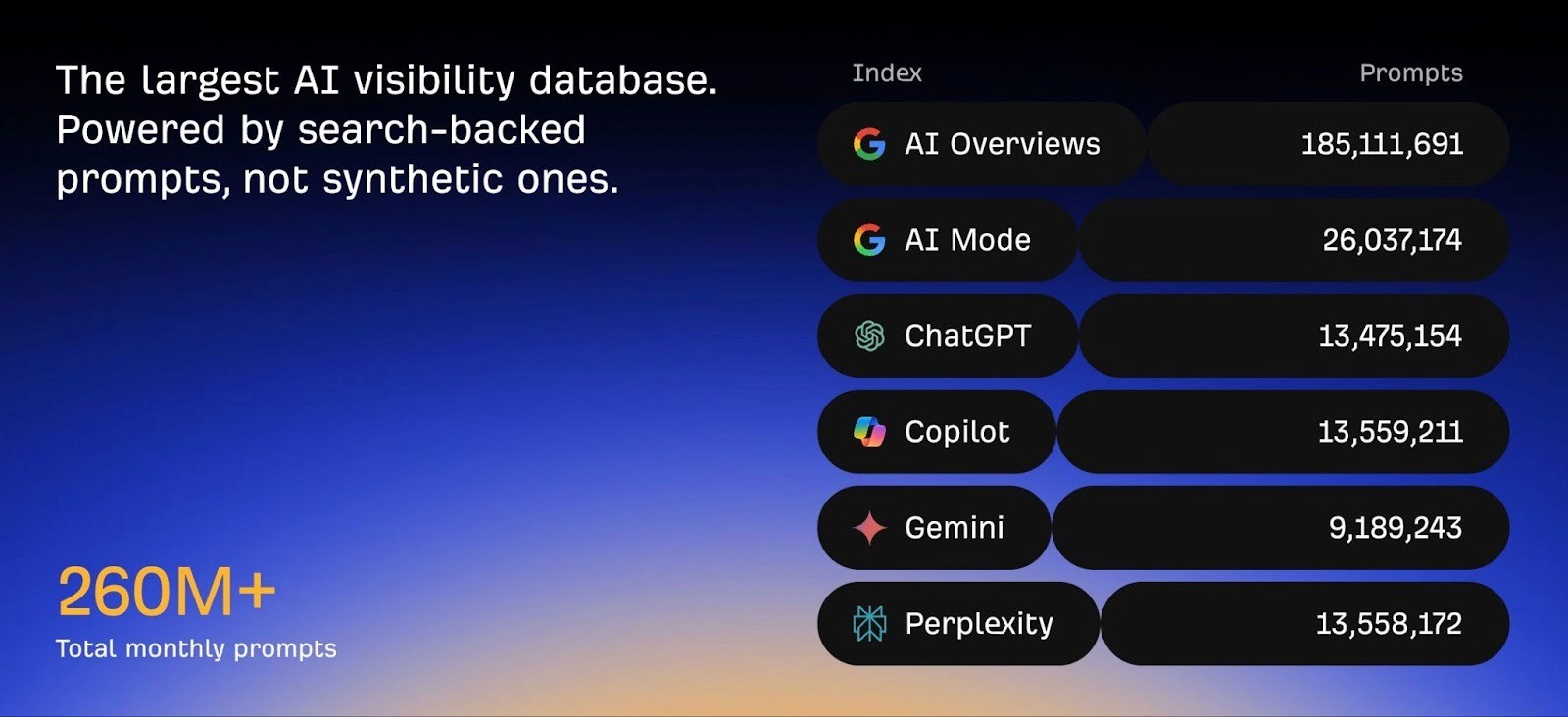
Brand Radar and Peec AI take fundamentally different approaches to AI search tracking. Brand Radar offers a massive static dataset of 250+ million prompts sourced from Google's People Also Ask (PAA) questions, updated once monthly. Peec AI focuses on real-time tracking of custom prompts you choose, updated daily. Each approach has distinct advantages and limitations worth understanding before making a decision.
How Brand Radar sources its data
According to Ahrefs' help center, they take Google PAA questions and run them through each supported large language model (LLM) to capture the responses. No further edits are made to these questions and this dataset is updated once a month.
The question worth asking: is People Also Ask really the most accurate proxy for how people actually prompt AI assistants? PAA questions might not accurately reflect how people actually prompt AI assistants. These questions are generated by Google's algorithm to serve traditional search, and people phrase search queries often quite differently from ChatGPT or Perplexity prompts. This sourcing method means the dataset may not fully reflect real-world AI search behavior.
Pricing
You can buy Brand Radar as an add-on to a base Ahrefs subscription (starting at $129/month for the Lite plan) or as a standalone tool:
$199/month per individual AI index
$699/month for all indexes (currently 6 AI platforms)
The all-indexes plan includes 2,500 custom prompt checks per month. This works out to about 80 checks per day for one AI model. Additional checks are available at $0.020/check.
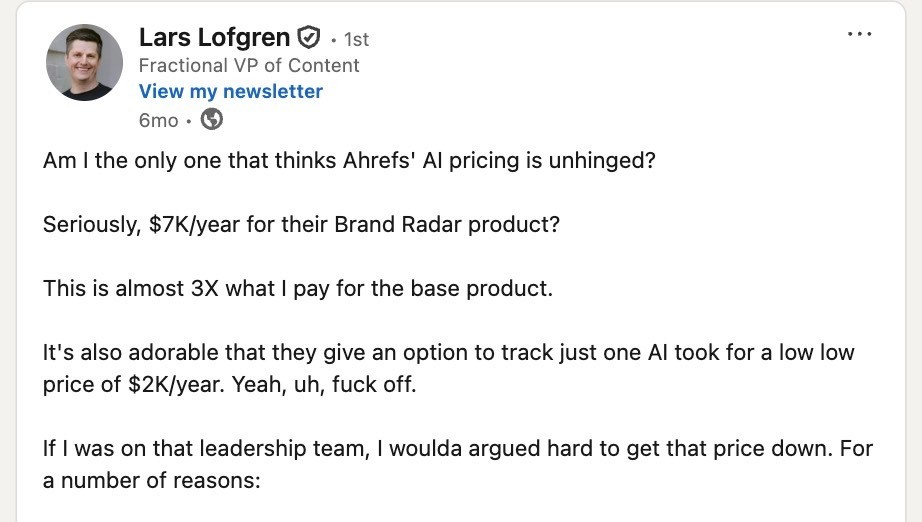
As several industry commentators have noted, this price point is hard for many users and agencies to justify, especially given the various data limitations outlined we’ll explore.
Dataset composition and bias
Let's look at how the Brand Radar dataset is distributed, using Tesla as an example (available via the Ahrefs Brand Radar demo). The table below shows all retrieved mentions for Tesla for the US in the dataset:
Platform | Mentions |
Google AI Overviews | 57,500 |
Google AI Mode | 38,800 |
Gemini | 14,100 |
Copilot | 9,700 |
ChatGPT | 7,800 |
Perplexity | 5,300 |
Google properties (AIO + AI Mode + Gemini) account for over 70% of the Brand Radar dataset, heavily weighting the overall data toward Google's ecosystem. If your primary interest is understanding visibility in ChatGPT or Perplexity, only a fraction of the dataset is relevant to you, yet you're paying the same price regardless of which index you purchase individually. This is confirmed by Ahrefs’ model distribution overview of the prompt dataset. The cost is the same for adding each AI index, even if their distribution is not.
Screenshot: of Brand Radar data distribution:
Branded term bias
Branded terms such as “how much does a Tesla cost?” are included in the dataset by default, causing significant data bias. If you're trying to understand how your brand performs with non-branded, discovery-type prompts (arguably the most valuable use case), you would need to manually filter out branded terms. In Brand Radar's current UI, this means applying a separate filter for each individual brand you want to exclude. For a competitive analysis involving multiple brands, that's a lot of manual filtering.
Questionable prompt volume data
Brand Radar's volume data raises questions. For example, it reports 576,000 users searched "Can a Cybertruck go through a car wash" versus just 1,200 for "how much do Cybertrucks cost?"
Screenshot: Overview of Brand Radar results for prompts for “Cybertruck” topic
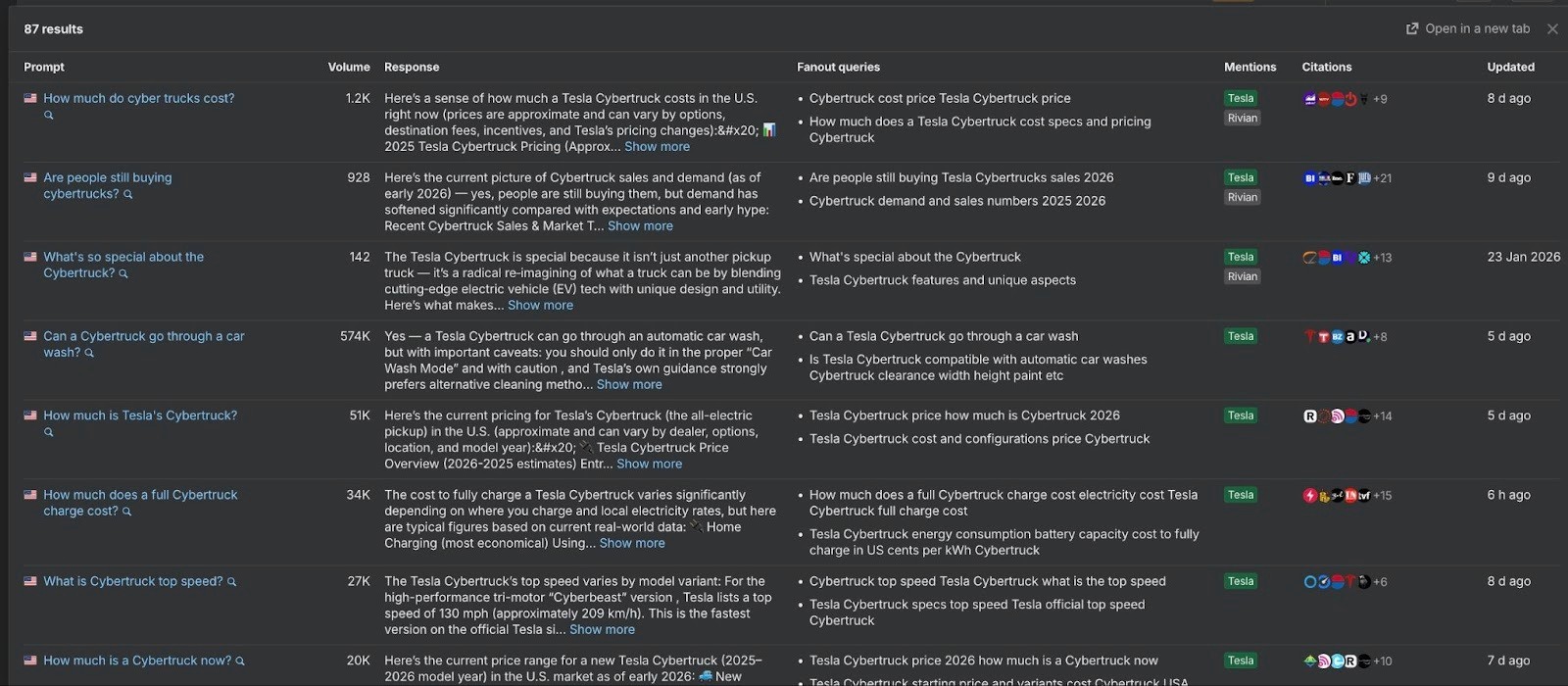
With approximately 50,000 Cybertruck owners worldwide, the idea that 576,000 people asked about car wash compatibility seems unlikely. When this volume data feeds into calculated metrics across the platform, the downstream effects of these inaccuracies compound quickly. This makes it very difficult to assess topic performance in a balanced way.
The prompt dataset updates monthly, but each prompt may update at different times, as we can see from the screenshot above. This introduces temporal bias into the data.
UI and filtering limitations
Let’s say I want to find the top cited pages for all non-branded prompts. I have to manually filter out brands, row by row, for both prompt and topic. In the screenshot below, I applied 8 filters just to filter out 4 brands.
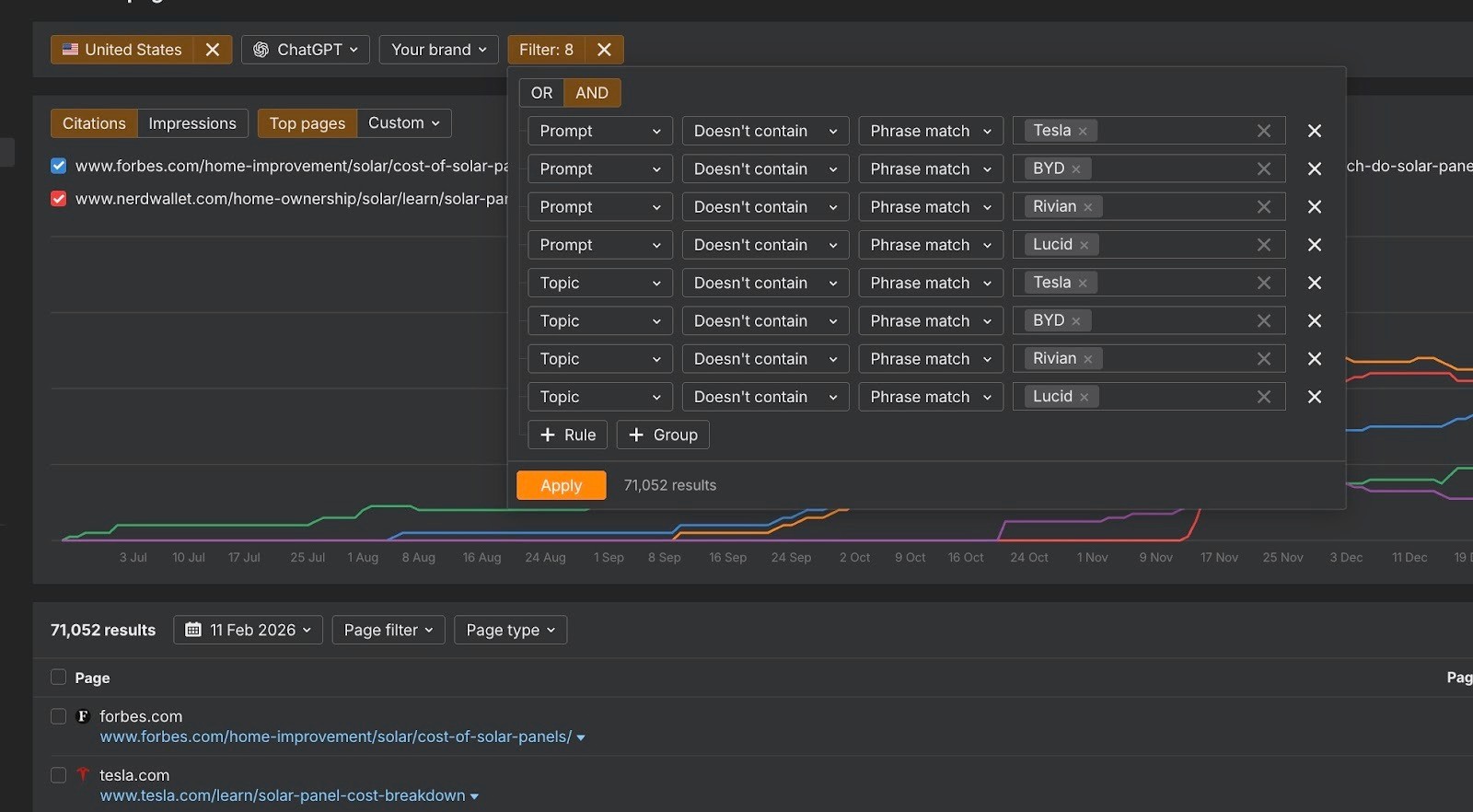
Note as well that one of the first sources returned is still Tesla.
I found additional usability issues that make it harder to extract actionable insights from Brand Radar:
Column sorting: You can’t sort columns ascending/descending in much of the UI. This makes surfacing top-performing or worst-performing items unnecessarily tedious.
Data export: Exports are currently limited to 1,000 rows, which is restrictive for any serious analysis.
Date filtering: You can select time periods from a dropdown, but the granularity is limited.
Irregular update frequency: Some prompts show update dates weeks apart from others in the same dataset, making it difficult for consistent time-based comparisons.
No sentiment analysis: Brand Radar doesn’t currently offer sentiment scoring for brand mentions.
Summary of Brand Radar static dataset
Heavy distribution favoring Google properties in the prompt dataset
Each AI index costs the same ($199/month) despite significant dataset imbalance
Limited export features (1,000 row cap)
No sentiment analysis
No easy exclusion of branded prompts
Questionable prompt volume figures
Cannot sort by column in much of the UI
Verdict: Making Brand Radar’s data more actionable requires significant domain knowledge and extensive manual filtering. At the current price point, you’d need ta much easier way to filter out irrelevant prompts and topics, surface key insights, and tailor the data in the UI to make this worthwhile for most agencies and brands.
Part 2: Peec AI vs Ahrefs Brand Radar for custom prompt tracking
This section compares Peec AI with the custom prompt tracking functionality that Ahrefs added to Brand Radar in January 2026 (currently in beta).
Ahrefs custom prompt tracking overview
Custom prompt tracking in Brand Radar lets you specify your own prompts and monitor how AI assistants respond to them on a daily, weekly, or monthly basis. The supported LLMs are:
ChatGPT
Perplexity
Gemini
Microsoft Copilot
Custom prompt tracking is included with the Brand Radar all-indexes plan ($699/month), which comes with 2,500 checks per month. Additional check packages are available:
$50/month for 2,500 additional checks
$100/month for 7,000 additional checks
$250/month for 25,000 additional checks
One check equals 1 prompt x 1 LLM x 1 location. So if you're tracking 20 prompts across 4 models in 1 location daily, that's roughly 2,400 checks per month, nearly exhausting the base allowance.
Custom prompt tracking requires a Brand Radar subscription. The single-index Brand Radar Plan doesn;t include custom prompt tracking. For custom prompt tracking, you’d need to purchase the single index at $199/month and add custom prompt tracking at the rates listed above.
Peec AI overview
Peec AI is a specialist AI search analytics platform built for tracking and optimizing brand visibility across AI search platforms. It supports the following AI engines:
ChatGPT
Perplexity
Gemini
Google AI Overviews
Google AI Mode
Claude
Additional models depending on product tier
Here’s how the platforms compare using specific use cases.
Use Case 1: Get a quick overview of how my brand is doing in AI search
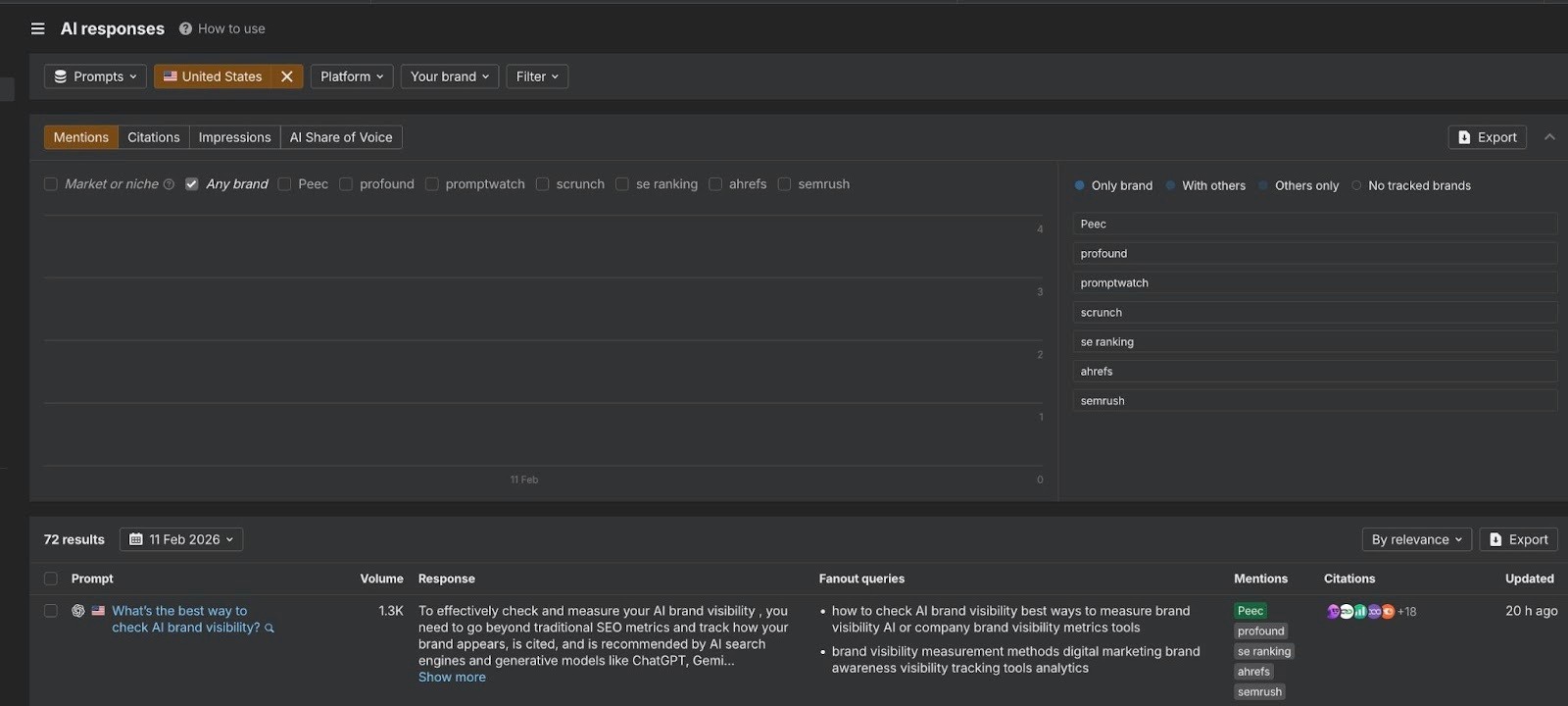
Keep in mind that Ahrefs custom prompt tracking is still in beta. However, even after updating the competitors I want to track, there’s no overview chart shown. The brand tracking couldn’t pick up the target or competitor brands for this overview.
Screenshot of Ahrefs prompt tracking overview:
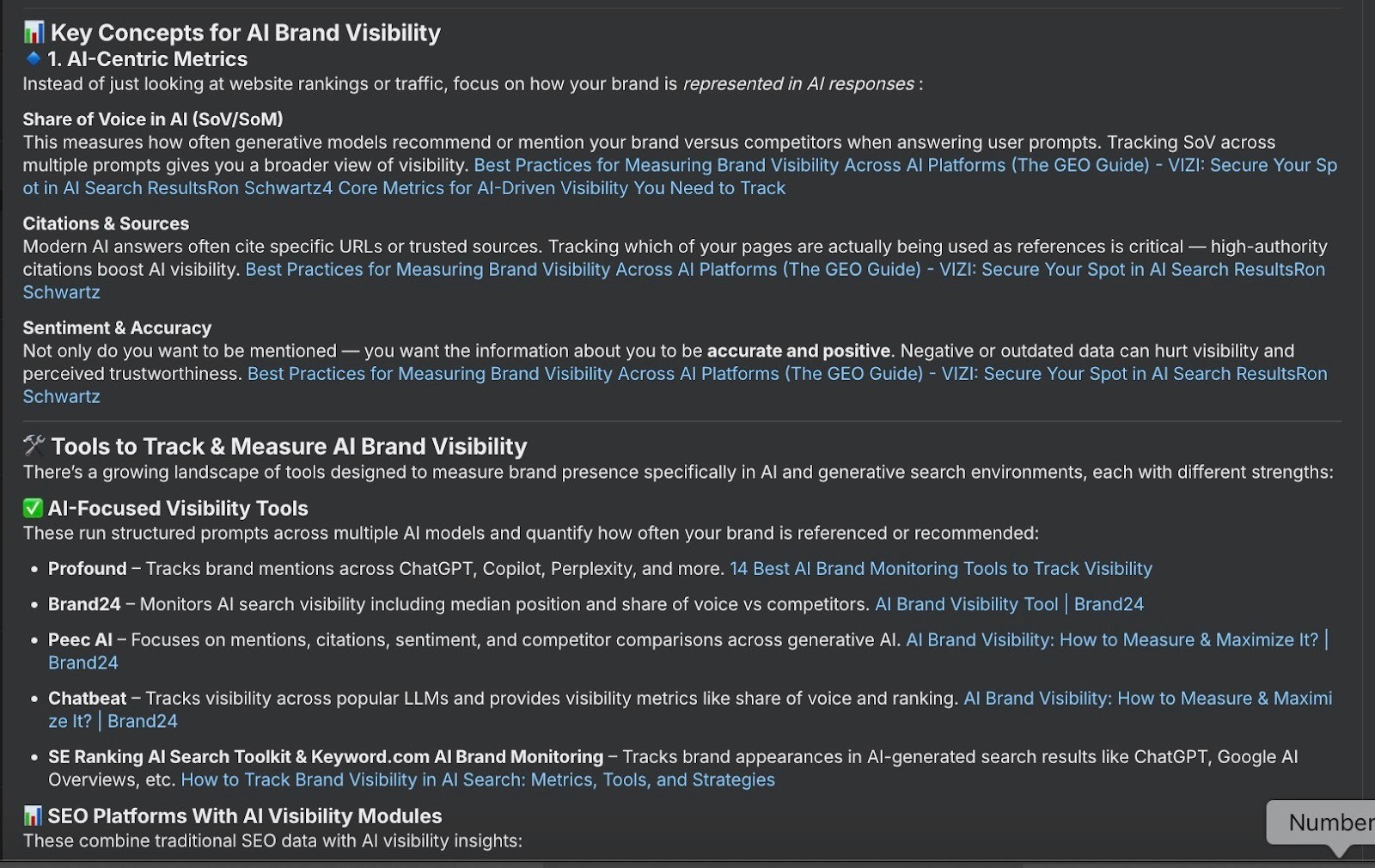
When we switch to the prompt detail to see what’s happening, it detected Peec AI but none of the competitors that are clearly present like Profound and SE Ranking. Even after multiple attempts adding the correct brand name and URL for that brand, this overview didn’t update.
Screenshot of Ahrefs prompt detail page:
In comparison, the overview pages in Peec AI includes an overview of metrics such as visibility, sentiment, position. Top sources are also included, along with their content types. The filters at the top allow us to filter by tag or topic. Each table is interactive and you can filter and sort every column just by clicking on it.
Screenshot: Peec AI dashboard overview showing top mentioned brands and domains.
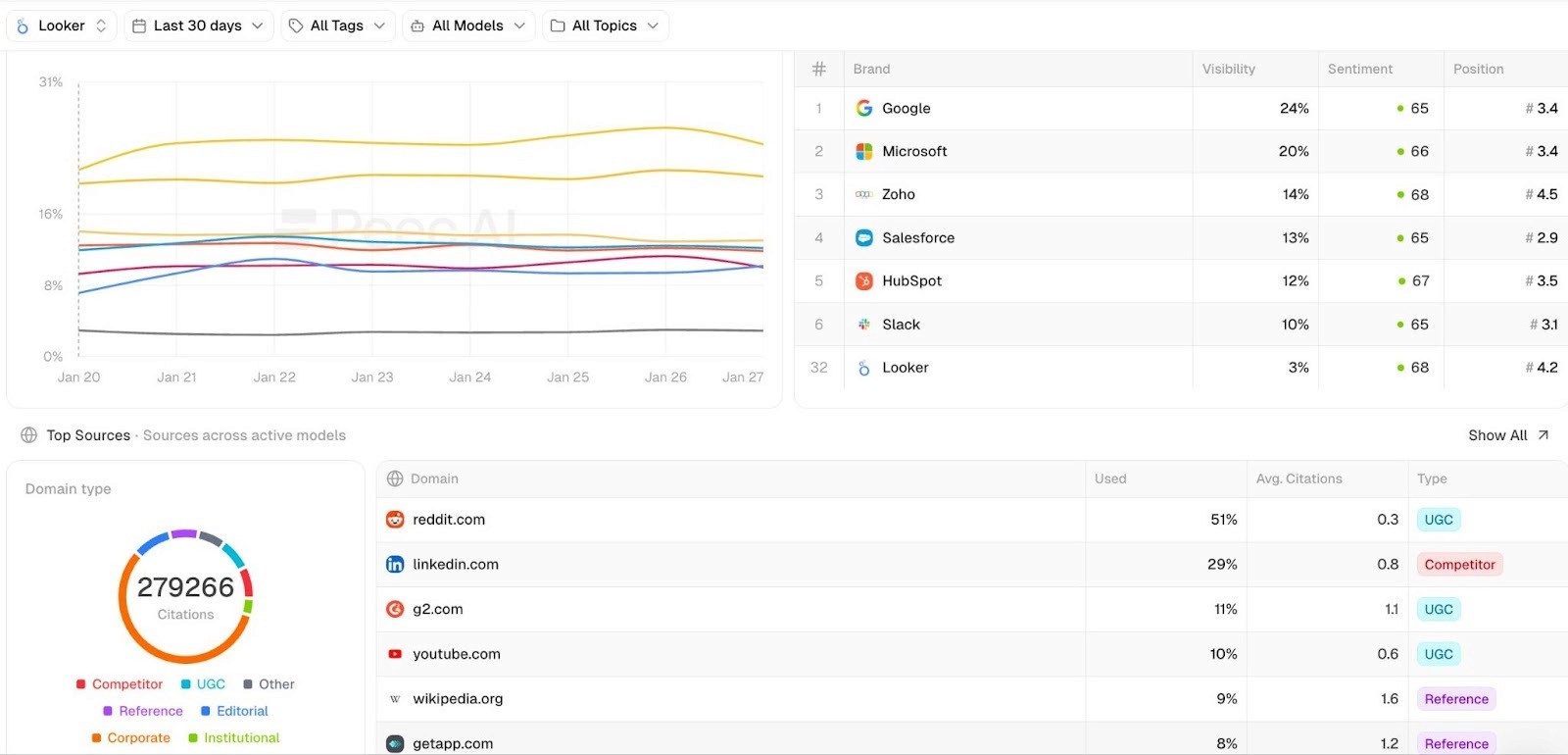
This overview page gives you key information at a glance, such as the top mentioned domains, their average visibility and sentiment. It also shows top sources by domain and content type. You can track as many brands as you like and change the overview to show data only relating to that brand.
Use Case 2: Granular insights and tag filtering
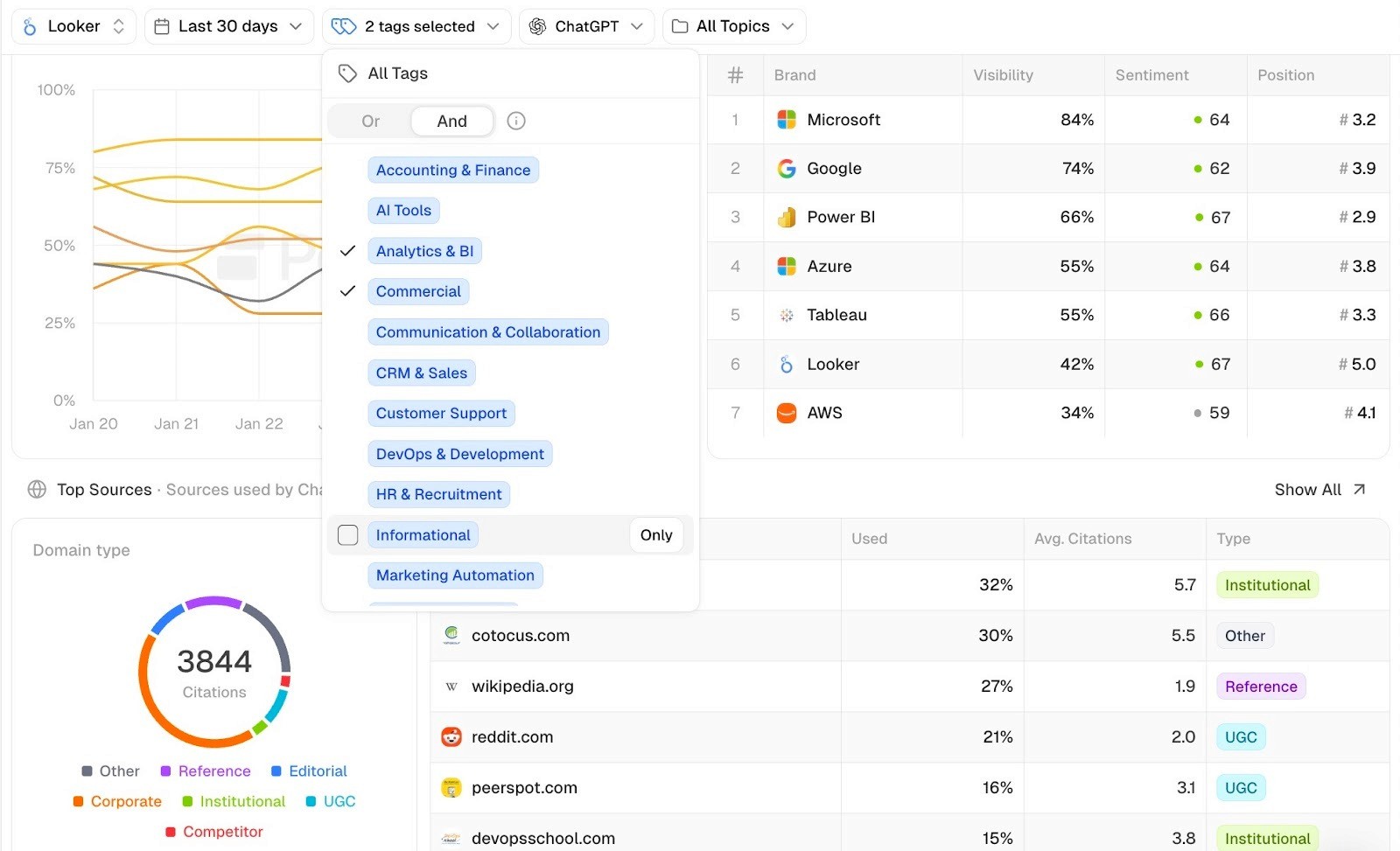
In Peec AI, you can filter data by multiple tags, topic, AI model, data range all at the same time. In the screenshot below, I filtered by Commercial intent tag and Analytics & BI tools category tag, as well as ChatGPT for AI model. This gives you detailed, actionable insights. You can see exactly how your AI visibility changes for different buyer personas or prompt intents.
Screenshot: Using multiple tags in Peec AI dashboard to filter data.
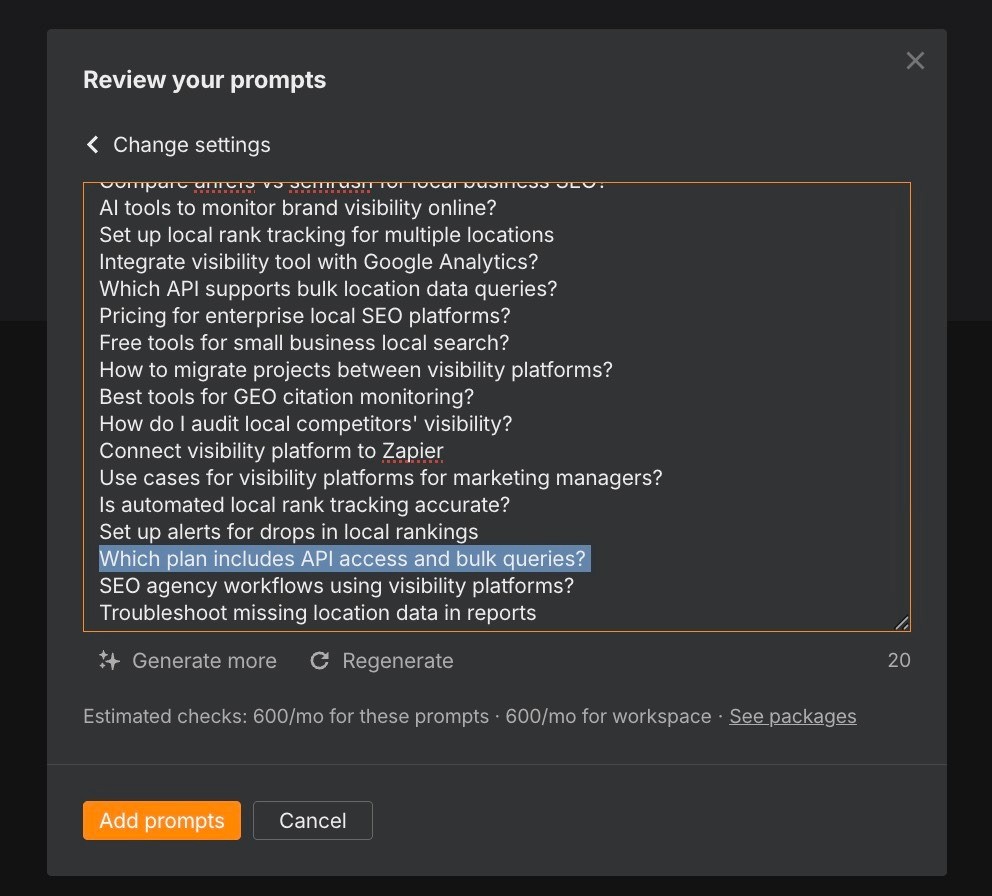
Brand Radar doesn't let you tag custom prompts, which means you can't filter them later for detailed analysis. Here's the page for adding prompts:
Use case 3: competitor gap analysis
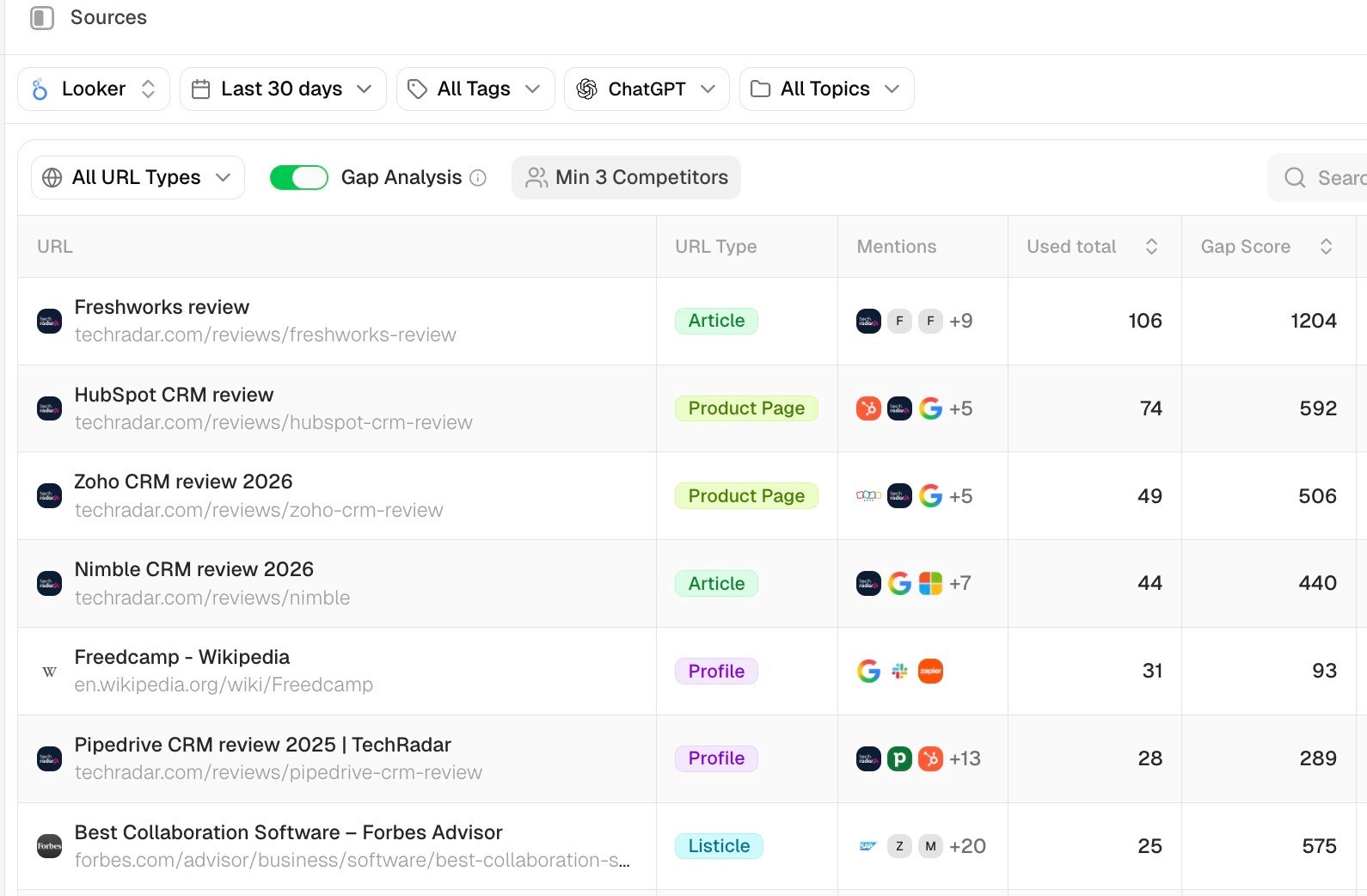
One of the most common and powerful use cases of AI prompt tracking is finding sources where your competitors are mentioned but you’re not. In Peec AI, you can do this in the sources page. By selecting “gap analysis”, you can find every URL source where at least three of your competitors are mentioned but you’re not. You can also adjust this to any number of competitors.
Screenshot of Peec AI gap analysis:
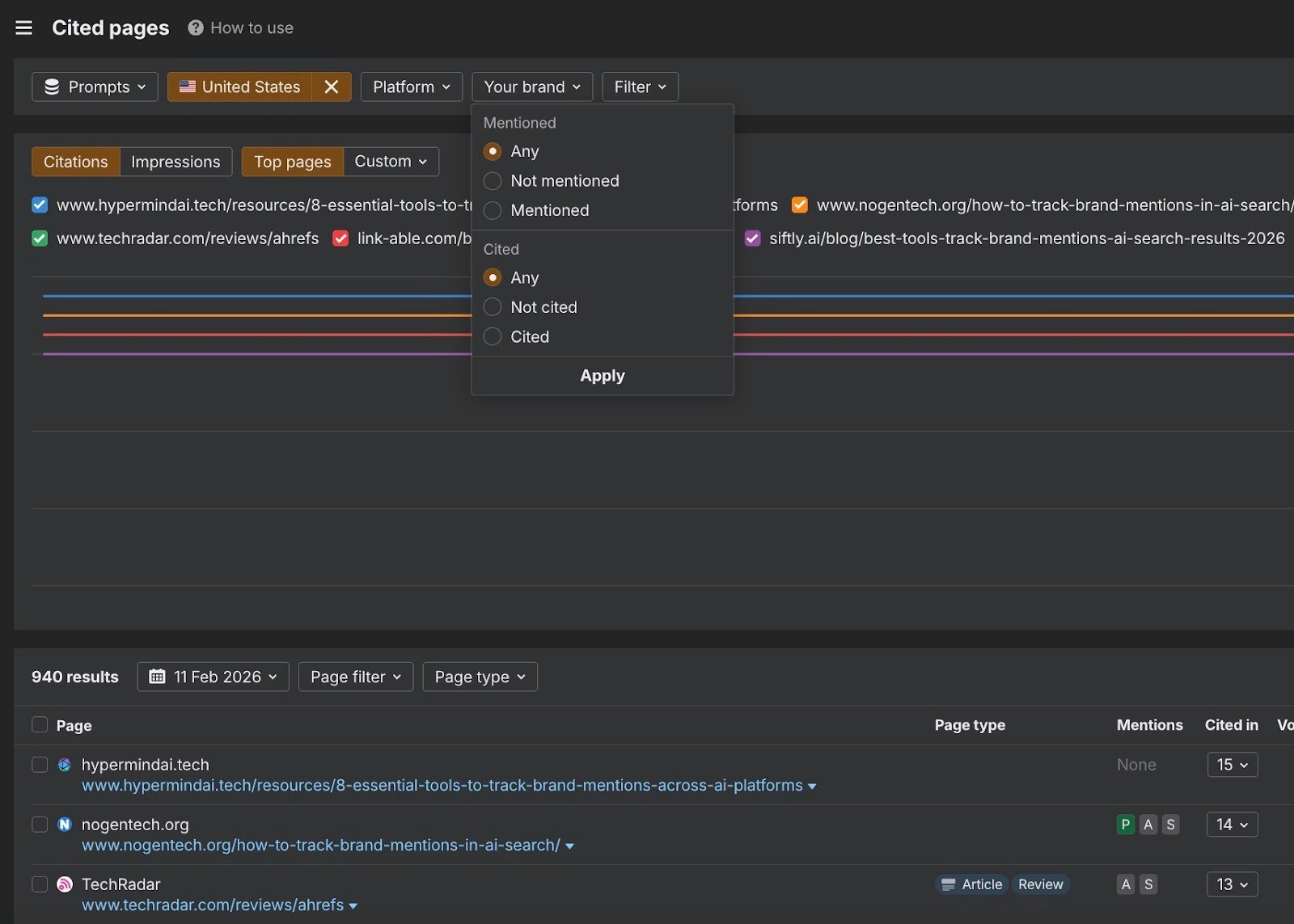
In Ahrefs, I can only toggle sources where my brand is not mentioned but I don’t have detailed control of filtering my competitors. In Peec AI, I can also switch to analyze sources from a competitor's viewpoint, which Ahrefs doesn't allow.
Screenshot of Ahrefs filtering in Brand Radar overview:
These use cases show that while Brand Radar offers extensive data, Peec AI is built around common workflows like gap analysis and performance filtering. The difference matters when you need to quickly identify opportunities rather than manually sift through broad datasets.
Peec AI vs Ahrefs: Feature comparison for starter packages
Feature | Peec AI Starter ($95/month) | Ahrefs Brand Radar single index + minimum custom prompts add-on ($249+/month) |
Daily checks included | 150 (50 prompts x 3 engines) | 75 (25 prompts x approx 3 engines) |
AI engines covered | ChatGPT, Perplexity, Google AIO (add-ons for Gemini, AI Mode, Claude, and more) | ChatGPT, Perplexity, Gemini, Copilot |
Geographic coverage | 80+ regions | 80+ regions with model-specific limitations |
Team seats | Unlimited (free) | Single seat, additional seats upsell price not disclosed |
Sentiment analysis | Yes | No |
Prompt tagging | Yes, with custom tag grouping | No |
Gap analysis | Yes, one-click identification of where brand is not mentioned | Only via manual filters |
Competitor gap analysis | Yes, filter by minimum number of competitor mentions | No - complex manual filtering required |
Optimization actions | Yes, recommended next steps for owned and earned media | No |
Column sorting/filtering | Yes, ascending/descending on all tables | No - most of the columns in the UI can’t be sorted |
Cross-engine comparison | Yes, compare across all engines in a single project | Yes |
Citation detail | Domain and URL-level | Yes |
Top mentioned brands | Yes, core feature | Yes |
Data export | Available on all plans | 1,000 row limit |
Free trial | 7-day, no credit card required | Free Ahrefs account gives limited demo access to Brand Radar (no prompt tracking) |
For complete pricing and feature comparisons across tiers, visit their respective pricing pages. Both Peec AI and Ahrefs have enterprise plans for large-scale tracking.
Key Peec AI features not available in Ahrefs Brand Radar
Sentiment analysis: Understand whether brand mentions are positive, negative, or neutral
Gap analysis: One-click identification of prompts where your brand is absent from sources
Competitor gap analysis: Filter for prompts where a minimum number of your competitors are mentioned but you're not
Actions module: Get recommended optimization steps for both owned and earned media
Full table filtering: Click to sort any table column ascending or descending
Cross-engine comparison: Compare brand performance across all AI engines within a single-project view
Cost comparison
To get custom prompt tracking in Ahrefs, you need at minimum:
Brand Radar single indexes: $199/month
Custom prompt tracking add-on 2,500 = approx 25 prompts x 3 models daily = $50
Total minimum for 25 prompts and 3 models = $249
This pricing would only allow access to the Brand Radar prompt dataset for one LLM, such as ChatGPT. In the Brand Radar signup flow the first step is to purchase either the single index of all of them for $699.
With Peec AI, you can start tracking 50 custom prompts across 3 AI engines (150 in total) with daily frequency, sentiment analysis, gap analysis, and unlimited team seats for $95/month. The value to cost ration is significantly higher with Peec AI.
Brand Radar vs Peec AI: Which should you choose?
Ahrefs Brand Radar's static prompt dataset offers one of the largest prompt databases in the space (259M+ prompts). With monthly data updates and People Also Ask sourcing, the question becomes whether this approach fits your team's workflow needs and budget constraints.
For most teams and agencies, the combination of high pricing, data accuracy concerns, limited filtering, and the lack of features like sentiment analysis presents challenges. The custom prompt tracking addition addresses some gaps, but requires a full Brand Radar subscription ($199+/month) plus add-on costs for what's still a beta feature.
Peec AI offers a different approach with simple pricing, unlimited seats, real-time custom tracking, and workflow-focused features like sentiment analysis, gap analysis, and optimization actions.
The right choice depends on your specific needs:
Ahrefs Brand Radar suits existing Ahrefs customers that need macro-level research across a massive prompt dataset. Peec AI fits teams that want a specialist daily AI search tracker with sentiment analysis, prompt tagging, competitor gap analysis, and unlimited team seats - so marketing teams spot citation gaps within minutes, not days.
The right choice depends on whether you need comprehensive data coverage or focused custom tracking. Both platforms offer trials to test with actual prompts – details on their respective pricing pages.
Pricing information sourced from official Ahrefs and Peec AI pages as of February 2026. Custom prompt tracking in Brand Radar is currently in beta.