
If you're evaluating tools to monitor your brand's presence in ChatGPT, Perplexity, and Google's AI ecosystem, you've likely encountered both Peec AI and Semrush AI Visibility Toolkit.
Semrush is an established SEO platform that recently added AI search tracking to their comprehensive marketing suite. Peec AI is built exclusively for AI visibility analytics – it’s not a traditional SEO tool with an AI add-on.
This comparison focuses specifically on their AI search capabilities. The question isn't whether Semrush is a good SEO platform (it is), but how their AI search features compare to a purpose-built alternative when it comes to solving specific GEO/AEO challenges.
To understand which tool fits your needs, I tested both platforms using real-world scenarios. This article examines 5 use cases that matter most when tracking AI visibility:
Understanding your current performance in AI search: Can you trust the visibility metrics you're seeing?
Understanding your performance over time: Are trend changes real or just noisy data?
Discovering which sources drive AI citations: Which specific URLs shape AI narratives in your industry? How frequently does AI cite your website?
Understanding performance across customer segments: How do you track personalized AI results for different audiences?
Exporting and analyzing your data: Can you integrate AI visibility data with your existing workflows?
For each use case, I'll show you what both platforms offer, where they excel, and where they fall short, all based on hands-on testing, not marketing claims.
Let's dive in.
Use case 1: Understanding your current performance in AI search
The scenario: Your CMO asks: "Are we visible in ChatGPT and other AI platforms? How do we compare to competitors?"
You need data showing whether your brand appears in AI responses and how you stack up against the competition.
Semrush offers two ways to track AI visibility:
Visibility Overview: Their main offering is based on a global prompt database of 239M AI prompts they maintain. For clarity, we’ll refer to this as the “global index”.
Custom prompt tracking: A daily tracking module where you can add your own prompts.
Tracking prompts using global index
Semrush mostly focuses its marketing on the global index, which makes business sense. Maintaining one global database across all clients is more scalable than running custom prompts for each user.
But is this feature really useful? Let me show you what I discovered testing the global index approach.
When you open the Semrush AI toolkit, the first thing you notice is the Visibility Overview.
It’s an aggregate number representing total mentions in AI search engines and LLMs across their global prompt database. Theoretically, when you see you're mentioned 10,000 times, you're performing better than a competitor that’s mentioned 5,000 times. Additionally, this toolkit offers a single number score from 1 to 100, the AI Visibility score.
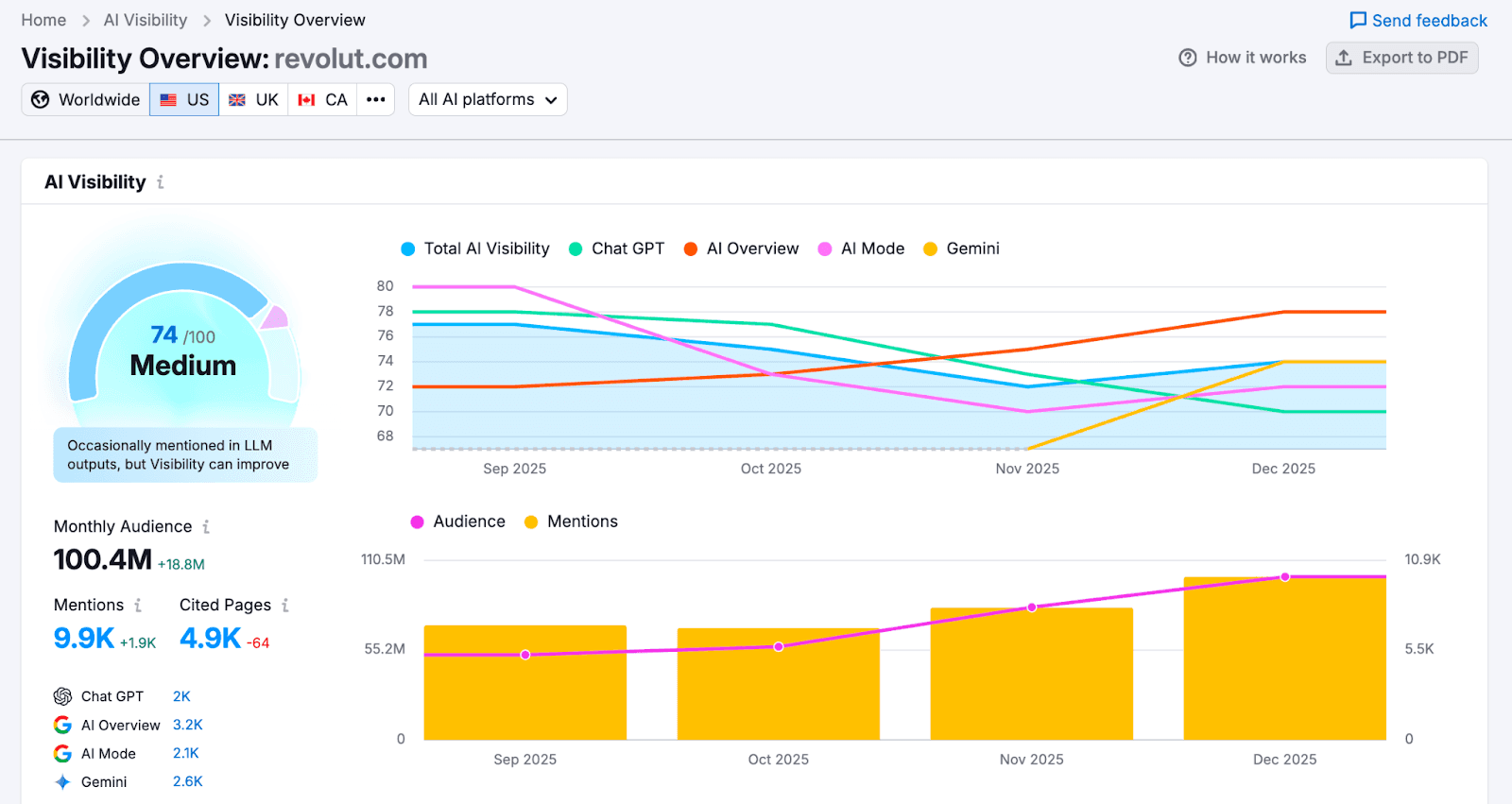
I tested what conclusions I could draw from these metrics.
Starting with mentions, when testing with Revolut vs Wise vs Chime in the US, the number became very concerning. It showed Revolut at 10,000 mentions compared to Chime’s 4,200.
On the surface, this suggests Revolut appears roughly 2 times more frequently in the US search. This is interesting because Chime is actually much more popular in the US than Revolut.
Just the recent data from J.D. Power, a global leader in consumer insights, of the new checking accounts that were opened in Q3 2025, 13% were with Chime. That rate outpaced all other banks, including national brands like Chase (9%), Wells Fargo (7%), and Bank of America (7%). It’s hard to estimate Revolut, because most sources say Revolut is a recognized global brand, but has no more than 1% of market share in the US.
This begs a question: maybe Revolut is more frequently searched online and maybe that explains the difference?
According to Google Trends, Chime is 10x more popular than Revolut in the US.
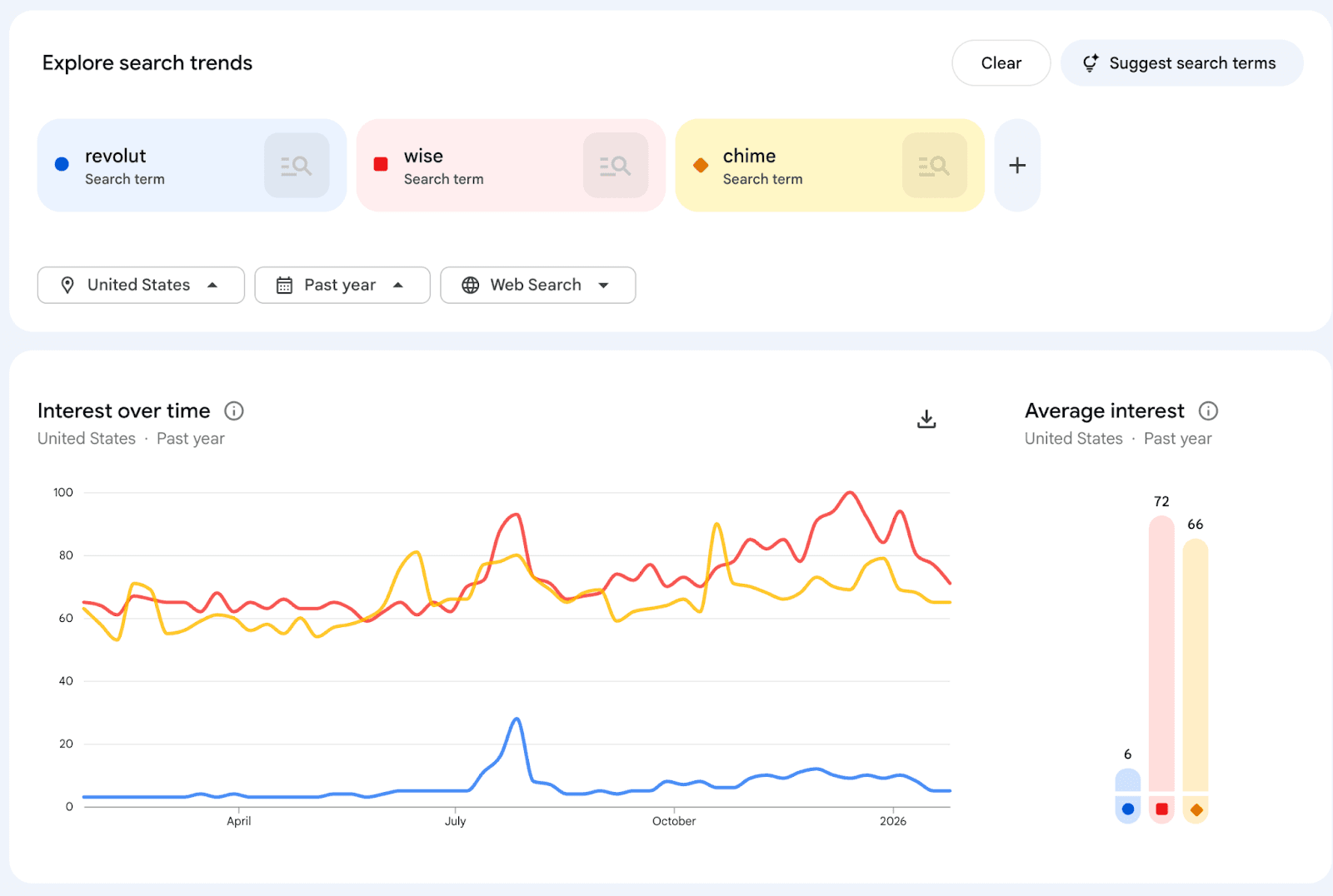
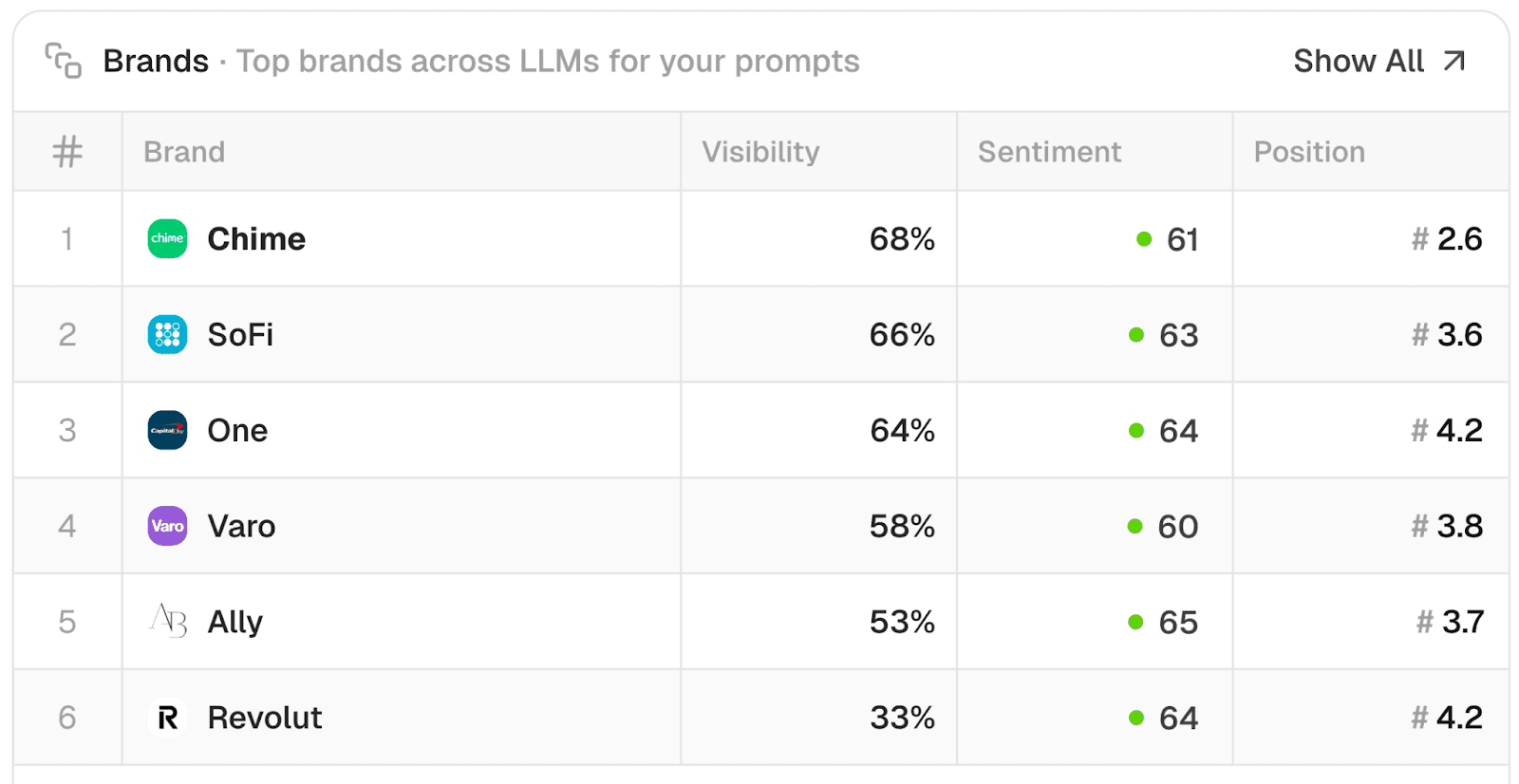
Testing the same comparison on business-relevant prompts in Peec AI confirmed the market reality. Chime dominates the US market with 13% of new checking accounts and 10x higher search interest than Revolut. Yet Semrush shows Revolut as twice as successful in AI search.
Either Chime - the market leader - is catastrophically failing at AI visibility, or there's a fundamental problem with how Semrush measures AI search performance.
Validating the data in Peec AI
When I tested the same comparison using business-relevant prompts in Peec AI, the results aligned with market reality: Chime significantly outperformed Revolut in AI search visibility.
Is the Semrush sample really representative?
When I examined which prompts were actually contributing to Revolut's 10,000 mentions, I found queries about F1 sponsorships, online casinos, and remote work - topics that don't directly relate to their core banking business.
These outliers weren't cherry-picked - typing "Revolut" into Semrush surfaced them directly
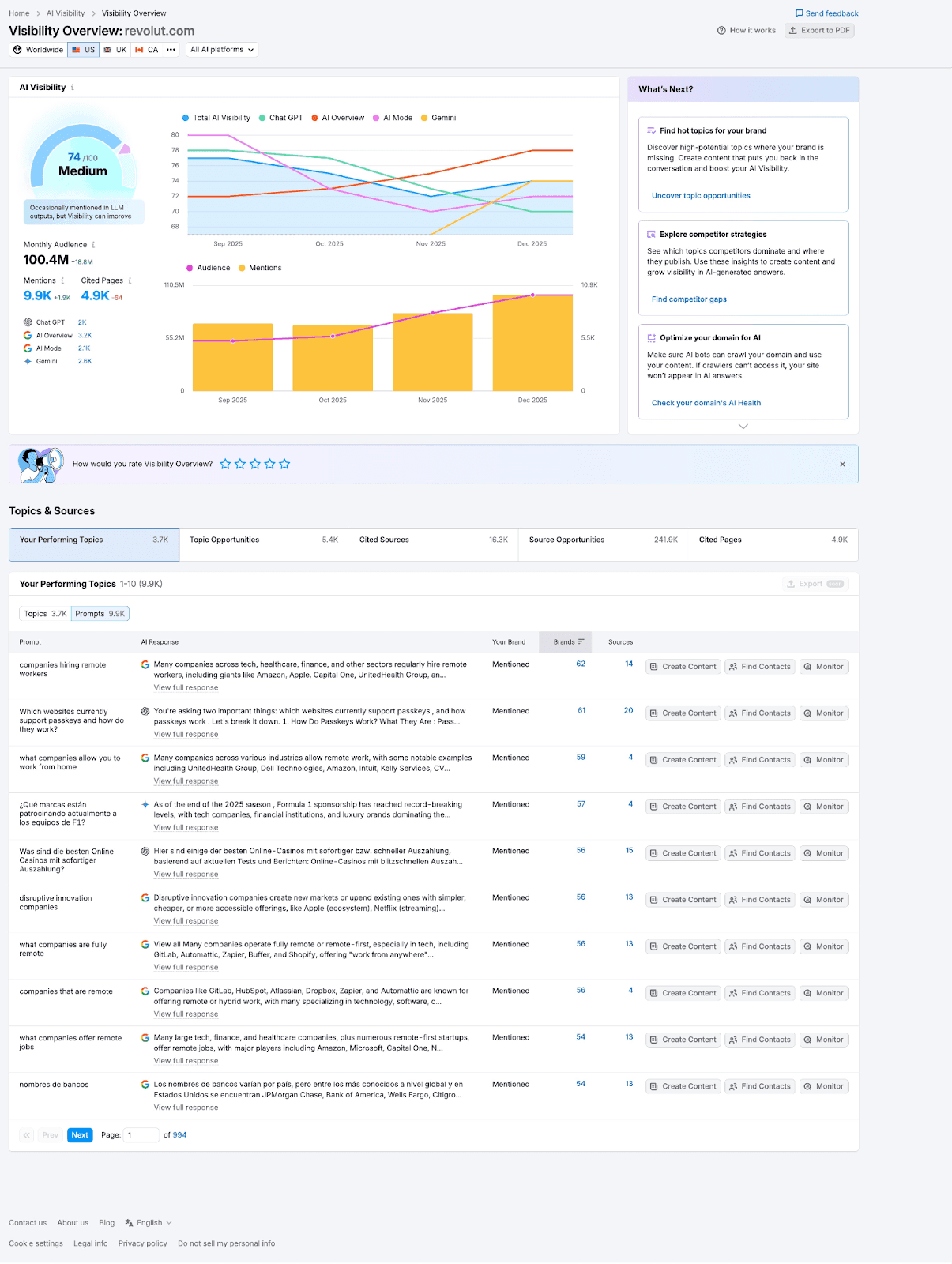
Here’s a link to the zoomed image.
This means you're potentially measuring Semrush's database construction rather than your actual competitive position on queries where you win customers.
You can't separate branded and non-branded visibility
I wanted to understand why Semrush data was inaccurate, so I analyzed which prompts were actually being tracked for Revolut. What I found was concerning - most were branded queries. Meaning, the searches included "Revolut" in the query itself, like "Revolut finance services."
But that's clearly not competitive visibility. When someone searches your brand name, of course you’ll appear. What matters is category competitiveness: when someone asks “What are the best online banks for international transfer?” without mentioning any brand name, do you show up? That's where you can win new customers who don't already know your brand or product exists.
Without filtering branded searches, you can't tell if you're genuinely winning in your category or just appearing when people already know your name.
When the global index works
However, if you want instant insights with zero setup - just to show your company whether you're visible at all - Semrush can serve that purpose. But for reliable competitive analysis, you need dedicated prompt tracking.
Custom prompt tracking approach
For deeper analysis, I recommend custom prompt tracking so you can control what’s measured. Both Semrush and Peec AI offer this.
The key is tracking prompts that are relevant to your business and to the core of our products. To read more about selecting the right prompts for LLM tracking see the Peec AI guide on prompt selection.
Semrush vs Peec AI: The differences in custom prompt tracking approach
Semrush positions the global index as their main offering, with custom tracking as an additional feature you can set up separately.
On the other hand, Peec AI is built entirely around custom prompt selection from the ground up, with a robust tag and topic system to organize prompts strategically.
Here's how this works: Based on Revolut's website, they divide clients into Personal, Business, and Enterprise. Using Peec AI's tagging system, you can tag prompts accordingly:
"Best online bank for freelancers" → Tagged: Personal
"Business banking for startups" → Tagged: Business
"Enterprise payment solutions" → Tagged: Enterprise
Now you can see performance by customer segment, like 78% visibility for Personal, 65% for Business, 42% for Enterprise, so you know exactly where to focus optimization.
You can also see your brand visibility, citation frequency, and sentiment on three levels:
Project level: Overall performance across all prompts
Tag level: Performance for specific customer segments or journey stages
Prompt level: Individual query performance
When custom tracking works better
Custom prompt tracking provides the control you need when:
You need to understand which journey stages or customer segments you're winning versus losing.
You want to filter branded vs non-branded visibility to see true competitive positioning.
You need to show stakeholders specific optimization opportunities rather than aggregate numbers.
You want platform-by-platform breakdown with strategically-selected prompts.
In comparison, the global index shows you how you perform in Semrush's general database, while custom tracking shows you how you perform on the queries that actually matter for your business.
If you're not sure how to create prompts that reveal if you're successful in AI search, read our guide on selecting the right prompts.
Peec vs Semrush: How do they compare for AI search prompt tracking?
Note: Semrush offers different features and different supported models for global index (global index of prompts) and prompt tracking module. For clarity, the table below compares specifically prompt tracking modules of Peec AI and Semrush.
Feature-by-feature comparison for starter packages
Feature | Peec AI (Starter: $95) | Semrush AI visibility add-on (Starter: $99) |
Unique prompts | 50 | Up to 25 (Shared across engines) |
Total Daily Checks | 150 (50 prompts × 3 engines) | 25 (Total across all engines) |
AI engines covered | 3 LLMs of your choice including: ChatGPT, Google AI Overviews, Perplexity. | Google AI Mode and ChatGPT only |
Prompt geographic coverage | 80+ regions | 6 regions (US, UK, Canada, Australia, Spain, India) |
Additional team members | Unlimited seats for free | $45/month per user |
Top mentioned brands | Yes, it’s one of the core features of Peec AI | Limited to own brand only |
Cross-engine comparison | Yes - compare performance across all engines in single project | No - requires separate tracking projects per engine |
Citation sources | Domain and URL-level detail | It lists only Owned Sources (your own pages) |
Custom tagging | Yes, with the ability to group by custom tags | Yes |
Prompt volume and engine coverage differ sharply at the starter tiers. Peec AI’s basic plan tracks 50 unique prompts across 3 AI engines such as ChatGPT, Google AI Overviews and Perplexity for 150 daily checks — 50 prompts × 3 engines. Semrush's add-on covers only ChatGPT and AI Mode with just 25 prompts total. Peec AI reaches 80+ countries compared to Semrush's 6 (US, UK, Canada, Australia, Spain, India). Team seats are unlimited on Peec AI; Semrush charges $45/month per additional user.
Peec AI surfaces top-mentioned brands, domain- and URL-level citations, and cross-engine comparisons within a single project — capabilities Semrush's AI module does not offer. Semrush's AI module lists only owned sources and requires separate tracking projects per engine. Both platforms offer custom tagging.
For detailed pricing and feature comparisons across tiers, visit their respective pricing pages. Both platforms offer enterprise plans for larger tracking needs.
Semrush's custom prompt tracking module is one component within their broader toolkit. In contrast, Peec AI is built specifically for GEO/AEO tracking.
Use Case 2: Understanding your performance over time
The scenario: You need to know if your AI visibility is actually improving, or if changes are just due to how the tool measures data.
Semrush approach: Tracking mentions based on a global database
Having a huge number of mentions tracked sounds plausible - until you start comparing those numbers over time. That's when things get murky.
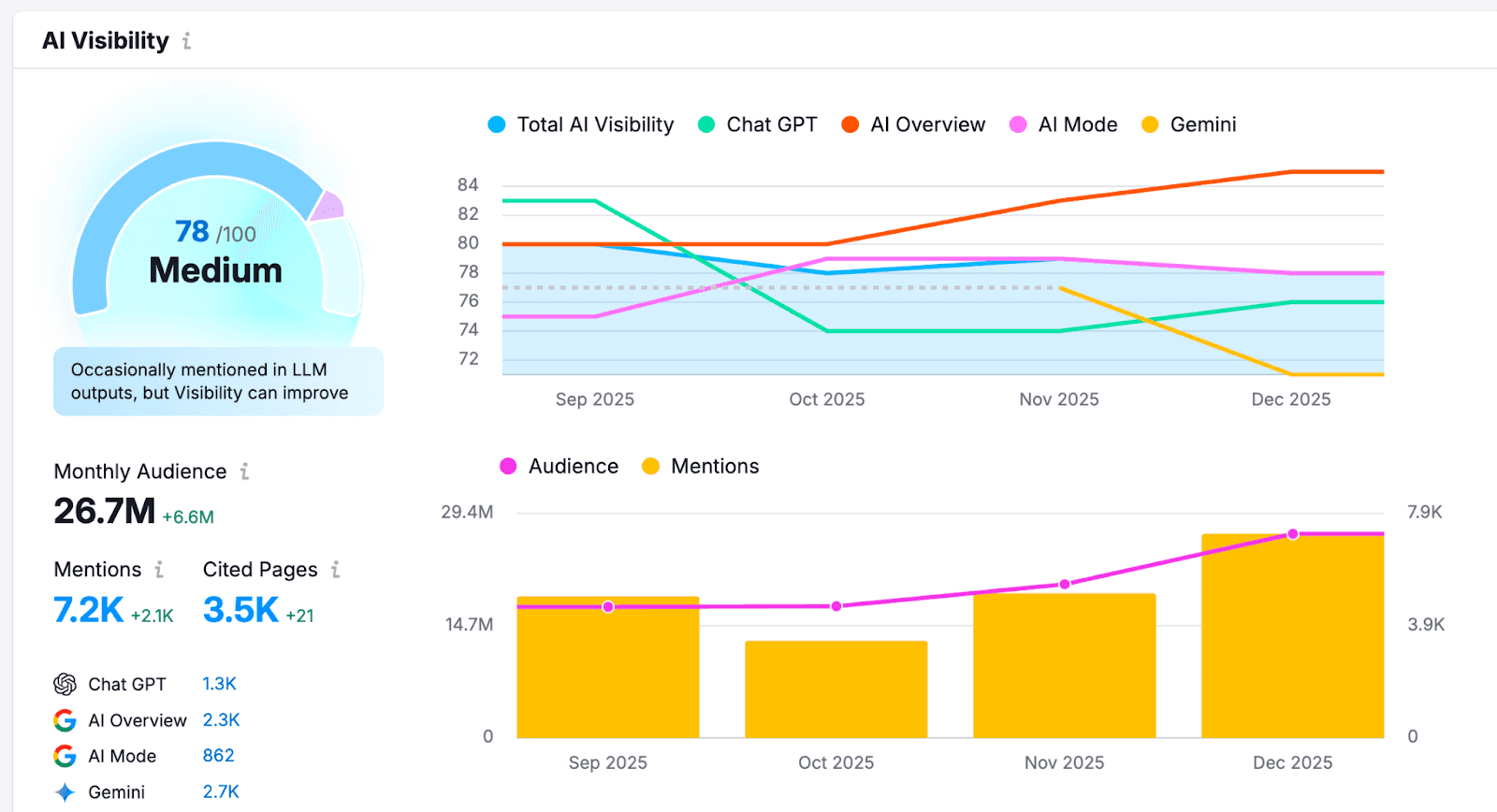
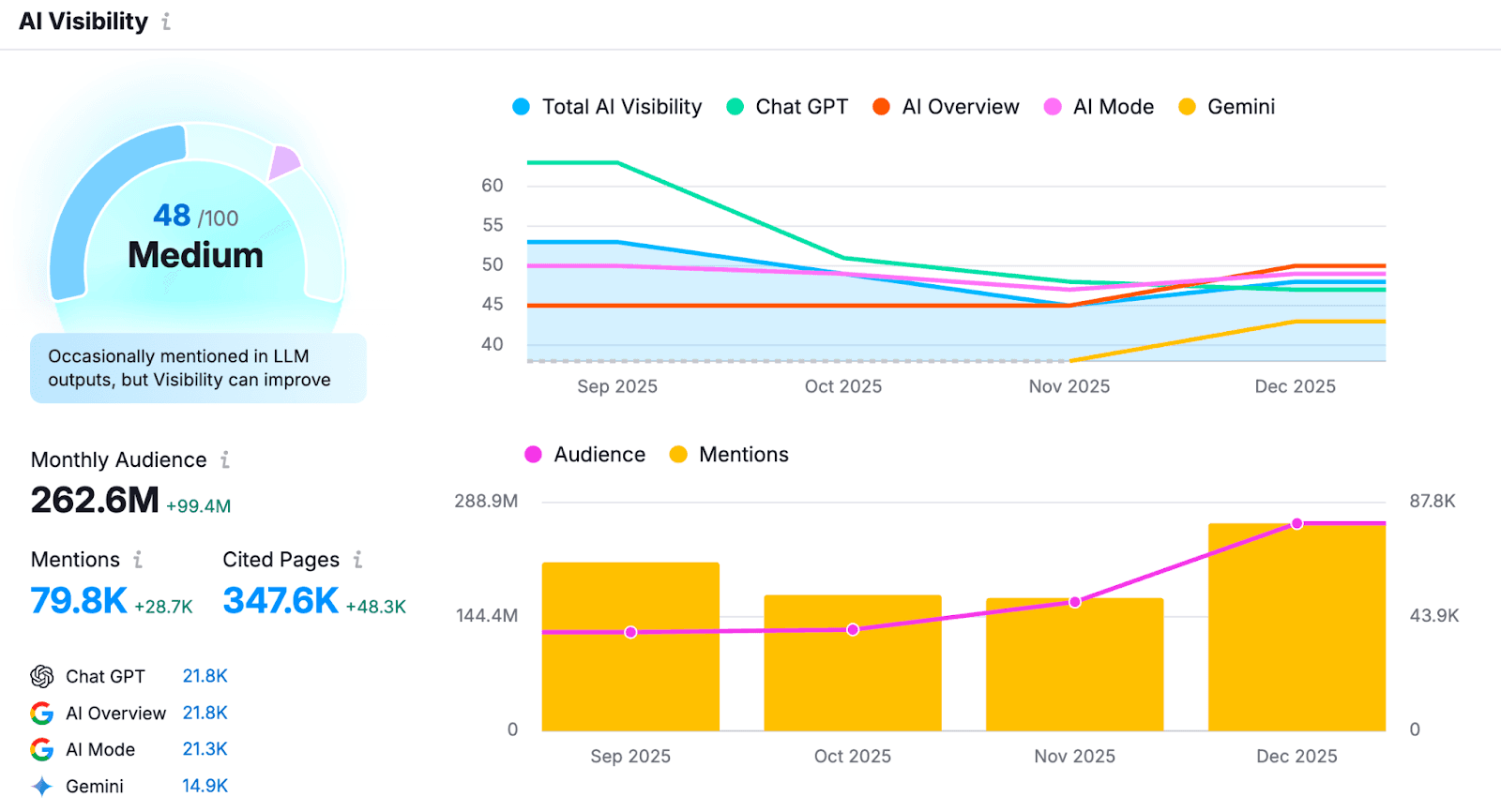
I decided to test how Semrush tracks visibility trends by monitoring several UK brands over a few months. What I discovered raised a red flag. Most brands showed visibility drops in October, then mysteriously recovered in January. I saw this across different brands in completely different industries, such as online banking, SaaS, e-commerce. The pattern was too consistent to be coincidental.
Below are a few examples:
Revolut.com:
Amazon.co.uk:
Vodafone.co.uk:
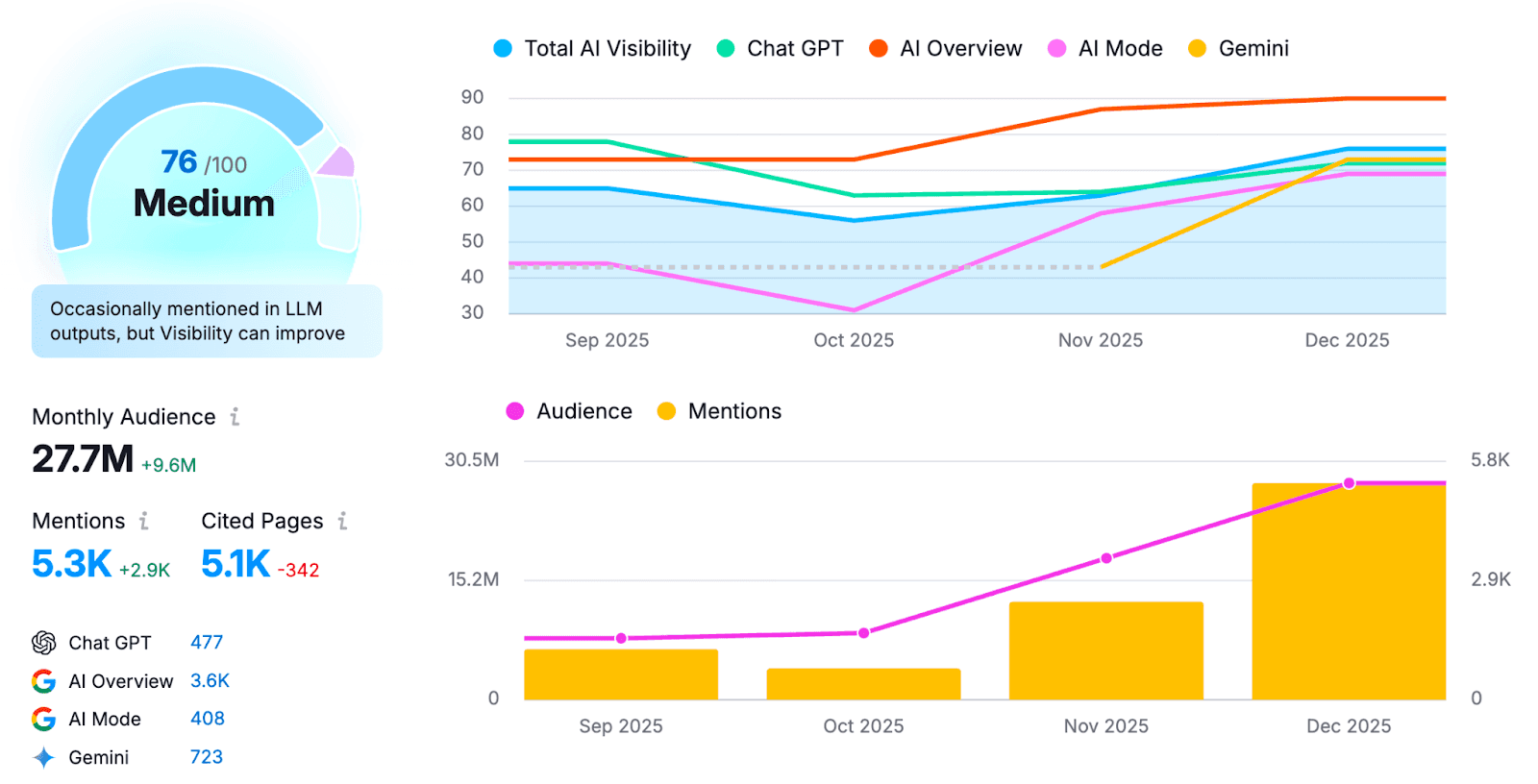
When I dug deeper, I found that all these brands had drops in ChatGPT mentions at the same time, across unrelated industries.
Without access to their internal documentation on sampling procedures and prompt database updates, making confident assessments about brand performance in AI search based on these metrics alone is challenging.
An even more compelling example: Google.com increased their AI search visibility by 700% in just 3 months according to Semrush. Such a dramatic jump suggests database methodology changes rather than actual performance shifts.
When this approach can work
For very long-term directional trends - quarterly or annually - Semrush's aggregate view might provide general guidance. But for optimization decisions, you need reliable data.
Imagine being an agency when every brand you track mysteriously drops in October - how do you explain that to paying clients when you can't tell if it's real performance or database changes?
To reliably analyze trends in AI search, you need custom prompt tracking, available both in Peec AI and in Semrush.
Peec AI tracks chosen prompts consistently over time (i.e. the 100 prompts selected in September are the same 100 tracked in December). If visibility drops from say 75% to 60%, you know that drop is a real performance change — not a database resampling artifact.
Evolving without losing history
I was tracking a project with 6 months of data when I wanted to add better prompts. The solution: tag old prompts as "Old" and new ones as "New." Now I can track new prompts for current insights while filtering to "Old" for historical trends, which gives consistent comparison over time.
When you delete irrelevant prompts, charts automatically recalculate. No artificial spikes.
Why this matters
When visibility changes, you can investigate: "We lost visibility on these 5 prompts - did a competitor publish new content? Did the platform change how it weights sources?"
You're making decisions based on real signals, not how the tool samples data.
Use Case 3: Discovering which sources drive AI citations
The scenario: You need to know which specific sources to engage for better AI visibility.
AI search results come from two types of sources: your own website and external sources, such as Reddit threads, G2 reviews, industry publications, and LinkedIn posts. External sources heavily influence what AI engines say about your brand, but you don't control them.
Semrush shows influential domains - reddit.com, nytimes.com, yourbrand.com - with general rankings.
You might learn that Reddit and YouTube are the most influential sources in your space. That's useful directional information, but you can't extract specific URLs, even if you try their custom prompt tracking module.
Peec AI approach: Domain and URL-level
Peec AI shows both domain and URL views. At the domain level, you see the same sources as Semrush: Reddit and YouTube.
But you can also get specific URLs being cited. For example:
reddit.com/r/personalfinance/best-neobanks-for-freelancers
reddit.com/r/Banking/revolut-vs-wise-comparison
reddit.com/r/digitalnomad/international-banking-recommendations
Seeing specific URLs allows you to read those threads and engage in conversations.
In addition, Peec AI offers Citation Gap Analysis, which shows where competitors appear but you don't. For example, you might see that a competitor is cited in 8 Reddit threads but your brand is not a part of the conversation. Or, your competitor might be mentioned in several G2 articles, while your brand is present in none of them. That's your gap. That's where to focus.
When Peec AI works better: Peec AI shows exactly which sources to target. Teams can see specific Reddit threads, G2 articles, or industry publications where competitors appear but their own brand does not — and engage those sources directly.
When Semrush works: If domain-level information ("Reddit matters in our space") is sufficient and you already have a Semrush subscription, it provides that baseline view.
Use Case 4: Understanding performance across customer segments
The scenario: Your different customer segments ask different questions. How do you track AI visibility for each one separately?
Think about buying graphic editing software. A newbie asks completely different questions than a professional designer: "Best graphic design software for beginners" versus "Best graphic design software for professional workflows." The AI responses will be different, citing different sources and recommending different products.
This gap widens as LLMs become more personalized. Google’s Gemini, AI Mode, and Perplexity already tailor results based on user context and search history, meaning a startup founder and an enterprise CTO asking the same question might see different answers.
If you serve multiple customer segments, you need to track how you perform for each one.
Semrush approach: One database for everyone
Semrush's massive prompt database doesn't target specific personas or user contexts. You see aggregate performance across a generic sample, not performance for your specific audience segments.
This becomes limiting when your target segments have different profiles: B2B vs B2C, different industries, different seniority levels. You're getting average performance when you need segment-specific insights.
Peec AI approach: Segment-specific tracking
Peec AI solves segment-specific tracking with tailored prompts per customer segment, tagged and tracked separately.
In the example below, Peec AI tracks separate prompts for beginners versus professionals.The dashboard reports 74% visibility for beginners and 25% for professionals – making the gap actionable.
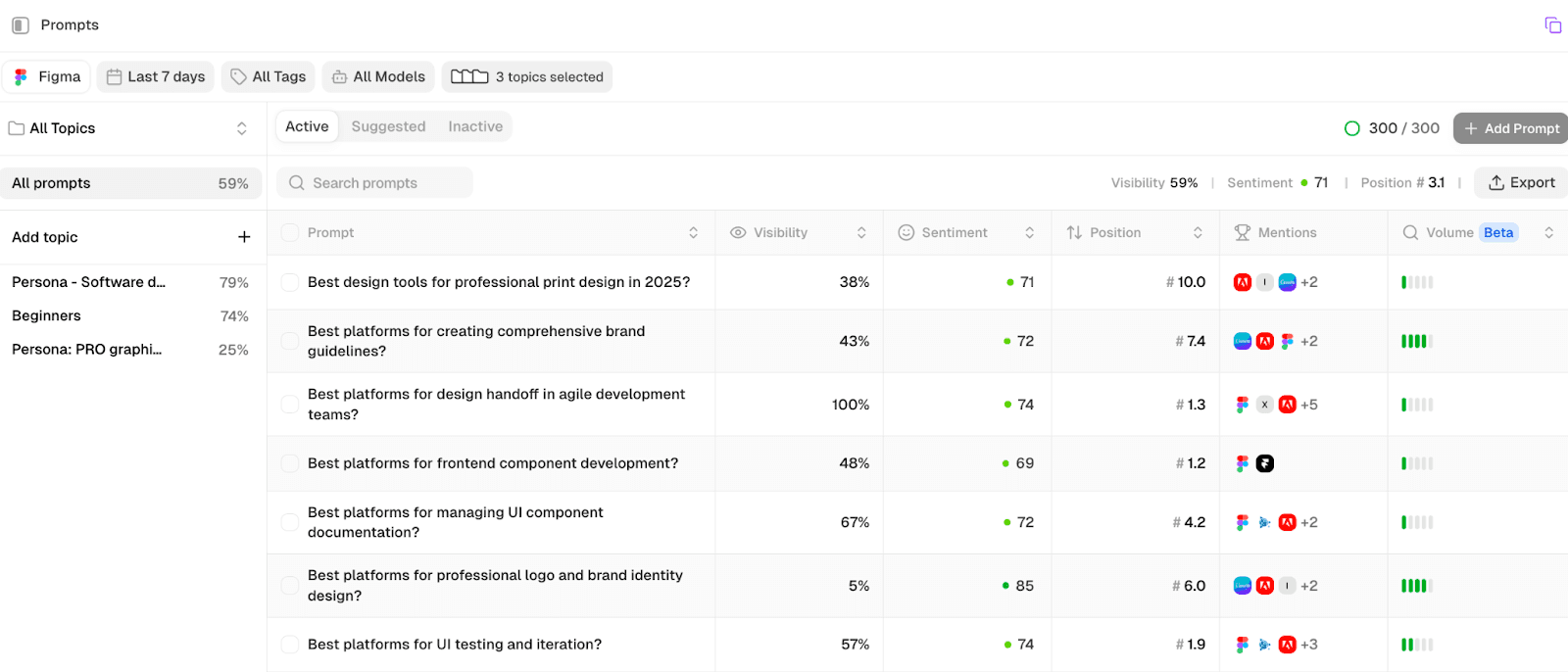
Now the problem becomes clear: your beginner content is strong, but your professional-focused messaging isn't resonating with AI engines. You know exactly where to improve.
Use Case 5: Exporting and analyzing your data
The GEO space is becoming increasingly complex. No single tool will cover every possible use case. That's why the ability to export data matters - whether you're combining it with server logs in Python, building custom dashboards, or just analyzing trends in Excel.
For most teams, you need two things: Excel/CSV export (for basic analysis) and Looker Studio integration (what most marketing teams already use). Enterprise clients will also benefit from API integrations.
Semrush approach: Limited export for AI search module
Semrush as an established SEO platform offers robust exporting to Excel and Looker Studio in their traditional SEO modules. Their Advanced plan even offers API access and MCP integration.
But here's the catch: these export functions aren't available for Semrush's AI search module yet.
I checked Semrush documentation and the AI search data isn't there. Semrush’s export capabilities that work well for traditional SEO simply haven't been built out for AI search tracking yet.
Peec AI approach: Full export on all plans
Every Peec AI plan includes:
Excel export
Looker Studio integration
MCP integration
Plus, Enterprise plans offer API access.
When Peec AI works better
If you need to export AI visibility data for custom analysis, integrating with existing dashboards, combining with other data sources, or building automated reporting workflows, Peec AI provides these capabilities already in the Starter’s tier.
Peec AI's MCP integration pulls AI visibility data directly into Claude, Cursor, or n8n — so teams can quickly build advanced workflows.
I expect Semrush will eventually add these export features to their AI search module. But as of now, they're not available.
Feature comparison
Feature | Peec AI | Semrush AI Search |
Ability to run custom prompts | Yes | Yes |
Update frequency | Daily | Global Index module: Monthly Custom prompt tracking module: Daily |
AI Models available | Peec AI tracks ChatGPT, Perplexity, AI Overviews, AI Mode, Microsoft Copilot, Gemini, Naver AI, Claude, GPT, Grok, Deepseek, Qwen, Mistral and Meta Spark | Custom prompt tracking module: ChatGPT and AI mode Global index module: AI Overviews, AI mode, ChatGPT, Gemini |
Data export | CSV export and Looker Studio on all plans | Currently not available |
Team seats | Unlimited on all plans | Additional users cost $100/month |
Branded vs non-branded filtering | Yes (thanks to the tags module) | Yes (for custom prompt tracking module) No (for global index module) |
Citation source details | Domain and URL level | Global index module: Domain-level only Custom prompt tracking module: only owned sources |
Data filtering and grouping | Tag and topic system with full flexibility | Limited - some fragmentary groups, not consistent across reports |
API access | Yes (Enterprise plan) | Yes (Advanced plan), but no API endpoints for AI search module |
MCP access | Yes | No |
All-in-one vs specialized: The practical reality
The classic choice: an established all-in-one platform (Semrush) versus a highly specialized tool (Peec AI) for Answer Engine Optimization. Both serve different needs in AI search monitoring.
Semrush provides quick directional insights through its global index which is useful for teams that need immediate visibility into whether their brand appears in AI search at all.
The limitations become apparent when you need deeper analysis. Their global index mixes branded and non-branded queries, includes prompts of varying relevance, and shows month-to-month fluctuations that may reflect database changes rather than actual performance shifts. Export capabilities and granular filtering available in their traditional SEO modules aren't yet available for AI search tracking.
Peec AI's approach centers on custom prompt tracking from the ground up. You select prompts that matter to your business, tag them by customer segment or journey stage, and track consistent data over time. URL-level citation analysis, daily updates, unlimited team access, and full data export come standard across all plans.
The practical choice:
Semrush works best for SEO-reliant teams that want a quick first look at AI visibility. Its global index provides that baseline view with minimal setup.
Peec AI is the right choice for marketing teams that need custom prompt tracking aligned with specific business goals, performance monitoring by customer segment or journey stage, URL-level citation analysis, data export for custom reporting, MCP connectivity, and daily updates with reliable trend tracking.
Peec AI is built for teams that need to
Track prompts aligned with specific business goals, not a generic database
Monitor performance by customer segment or journey stage using custom tags
Analyze which specific URLs influence AI narratives in their industry
Export data for custom analysis and reporting via CSV and Looker Studio
Connect AI visibility data to other tools through MCP integration
Access daily updates with trend tracking you can trust