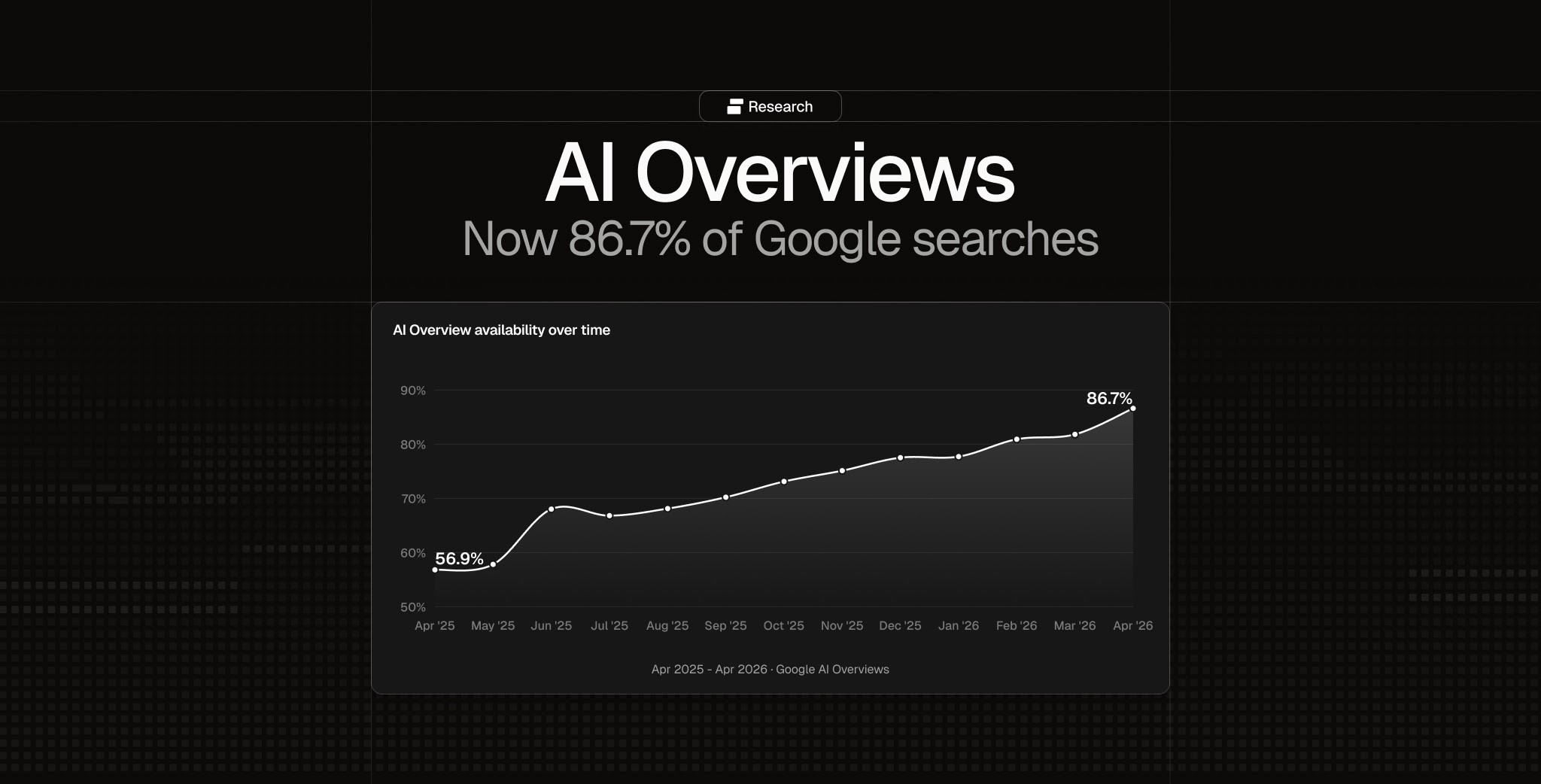
Google AI Overviews are hugely undervalued.
With 2.5 billion monthly users confirmed at Google I/O 2026, AI Overviews is officially the biggest AI search engine in the world, even bigger than ChatGPT, Claude, and Perplexity combined.
In my recent analysis of 500,000 prompts, AI Overviews showed up 86% of the time. And yet, AI Overviews barely features in most SEO and GEO conversations I'm part of, even as ChatGPT and Perplexity dominate the discussion.
If that matches how you're currently splitting your attention, it's worth reconsidering. Let me show you why.
In this article, I'll cover:
Where AI Overviews actually appears (informational vs. commercial queries)
How optimizing for AI Overviews differs from optimizing for ChatGPT
Which query types trigger AI Overviews most often
Why I believe Google's AI ecosystem will likely beat ChatGPT, and what that means for what you should track mid-term / long-term.
AI Overviews grew over 50% in just one year
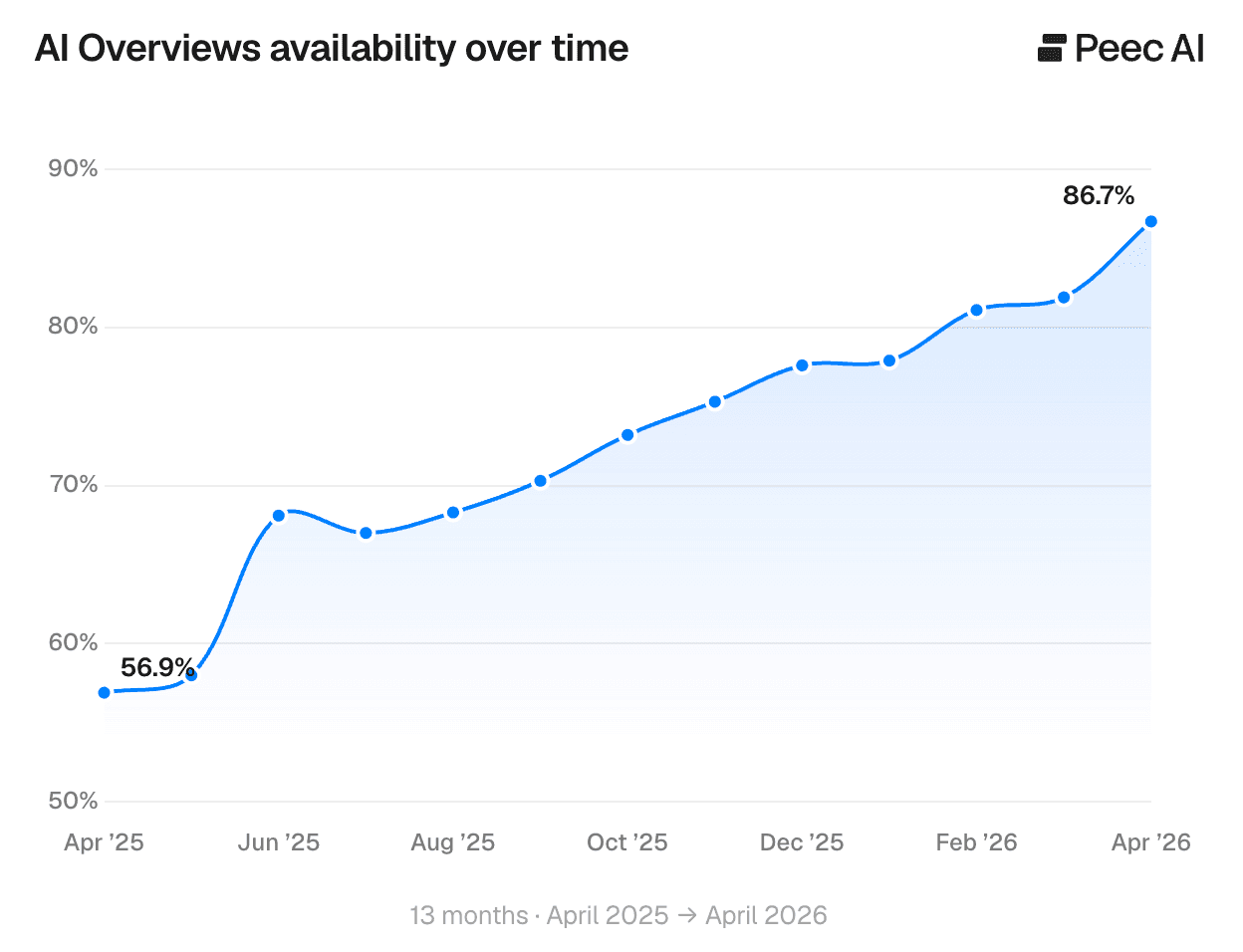
In April 2025, AI Overviews appeared in 56.9% of Google searches, based on our sample. By April 2026, that number had climbed to 86.7%. That's a 50% increase in just twelve months.
Short note about the methodology:
This dataset comes from Peec AI and skews toward business-oriented prompts, typically with clear buying intent, where users are actively evaluating their options. These are the kinds of questions brands monitor to measure their visibility in AI search: category research, product comparisons, and decision-stage evaluations.
Importantly, the dataset excludes navigational queries like "HubSpot" or "Tesla." While these have massive search volume, they fall outside the scope of our database.
AI Overviews appears for informational AND commercial queries
There's a common myth across SEO circles that AI Overviews only shows up for informational queries, but this is simply not true.
I kept seeing the opposite in my own testing. AI Overviews was showing up for prompts that were clearly commercial: comparison queries, "best X for Y" prompts, product research.
So I decided to verify it properly.
I trained a machine learning model to classify prompts by funnel stage, then ran it across the sample of 500,000 prompts from the Peec AI dataset (April 13–20, 2026).
Here's what the data showed:
For decision-stage (bottom-of-funnel) prompts, AI Overviews appeared 88.5% of the time - higher than the 87% average.
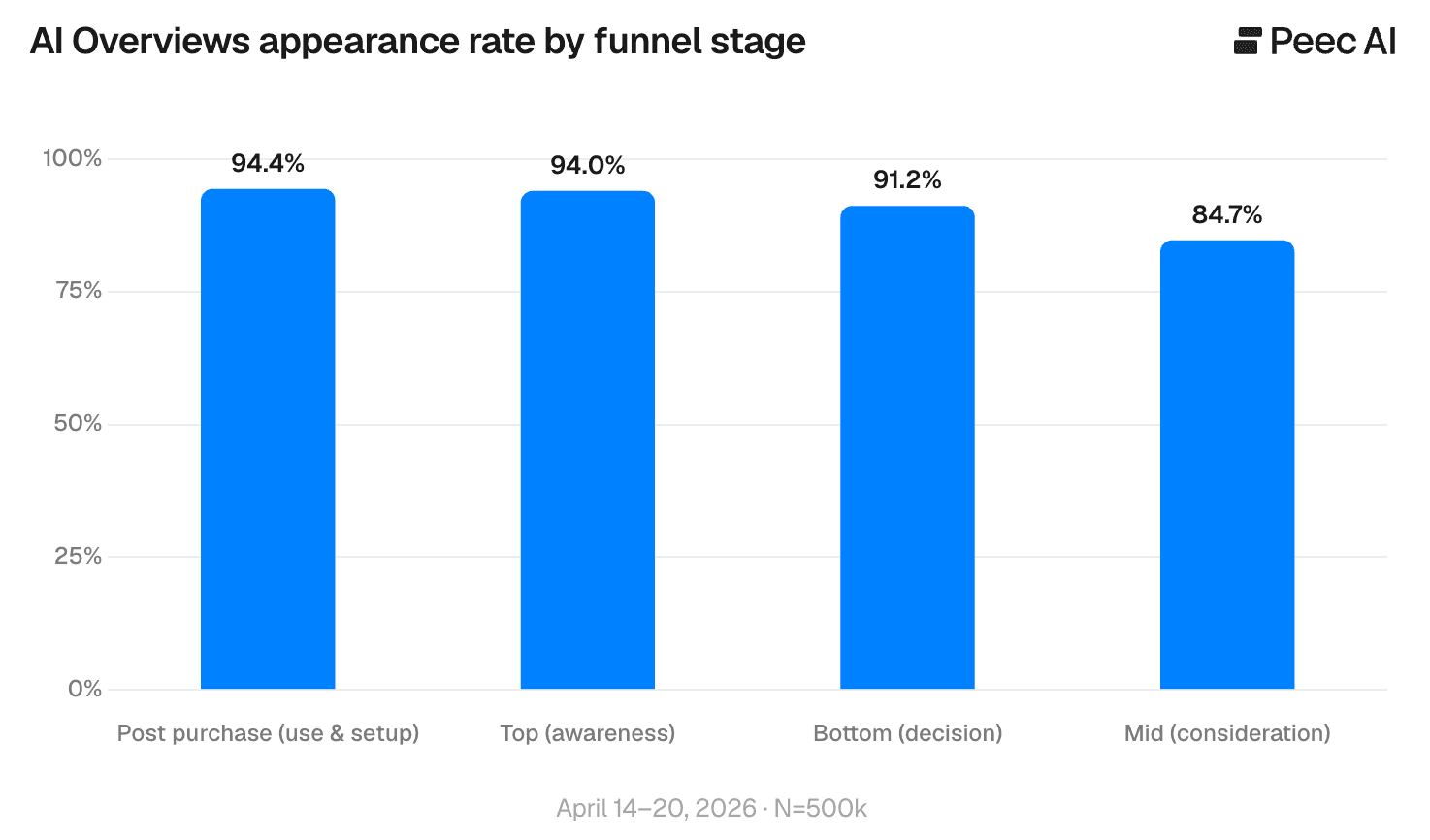
The data is clear: AI Overviews isn’t reserved for informational queries. It shows up across the entire funnel - informational, comparison, and decision-stage prompts alike.
AI Overviews isn’t just answering "how does X work" questions for curious researchers. It’s shaping buyer decisions at the moment someone is choosing between you and a competitor.
When a potential customer searches for "best CRM for small business" or "Salesforce vs HubSpot," AI Overviews is there - summarizing the options, recommending some, and leaving others out.
That's 2.5 billion people getting buying advice from a surface most SEO teams barely track. Most brands have no idea whether they're being recommended by Google AI Overviews, ignored, or excluded entirely, and it rarely comes up in GEO conversations.
Share of AI Overviews by query intent
Mark Williams-Cook's research surfaced something interesting from Google's internal systems: Google classifies queries into eight distinct categories:
Short fact: Quick factual lookups ("what's HubSpot's annual revenue")
Bool: Yes/no questions ("does Stripe support EU customers")
Instruction: How-to queries ("how to migrate from Mailchimp to ConvertKit")
Definition: "What is X" queries ("what is a CDP")
Reason: "Why does X happen" queries ("why is this product so expensive")
Comparison: "X vs Y" queries ("Salesforce vs HubSpot")
Consequence: "What happens if X" queries ("what happens if I cancel my AWS reserved instance")
Other: Everything else
I wanted to see how AI Overviews behaves across these categories. So I trained a machine learning model to classify all 500,000 prompts in my dataset into one of the eight query buckets, then measured how often AI Overviews appeared for each.
Here are the results.
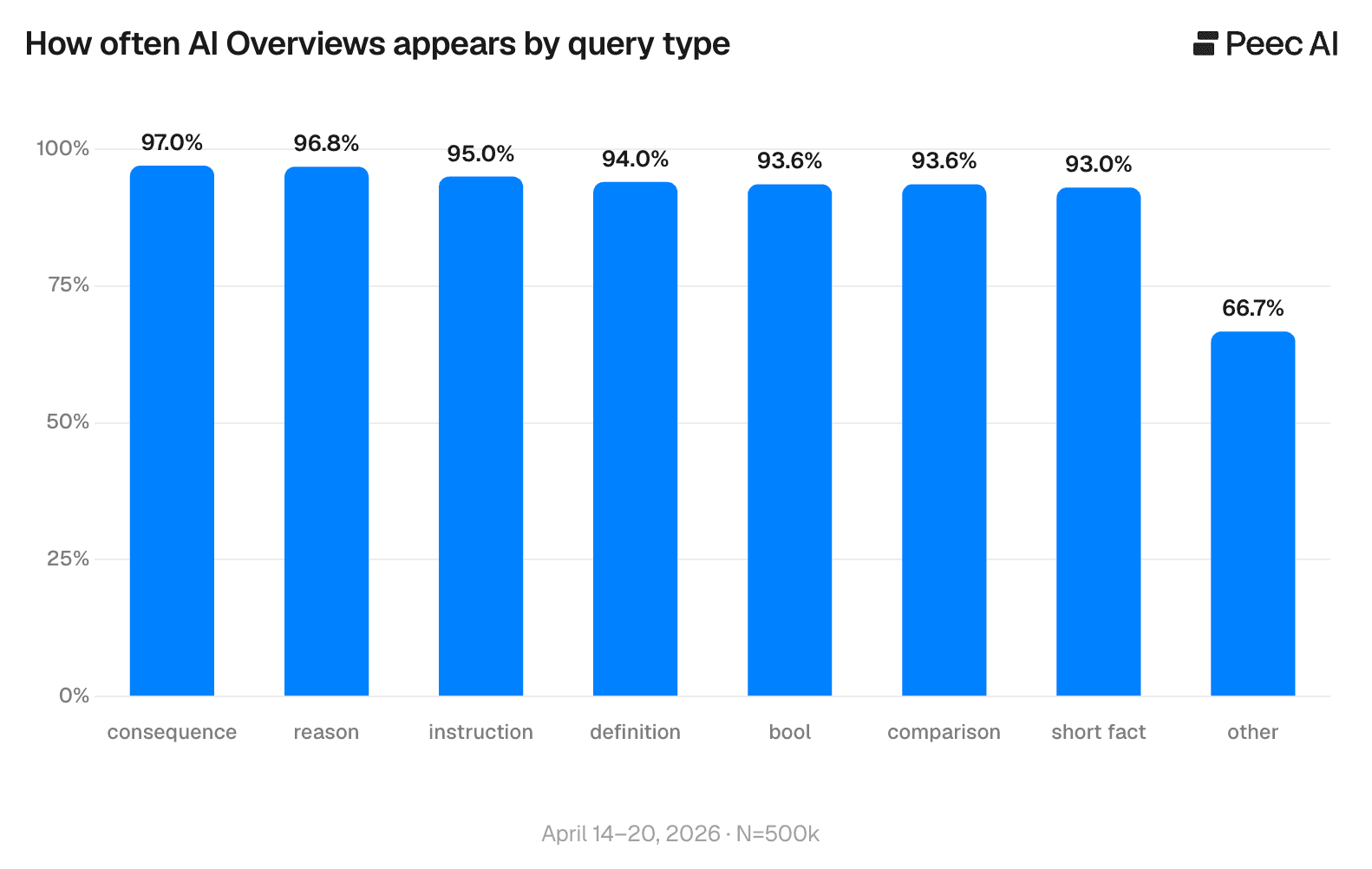
AI Overviews appears in 93–97% of every query that has a clear linguistic pattern that maps to one of the answer types Google's system recognizes: Short fact, Bool, Instruction, Definition, Reason, Comparison, and Consequence. The exact category barely changes the rate.
The one outlier is the "Other" bucket, meaning vague queries, fragments, and analytical requests that don't fit a clean intent shape. There, AI Overviews appears only 67% of the time.
The pattern underneath is simple: when Google can read a clear intent, it almost always serves an AI Overview. When the intent is ambiguous, it shows AI overviews less frequently.
Share of AI Overviews by location
If you operate across multiple markets, it’s worth knowing that AI Overviews appears less frequently inside the European Union (EU) than outside it.
In the EU, AI Overviews shows up in 76% of searches. Outside the EU, that jumps to 90.3%.
Here's the breakdown across major markets:
US: 91.4%
UK: 91.7%
Australia: 86.5%
Poland: 82.9%
Germany: 75.6%
France: 0% (not served by AI Overviews or AI mode)
France is the notable exception as the only major market where neither AI Overviews nor AI Mode is currently available.
But let's keep perspective
The EU/non-EU gap is real, but worth keeping in proportion. At 76%, AI Overviews still appears in more than three out of every four searches, and a market that active at 76% deserves the same attention as any other.
The bigger finding is that AI Overviews has reached maturity across almost every market. Appearing in 76–91% of searches, it's now the default search experience, and the approach is the same everywhere - track it, optimize for it, and stop treating it as optional.
Share of AI Overviews by word count
When we split all 500,000 prompts by word count, the pattern was unambiguous. Two-word queries, like "car insurance" or "wedding dress" get an AI Overview only 64.6% of the time. From there, the rate climbs with every word added: 5-word queries hit 78.5%, 6–7 words 84.2%, 8–10 words 87.7%, and 11–15 words peak at 89.1%. Above 15 words it plateaus between 87 and 91%. That is a 25-percentage-point swing between the shortest and longest queries.
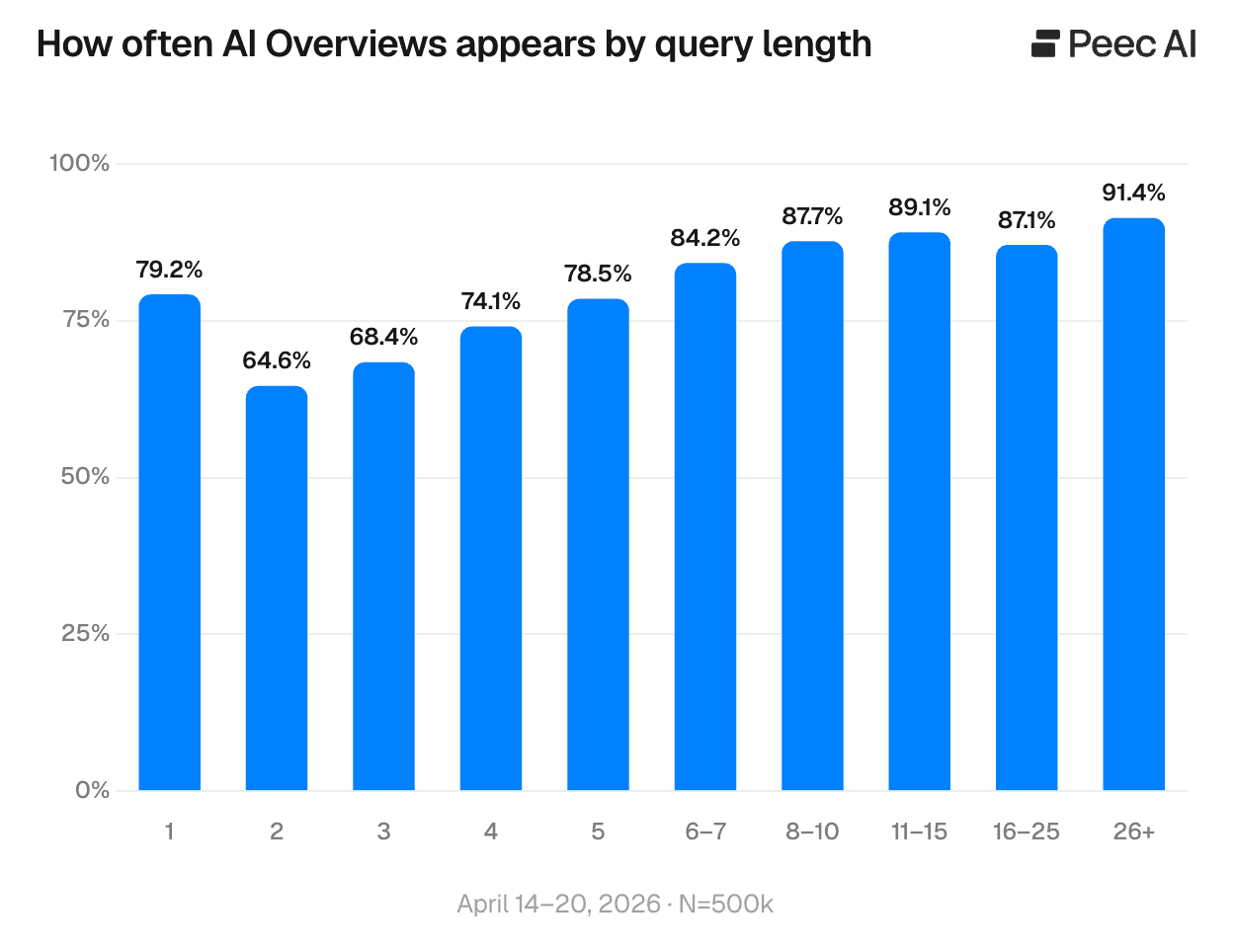
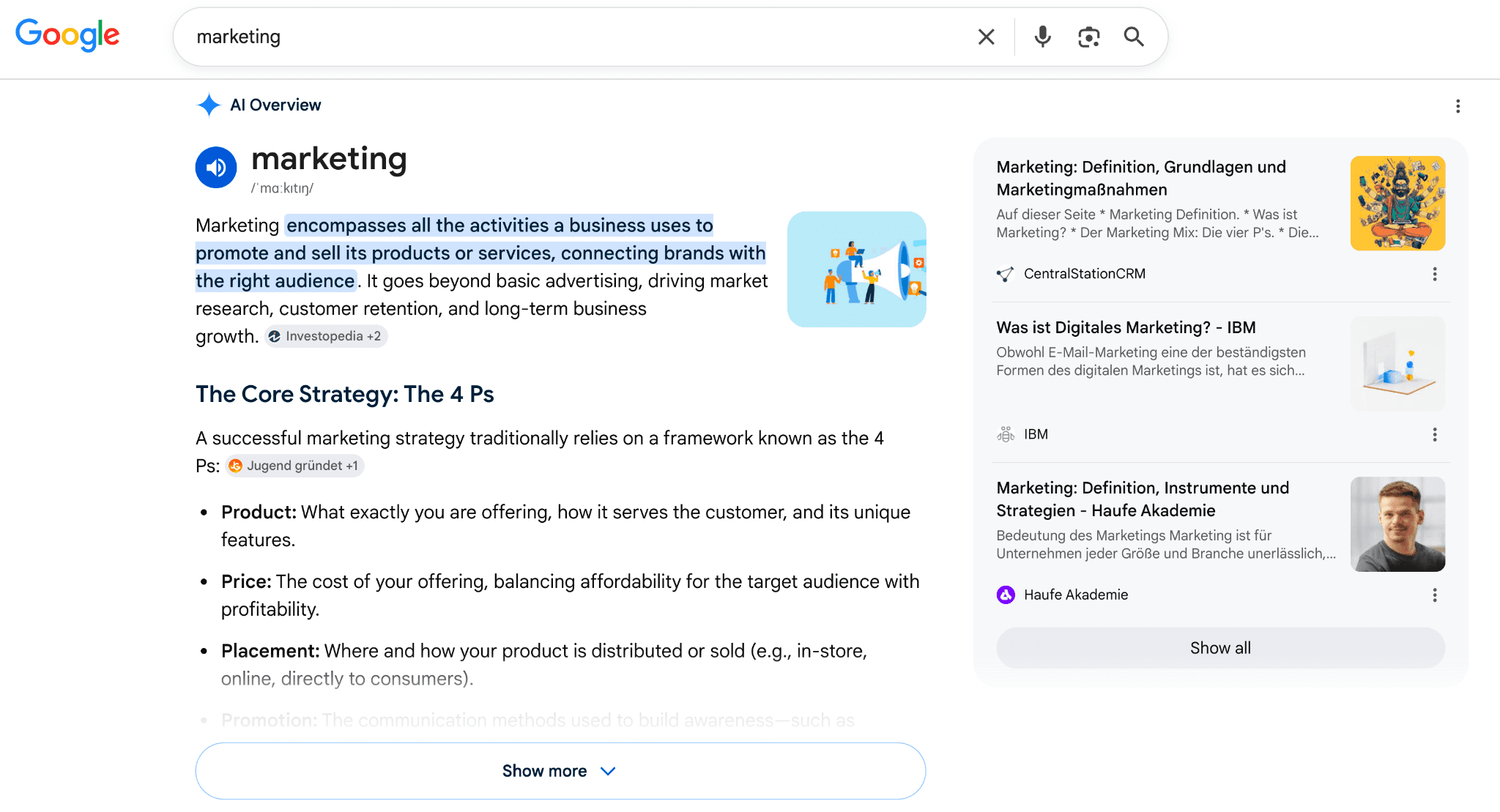
Interestingly, one-word sentences in our dataset appear in AI Overviews almost 80% of the time. Here’s an example of AI Overviews being shown for “marketing.”
Even at the lowest end - two-word keyword-style queries - AI Overviews still appears in 64.6% of searches. The average across all word counts is 87%.
AI Overviews shows up across almost every variable: word count, location, and search intent. The differences are there, but they're marginal.
Why Google AI chatbots will likely keep growing
Two recent changes tell me Google isn't slowing down on AI search. If anything, it's doubling down.
Change 1: The search box now thinks with you
Google is rolling out what it calls the biggest upgrade to its search box in 25+ years. Instead of a static input field, the search box will dynamically expand and help you formulate your question with AI-powered suggestions that go beyond autocomplete.
That means Google will no longer wait for users to know what to ask, and will instead coach them into better prompts - the kind that AI Overviews and AI Mode handle well.
This is a small UI change with big implications. It shows Google is moving toward full questions and conversations, and will no longer operate on keywords.
Change 2: Google is turning search into a full chat experience
In the past, Google Search felt fragmented. You'd get an AI Overview at the top, then ten blue links. AI Mode was a totally different experience because you had to actively switch tabs to open it. And Gemini lived in its own app entirely, disconnected from the search flow most people use.
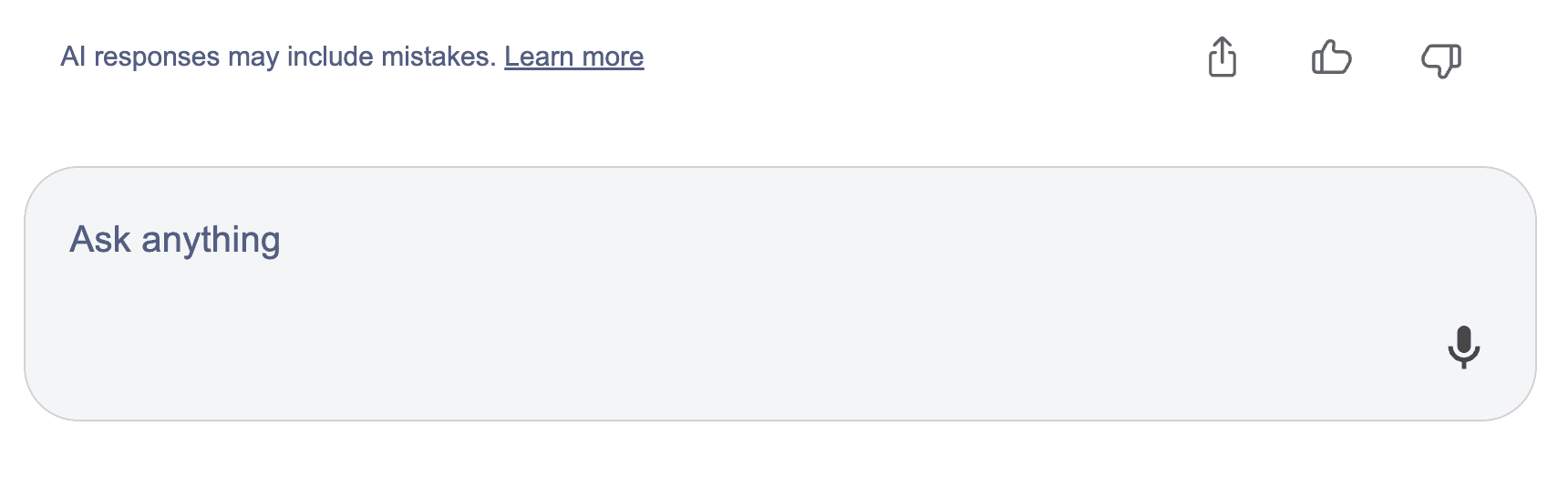
Now Google is consolidating it. When you see an AI Overview, you can click "Ask anything" and ask a follow-up, with Google routing you directly into AI Mode, where the conversation continues.
In other words, Google is closing the gap between AI Overviews and a ChatGPT-style chat. You don't leave Google to get a conversational AI experience anymore. It's built in.
The ecosystem this creates
Stack the numbers up and the scale becomes hard to ignore:
AI Overviews: 2.5 billion monthly users
AI Mode: 1 billion monthly users
Gemini: 0.9 billion monthly users
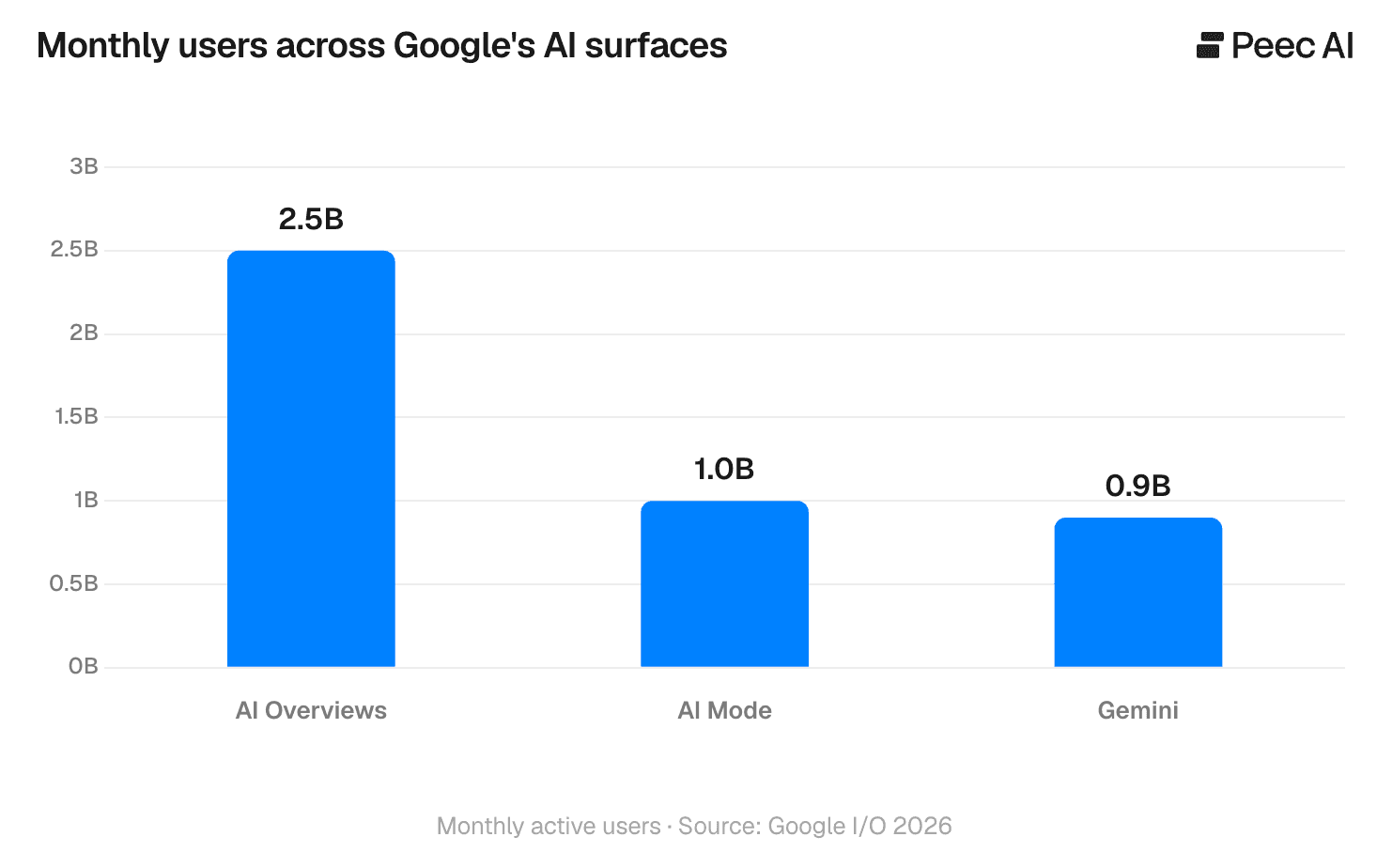
Together, they represent three massive surfaces powered by the same Google AI stack, all now connected to each other.
What this means for SEO and GEO teams
If your current tracking and optimization effort is weighted toward ChatGPT and Perplexity, the data in this article makes a reasonable case for rebalancing. You don't have to choose one over the other, because Google's ecosystem and OpenAI serve different audiences in different ways, and optimizing for one doesn't cover the other fully.
Key takeaways from our study
Based on 500,000 prompts, here's what the data tells us:
AI Overviews appears in 87% of Google searches, and 88.5% of them are bottom-of-funnel commercial queries.
According to Google internal data, AI Overviews reaches 2.5 billion monthly users, more than any other AI search surface.
Even in the EU (the most-restricted major market), it shows up in 76% of searches.
Google is consolidating AI Overviews, AI Mode, and Gemini into a connected ecosystem with massive distribution leverage.
Most SEO and GEO conversations still treat AI Overviews as an afterthought. ChatGPT and Perplexity have dominated the discussion, and the largest AI search surface has gone largely untracked as a result.
If you're not already, start tracking your visibility across:
AI Overviews: Where most of your buyers are getting AI-assisted answers
AI Mode: Google's next step, growing fast and connected to AI Overviews
ChatGPT: Still the AI most people talk about, even if Google has the reach
You don't need to optimize for everything at once, but you do need data on where you stand. You can't address a visibility gap you’re not measuring.
How optimizing for AI Overviews and AI Mode differs from optimizing for ChatGPT
Google's ecosystem and ChatGPT use different ranking signals, trust different sources, and reward different optimization strategies. Back in March, I analyzed 30 million sources across both to map out the differences.
1. AI Overviews heavily promotes YouTube. YouTube is Google’s, so this isn't surprising. But the implication matters: if you're trying to win in AI Overviews and AI Mode, video content is a direct pathway into Google's AI surfaces that ChatGPT doesn’t offer.
2. ChatGPT doesn't render JavaScript. If your site relies heavily on JavaScript to render content - common with modern frameworks like React or Vue - ChatGPT likely can't read it. Google can, which is a structural advantage for AI Overviews if your stack is JS-heavy.
3. ChatGPT uses Reciprocal Rank Fusion (RRF). In practice, this means ChatGPT fans out your prompt into multiple sub-queries and combines the results. To rank in ChatGPT, you need to appear across as many of those query fanouts as possible. It's less about ranking for one query and more about being present across dozens of related ones.
4. Both ecosystems lean heavily on Reddit. This is the one consistent signal across Google's AI surfaces and ChatGPT. If Reddit threads are surfacing in both, you can't ignore community presence in your GEO strategy.
5. Non-English markets are harder for ChatGPT. My research showed that ChatGPT often mixes English and local-language sources in non-English responses, sometimes leaning more heavily on English content even when the prompt is in another language. AI Overviews tends to stay more consistently within the language of the query. If you're optimizing for non-English markets, that's a meaningful difference.
The two systems share some signals, including Reddit presence, content quality, and citations, but the specifics diverge enough that treating them as one strategy will likely mean underperforming on both.
GEO teams need separate tracking and separate optimization workflows for each major AI surface.