If you want AI search engines to recommend your brand, you need to understand something first: AI doesn't pull answers from thin air - it cites sources it finds relevant and trustworthy. And not all platforms are equally likely to be cited.
We analyzed 30 million sources across ChatGPT, Google AI Mode, Gemini, Perplexity, and AI Overviews in the US to find out exactly which ones are commonly cited by large language models (LLMs). Below we present the results of our research.
Top 10 most-cited domains in AI search
Below are the ten most-cited domains in AI search, ranked by direct citations across five major AI platforms: ChatGPT, Google AI Mode, Gemini, Perplexity, and AI Overviews.
1 Reddit.com
2 YouTube.com
3 LinkedIn.com
4 Wikipedia.org
5 Forbes.com
6 G2.com
7 Yelp.com
8 Facebook.com
9 Medium.com
10 Techradar.com
To make data accurate, we counted actual sources that were directly cited by LLMs. Meaning, sources that influenced AI search results.
How top sources vary by platform
At Peec AI, we didn't just look at the overall rankings across all AI search engines. We broke down the top sources for each major AI platform separately.
Platform | Top 5 Sources |
AI Mode | YouTube, Reddit, Facebook, LinkedIn, Yelp |
AI Overviews | YouTube, Reddit, Facebook, LinkedIn, Medium |
Gemini | Reddit, YouTube, Wikipedia, Medium, PCMag / Forbes |
Perplexity | Reddit, YouTube, LinkedIn, Wikipedia, G2 |
ChatGPT | Wikipedia, Reddit, Forbes, Techradar, Linkedin |
Reddit and YouTube appear across all five platforms, which reinforces the overall ranking. But then the platforms diverge - Google's AI Mode and AI Overviews favor social content (Facebook, Yelp), while ChatGPT leans toward more authoritative editorial sources like Forbes and Techradar. Wikipedia shows up strongly for ChatGPT and Perplexity but not for Google's platforms at all. G2 only appears for Perplexity, which is worth flagging for anyone in B2B.
Reddit: The #1 most-cited domain in AI
Our research shows Reddit is the most-cited domain in LLM responses. For all the LLMs we tested, it was either the #1 or #2 most-cited source.
As I shared in my Ultimate guide to tracking brand sentiment in LLMs, AI search engines trust Reddit because it captures authentic user experiences and discussions that feel more trustworthy than marketing content, with real people asking real questions and getting real answers.
Monitor what's being said on Reddit about your brand, and if you participate, be authentic and add real value.
YouTube: #2 Most-cited video source in AI Search
YouTube is massive for AI citations. The vast majority of AI-referenced video content comes from YouTube, and it's not just main channel videos. AI also cites Shorts and YouTube Music pages, which means even shorter-form content on your brand channel can end up as a source.
As for where AI actually pulls the content from, I found it uses both the video description and the auto-generated transcription. We've seen clear examples of AI Mode pulling directly from a video description, and separate examples where it pulled from the transcript instead.
For example, in the search below, the AI Mode used the video transcription to create its answer.
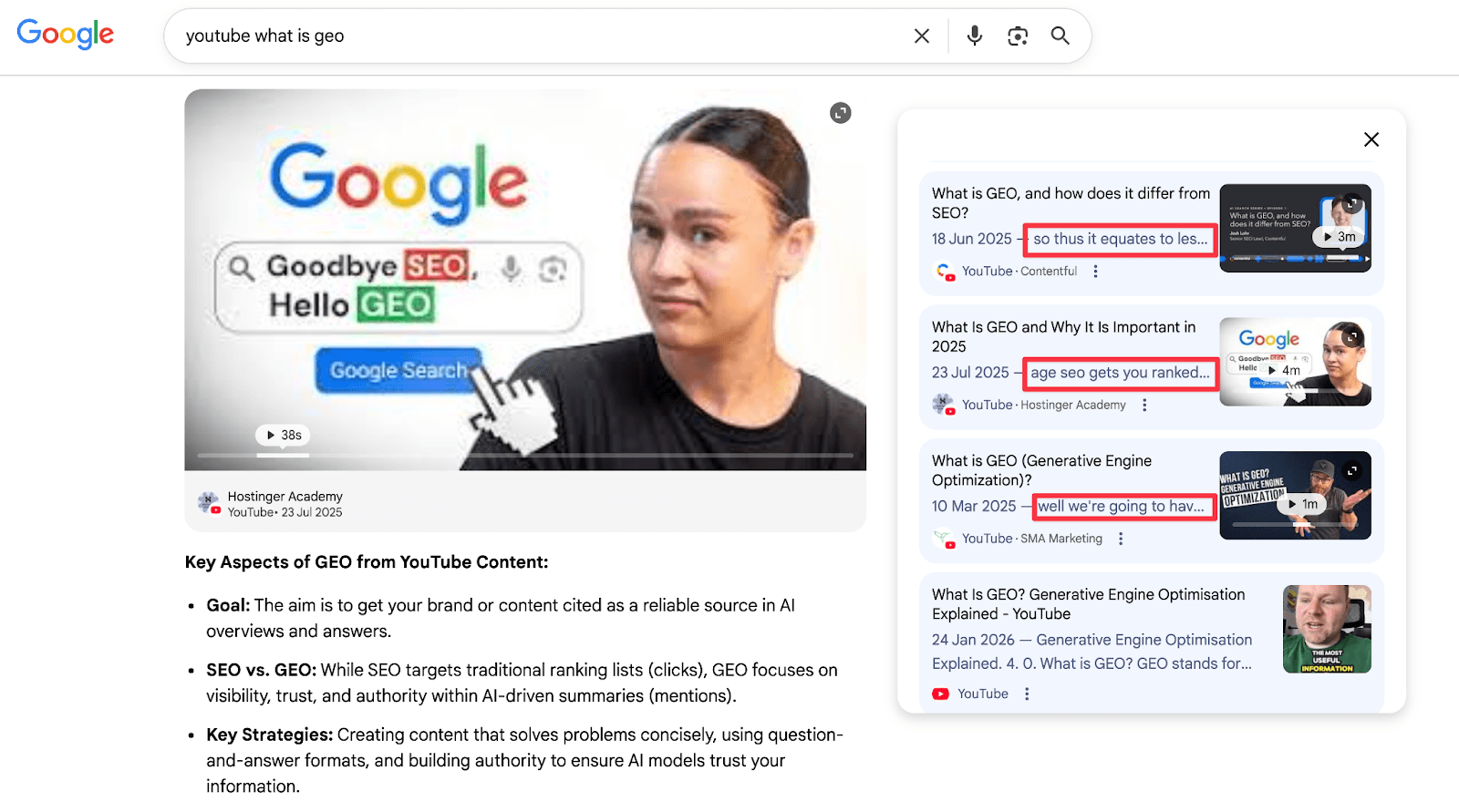
This leads to an important (and often missed) publishing checklist item: always review the auto-generated transcription before your video goes live.
Wikipedia: Influences AI on two levels
Wikipedia influences AI differently to most platforms. First, live retrieval where AI actively pulls from it when generating answers. Second, training data: before an AI model is released to the public, it learns from a massive amount of text from the internet. Wikipedia is one of the core sources it learns from. At some point that learning stops, which is called the knowledge cutoff date. After that, the model doesn't automatically know about new information unless it searches for it.
What this means for your brand: if you had a Wikipedia page before that cutoff, the model has likely already learned about you. You're not just a source it might cite but something it already understands.
But there’s a catch. Getting onto Wikipedia isn't easy. The platform has strict notability guidelines, and submissions that don't meet them get rejected or deleted. It's not a quick win but for brands that qualify, it's worth pursuing.
Facebook: Blocking Perplexity, but still worth your attention
Facebook isn't the strongest AI source on this list, but there's a strategic reason to maintain a presence anyway. AI search engines surface several content types from Facebook: posts from public groups, profile posts, and posts with videos. That said, there are some important platform-specific limitations worth knowing before you invest time in it.
If Perplexity is a priority channel for you, Facebook is largely a dead end because the platform blocks Perplexity's bots entirely (see their robots.txt). Facebook also blocks most of the crawlers used for model training, so if your goal is to influence how LLMs are trained on your brand, other platforms will serve you better.
But there's a bigger strategic reason to maintain a Facebook presence, and it comes down to diversification. We know from history that both Google and ChatGPT have gone through periods of pulling back from Reddit, and it could happen again. If Reddit disappeared from AI search results tomorrow, brands with no presence elsewhere would lose a significant source of AI visibility overnight.
Being present across multiple platforms reduces risk and actively increases your chances of being cited. AI systems encounter your brand across different sources and contexts, which reinforces your authority. The more places AI sees consistent information about you, the more confidently it references you.
Facebook or LinkedIn gives you a fallback. But more than that, every additional platform where your brand has a credible presence is another opportunity for you to show up in AI responses.
LinkedIn: From social platform to AI source layer
LinkedIn is another significant source for AI search, and it surfaces three types of content: LinkedIn Pulse articles, standard posts, and company page updates.
We see it sometimes with our own updates that we publish on our LinkedIn company page or via employee accounts - they get picked up by LLMs.
Don't treat LinkedIn as just a distribution channel. Posts from founders, executives, and employees, especially around product news or company milestones, can end up directly shaping how AI describes your brand.
The review sites quietly shaping AI recommendations
Yelp turns out to be a surprisingly significant source for AI search. A common example is someone asking AI for the best restaurants in a city, with Yelp frequently referenced in the answer.
But it's not just Yelp. Looking at the top 100 most-cited domains, several other review and recommendation platforms show up, such as Tripadvisor, Trustpilot, G2, and Clutch. Each platform serves a different category, from local information and hospitality to B2C services and B2B software.
But the pattern is the same across all of them. When AI needs to recommend something, it looks at review platforms. If your business is listed on any of these, your company profile is likely influencing how AI talks about you. It's worth making sure that presence is accurate, complete, and actively maintained.
The top domains are just the starting point: What to do next
Everything I've covered so far is based on the top domains across all industries. It's a useful starting point but it's not the full picture for your specific situation.
The reason I walk through these platforms is to help you understand how AI search sources its answers. Once you understand that, you can make smarter decisions about where to invest your time and content.
The best strategy is finding out which domains matter most for your specific industry and your specific prompts, not following a generic list.
For example, in the hotel space, platforms like Booking.com and Airbnb often outrank Reddit as AI sources. Your industry likely has its own version of platforms that carry outsized influence that wouldn't show up on any general top 10 list.
Using Peec AI, you can find this out in minutes. Go to Sources → Domains and you'll see exactly which domains AI cites most when answering questions in your space, all ranked by influence and specific to your industry.
In summary: AI visibility goes beyond your website
The data from 30 million sources makes one thing clear: AI visibility is about where your brand lives across the web, not just your website.
The platforms on this list - Reddit, YouTube, LinkedIn, Wikipedia, review sites - are the sources AI consistently pulls from. That doesn't mean publishing on these platforms guarantees you'll be cited. But based on what we see in the data, they're the ones worth considering when building your AI visibility strategy.
The brands thinking ahead are working on both layers: their own website and the external sources AI commonly cites. Start with the platforms that matter most for your industry - and let the data guide where you invest.