
Recently, in a study published on Search Engine Land, we revealed exactly where ChatGPT sources its carousel products: Google Shopping.
Today, we will focus on what your teams can actually do about these findings. This practical guide will give concrete action items that your teams can work on immediately.
If you want to read the full technical breakdown, check out the original write-up on Search Engine Land. But in this guide, we’ll focus specifically on optimizing your team’s strategy and KPIs for AI product ranking success.
What does ChatGPT shopping look like conceptually?
First of all, it helps to visualize processes as it’s so much easier to understand what’s happening. When a user searches for products such as “fitness trackers with HRV monitors” in ChatGPT, here’s what happens behind the scenes:
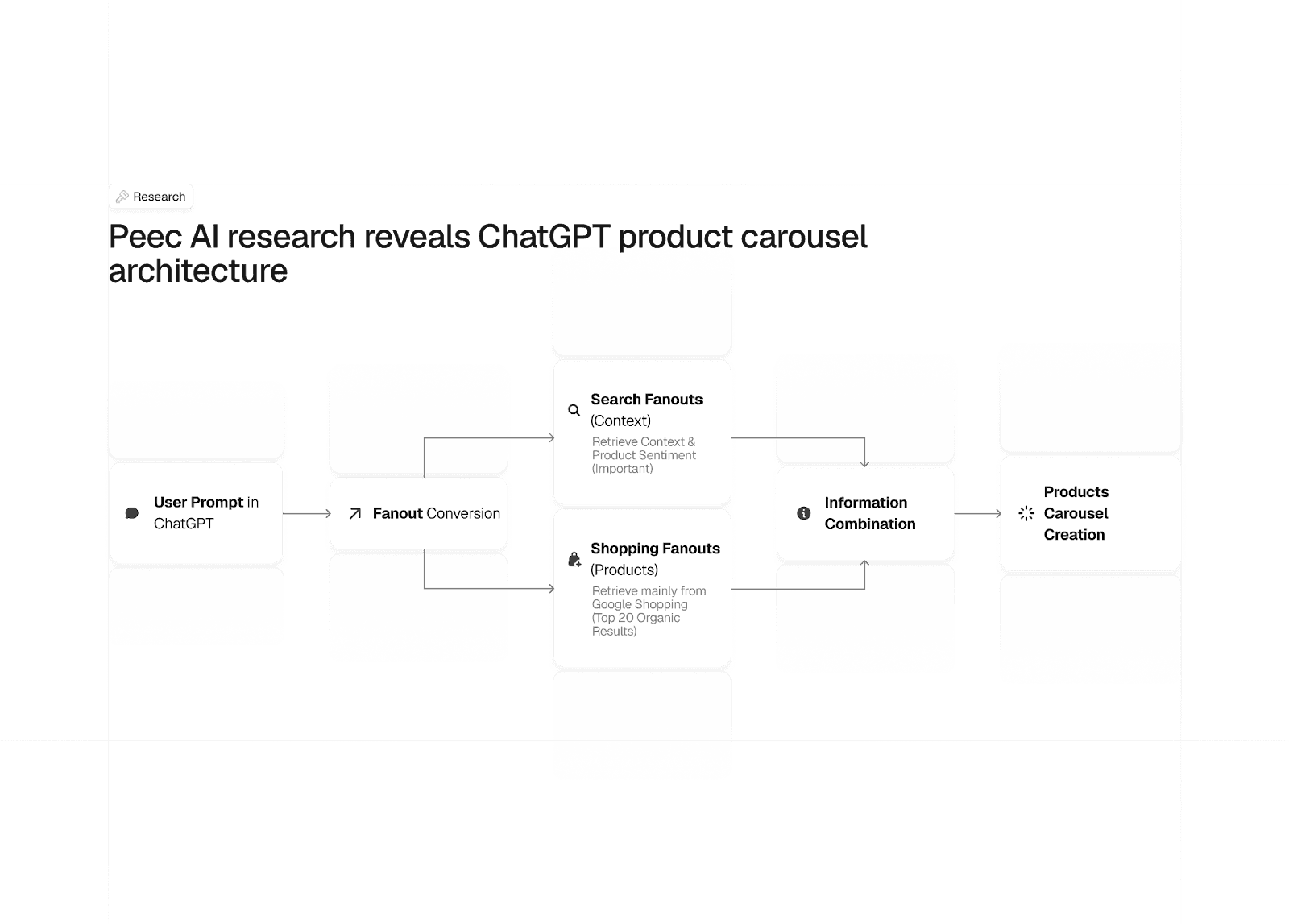
First, the prompt gets split into search fan-outs and shopping fan-outs. Then:
Search fan-outs aim to get as much context about the product category as possible, and often look like “what to consider when buying smartwatches with HRV monitors,” retrieving important contextual info.
Search fan-outs additionally gather context on leading brands and products as well as perceived market sentiment across these sources.
Shopping fan-outs target Google Shopping with shorter, more direct queries such as “best fitness trackers with HRV monitoring.”
In most cases, the top 40 organic shopping results make up the product selection set.
All of this information is then combined to create:
The product carousel usually features 8 products.
The AI answer that gives the user buying advice.
If ChatGPT sources from Google Shopping, what can we do about it?
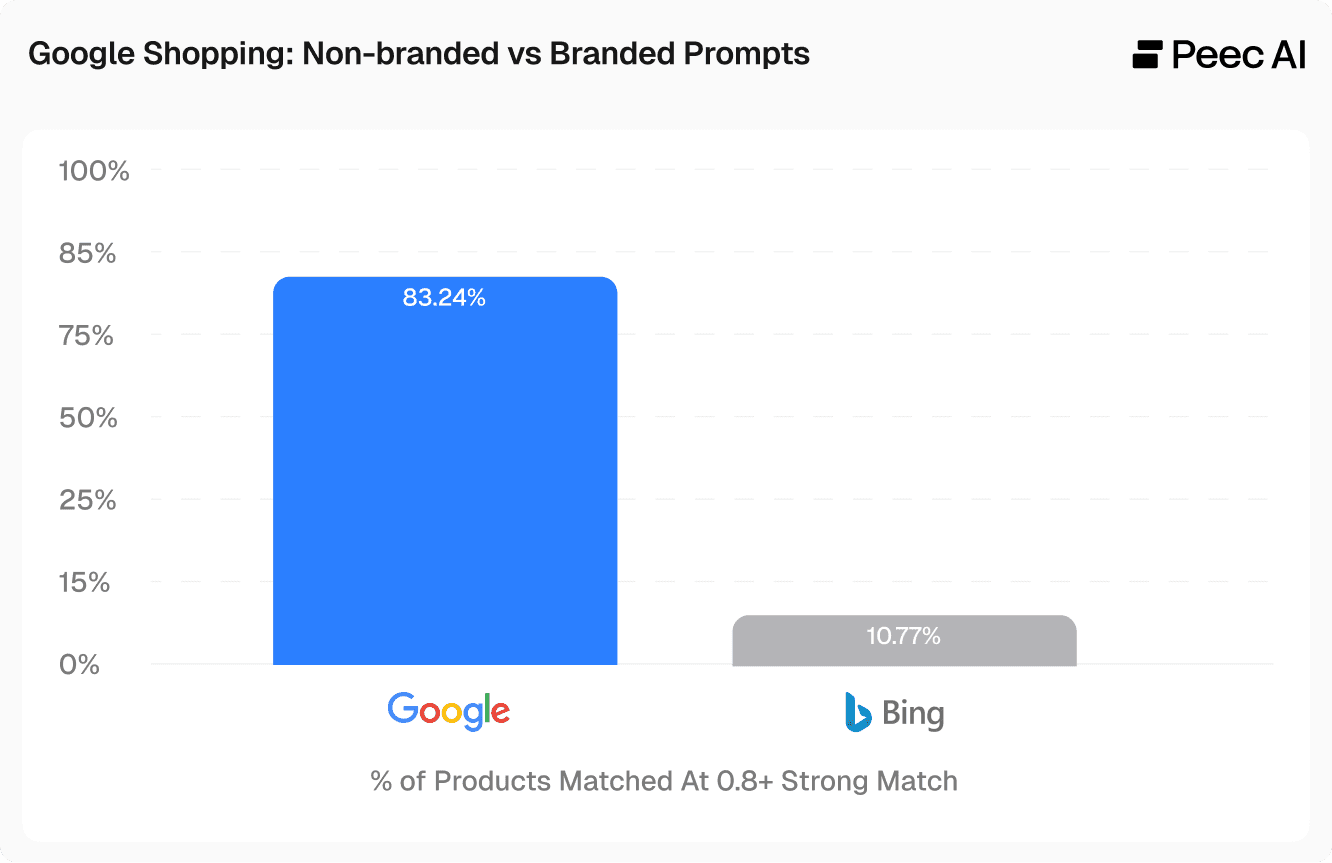
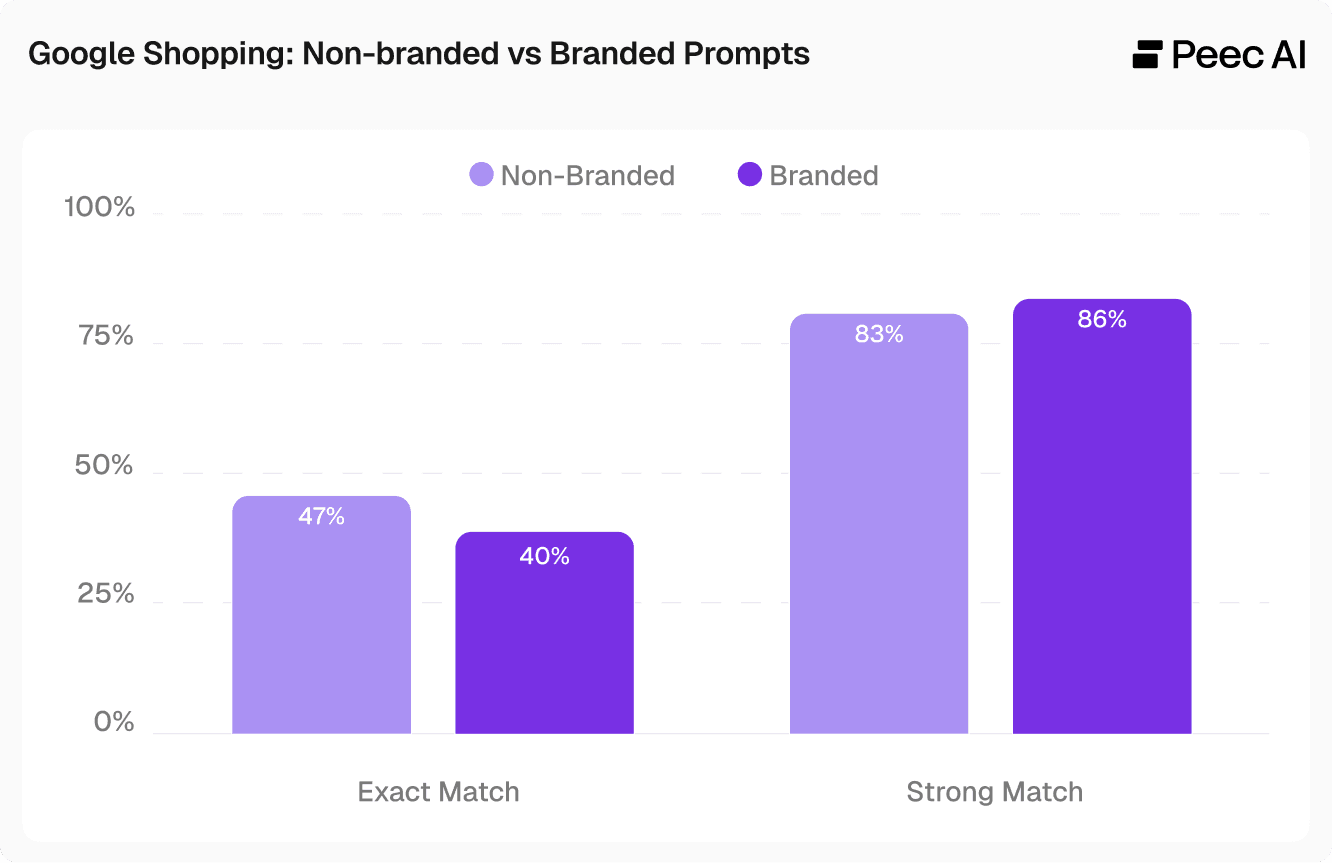
As per our research, ChatGPT pulls its carousel products almost entirely from Google Shopping organic results. The study analyzed over 43,000 ChatGPT carousel products and found that 83% were strong matches to products in Google's top 40 organic shopping results. The equivalent figure for Bing was 11%, and most of those Bing matches also appeared in Google anyway.
So, the question is what could and should your ecommerce teams do about it?
If your product is not in Google Shopping organic results, it will also not appear in ChatGPT carousels. That is a solid starting point. But let’s dive a bit deeper.
Why Google Shopping feed optimization is so important
Being listed in Google Shopping is not enough. We found that 60% of carousel matches come from the top 10 Google Shopping results alone. This jumps to nearly 84% from the top 20.
Products ranked 21 to 40 account for only around 16% of matches.
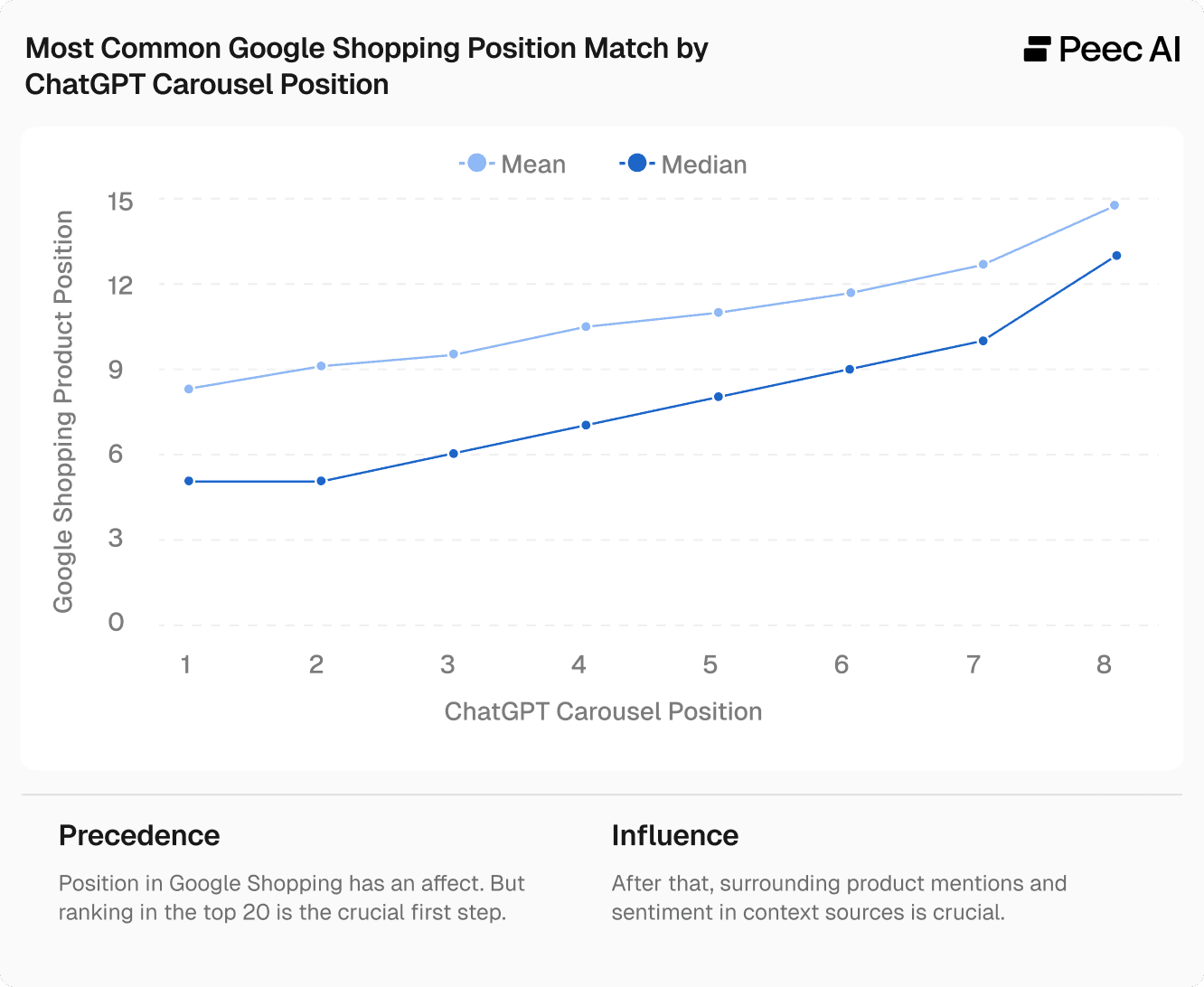
There is also a direct link between Google Shopping rank and ChatGPT carousel position. Products that rank higher in Google Shopping tend to appear earlier in the ChatGPT carousel. Treat top 20 Google Shopping rank as a concrete target, not a nice-to-have.
You don’t just need to show up in Google Shopping, you ideally need to target the top 10 organic products. This will drastically boost your chances of showing up in AI search.
“This data reinforces a pattern we've observed across multiple experiments: ChatGPT appears to be heavily reliant on Google's index and rankings to surface relevant, up-to-date answers. It's not surprising that OpenAI would lean on Google's Shopping results; Google has invested years building a shopping graph that is accurate, precise, and richly populated by merchants. But it's yet another signal that one of the most effective ways for a brand to establish visibility within AI search platforms - whether Google-owned LLMs, OpenAI, or other AI crawlers that draw from Google's index - is to maintain a strong presence within Google's own ecosystem.”


Google Shopping is still the source of truth for branded searches
The same is true for branded searches. If a user searches for “buy Ray-Ban Meta smart glasses” ChatGPT will still take Google Shopping as its ultimate source of truth.
You may think: if someone is already searching for my brand, why does it matter?
It’s a good question but remember that the retailers and resellers that show up in the top Google Shopping results are the ones that rank in ChatGPT. This includes how they price and describe your products. This matters most if you want your official website to be the preferred point of sale.
If your resellers or other partners outrank you on Google Shopping, they'll likely win the ChatGPT carousel too.
"This data represents a critical shift in ecommerce strategy: for Shopify Plus brands it is no longer sufficient to have just a high-converting storefront, but the health of your organic product feed and third-party sentiment is crucial. If you aren't ranking in the top 20 of Google Shopping organically, you effectively don't exist in the AI-assisted buyer's journey. At the Agency level, we are moving away from treating 'SEO' and 'Feed Management' as separate silos; to win in 2026, your product titles and editorial PR must work in a unified loop to feed the LLM’s discovery engine "


Below we see the data from our study showing Google sources its products for both non-branded and branded prompts from Google Shopping.
Does this still apply to ChatGPT 5.3 and 5.4?
Yes. The behavior described in this research has been consistent across at least four months of data collection, and holds for the latest available ChatGPT versions of 5.3 and 5.4. While normal search fan-out were removed from ChatGPT 5.3, shopping fan-out and the mechanisms behind it remain in place. This Google scraping method is a way to bridge the gap between moving vendors to their own feeds and opening the gateway for true agentic commerce. Until Open AI solves this engineering challenge, the same rules apply.
Two areas to prioritize for ChatGPT carousel visibility
If your goal is to improve your chances of ranking in ChatGPT shopping, our data suggests that you should focus on the following two areas:
1. Google Merchant data and product feed quality
ChatGPT sources its carousel products from organic Google Shopping results, not paid ads. That means the factors that drive organic Google Shopping rank are what matter.
Here’s what you can audit and improve:
Product titles: Descriptive, accurate, and matching how shoppers search. Include brand, model, and key specs, avoiding vague titles.
Product descriptions: Include use cases, features, and differentiators. Incomplete descriptions hurt your ranking.
Feed hygiene: Keep your Google Merchant Centre feed accurate, complete, and error-free.
Reviews and ratings: Star ratings and review counts influence Google Shopping rank. Review generation is not just a conversion tool; it affects discoverability.
Monitor how you appear in Google Shopping and optimize over time.
“To be eligible for showing up in Google Shopping, you have to ensure that your products in the Google Merchant Center are approved for free listings. If they are not, you cannot show up in the organic Google Shopping results and thus your chances to show up in ChatGPT are heavily reduced. So go to your GMC, go to products, check the status for "Free Listings" and see if there are any errors. A common one occurs if you use a CSS for your ads. Make sure you get this fixed asap so you have a head start in AI shopping results”


2. Third-party sentiment and product mentions across the web
ChatGPT runs two separate processes: one to retrieve products from Google Shopping, and a second to search the web for contextual information to write its response. That second layer, covering reviews, editorial coverage, and comparisons, likely influences which products from the Google Shopping pool make the final carousel.
A product that ranks in Google Shopping AND is consistently mentioned positively across editorial sources has a stronger signal than one with only the Shopping listing.
Focus on:
Editorial and publisher placements: Best-of roundups, gift guides, and review articles on high-authority sites build the contextual signal that ChatGPT draws on.
Comparison and affiliate sites: Ensure your products are accurately listed and positively reviewed on the major platforms in your category.
Product PR: Getting products reviewed by journalists and content creators now connects directly to AI discoverability. PR and performance are no longer separate.
Reducing negative sentiment: Patterns of negative coverage across multiple sources can suppress visibility. Monitor your products across review platforms and editorial sites, not just your own channels.
For more actionable tips, check out our helpful guide on tracking brand sentiment.
Your ChatGPT Shopping action checklist
Based on our research, we have put together a checklist for you to work through.
Audit your Google Merchant Centre feed: product titles, descriptions, categorization, and completeness.
Identify which products rank in the top 20 organic Google Shopping results for your key queries.
Make Google Shopping rank a tracked KPI for your highest-value products.
Map the editorial and comparison sites that cover your category and check how your products are represented.
Run a product PR program focused on review placements and roundup features on high-authority sites.
Monitor overall product sentiment across third-party sites, not just your own reviews.
Align your SEO, Merchant, and PR teams around the same goal: they are all feeding the same pipeline now.
Key takeaway: Winning in Google Shopping means winning in ChatGPT
ChatGPT carousels are not a new channel. They are an extension of Google Shopping, filtered by how well your products are represented across the web. Brands that rank well in Google Shopping organically and have strong third-party coverage are already in the best position. If your team is not tracking Google Shopping organic rank or investing in editorial placements, start there.