Showing up in AI search isn't enough. It's how AI describes you that matters. That's why we're launching brand perception in Peec AI.
Brand perception makes generative engine optimization (GEO) actionable across the marketing team: it shows how AI describes your brand, which sources drive the description, and what arguments run against you.
And it's live today.
From ten open tabs to one answer
Years ago, when you considered a new product, you went down a few avenues before the final call: Google, a friend who'd used it, a review site or two. None of them agreed exactly. That was fine; you weighed the information and decided.
Now customers ask an AI assistant, and it doesn't hand back a shortlist. It describes what's on it, characterizing each brand as it goes. 74% of shoppers say they trust the recommendations they get from AI. The weighing still happens; it's just the model's job now. A stale review, a competitor's comparison page, a forum thread from 2023, and your own pricing page, compressed into one paragraph that reads like a balanced answer.
Before, you knew the SERP for the keywords you cared about and how you stacked up. Now much of that research gets compressed into a single answer. The model weighs the sources, compares the options, and tells the buyer what each brand is known for.
The conversation that shapes the purchase is increasingly one you never see.
Visibility is good. Understanding is better.
Visibility tells you whether you showed up. It doesn't tell you what AI gave the buyer a reason to choose you for.
Your brand might appear in 60% of answers across your tracked prompts. But is it described as the innovative option? The enterprise option? The expensive option? The one that's easy to use?
An answer that names your brand also positions it. And that positioning can become the buyer's impression of you, often shaped by sources you don't control.
Brand perception shows you that layer: the specific attributes AI attaches to brands in your industry, read from real chat answers beyond your tracked prompts. It asks two separate questions about every attribute.
What is my brand known for? Returns an association score from 0 to 100: what models reach for when they describe you. Hover over an attribute to see the exact terms they use.
Which brands are known for this attribute? Returns a market prominence score from 0 to 100: where you place when users ask about the industry, not about you.
Both scores run from 0 to 100, and they answer different questions, so don't compare one against the other. Read them together instead: a brand described as fast in every answer can still be missing when people ask who's fast. That finding surfaces in the dashboard as your Biggest gap.
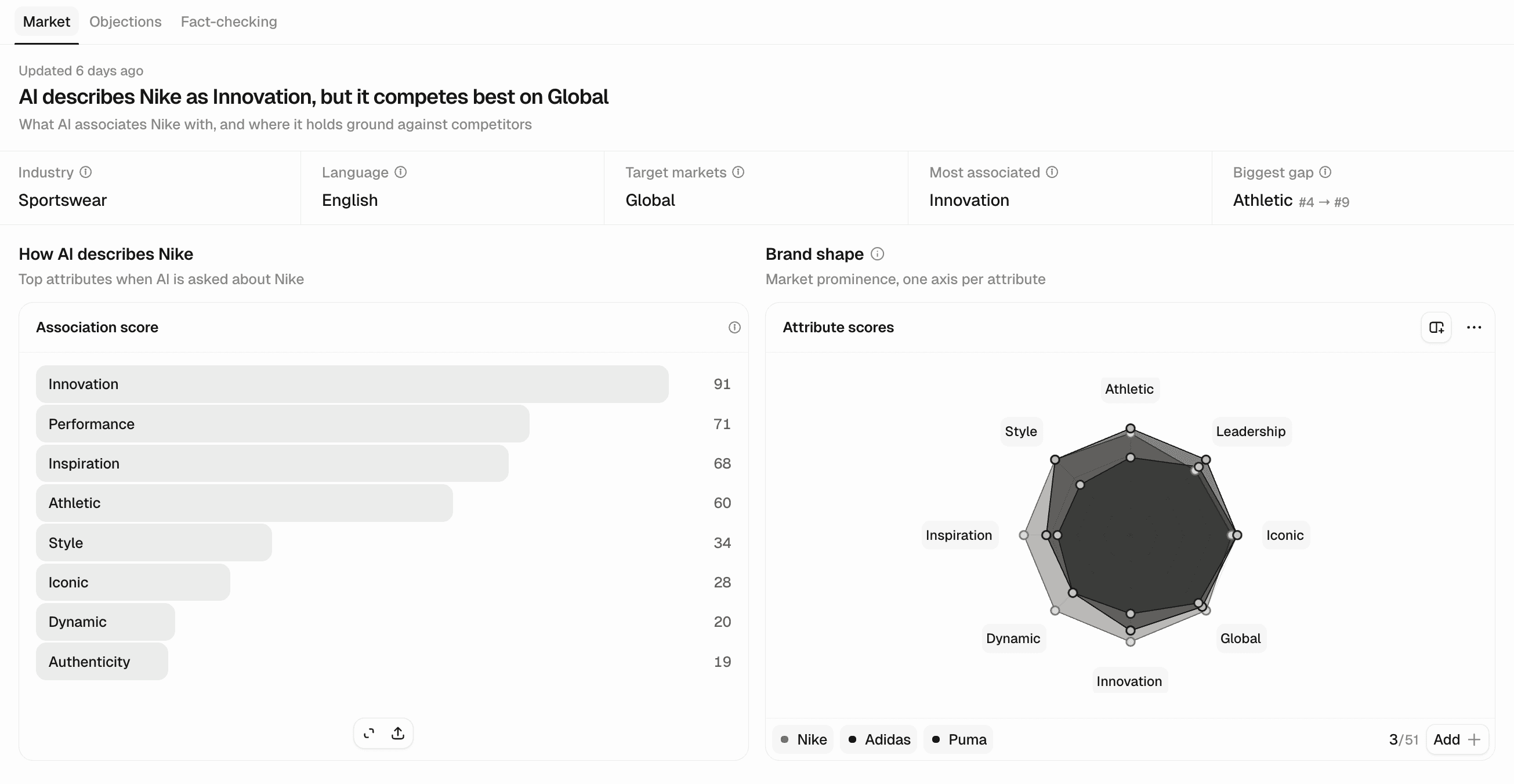
There are two ways to go deeper on the market view. Brand shape plots you against key competitors across up to eight attributes. Brand comparison by attribute is a side-by-side heat map showing which brands lead on each one.
Know what you're known for, and where you're losing
The Market view focuses on the positive attributes associated with you. The less flattering details matter just as much, and they're often more persuasive to potential buyers.
Switch to the Objections tab to see the recurring arguments against you across every model you track. It runs independently of your tracked prompts, so you don't have to think of an objection before Peec can find it.
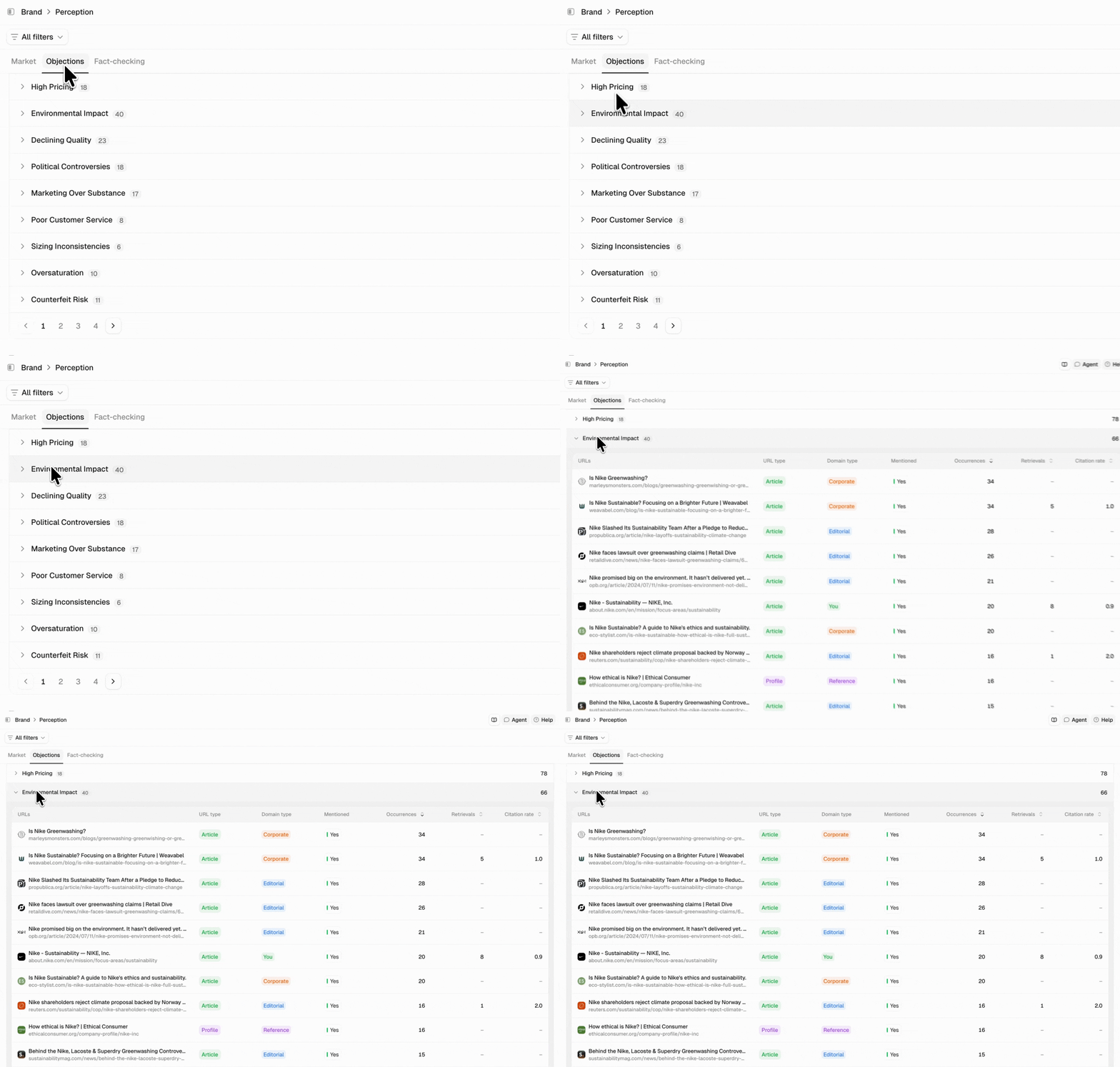
Then open the sources behind each one: a Reddit thread that spun out of control, a listicle from a competitor. Objections sting, but they're often the most actionable feedback on the page. Some are comms problems — narratives for marketing to reshape. Others belong to your product team, and addressing those pays off well beyond this dashboard.
Correct the record at the source
Some of what AI says about you isn't just unflattering. It's wrong.
A price that hasn't been accurate in a year. A feature you shipped months ago that models still say you don't have. And it's rarely limited to one chat; the claim gets repeated to every buyer who asks until someone changes it at the source.
As part of brand perception, we're also introducing fact-checking. It pulls the specific claims AI makes about you and tests each one against the facts you've defined for your brand. A sentence naming your starting price, an integration, and a customer count contains three separate claims, and each can be right or wrong on its own.

Start by setting up your facts. Peec checks every claim against them and returns one of four verdicts:
Contradicted. One of your facts says otherwise. Start here, and check the sources to see where the claim originated.
Supported. Backed by your current facts.
Inconclusive. Related to a fact, but we couldn't settle it.
Not covered. Couldn't be compared to your current facts. Scan this list to decide whether to expand your fact set.
Every claim traces back to the pages the models cited when they made it — including your own, when the source is a page you forgot you had. Large sites carry years-old product pages, stale help articles, and posts from two strategies ago, and AI reads all of it alongside everything else.
Shaping perception is a team effort
AI doesn't distinguish between your marketing strategy, a product review, a journalist's article, a Reddit thread, and a three-year-old page on your own website. It reads across all of them to form an answer.
That means shaping how AI perceives your brand can't belong to one channel or one team.
Every attribute, objection, and claim in brand perception traces back to the sources influencing the model, turning that top-level view into work different teams can act on.
Brand marketing gets an honest read on whether campaigns are influencing the online discourse, and where brand strategy and consumer reality diverge.
PR and comms get the media list: publications to pitch because they drive the industry conversation, or to follow up with to correct the record.
SEO and content get the brief: owned pages to create or update, and creators to consider for future partnerships.
Product gets the feedback: reviews, feature requests, and in some cases the customers making them.
Get started with brand perception
AI has already described your brand to your customers, prospects, and competitors — thousands of times over. You haven't seen most of it.
Go to Brand → Perception. The generated headline states the finding; start there. Then open your top objection and the pages behind it, and use the attributes and heat map as context. Invite the people whose work it touches; your plan includes unlimited seats.
Market view and fact-checking are on every plan, with fact and prompt coverage scaling by tier. Objections is available on Pro and above.
If you're not using Peec AI yet, start a free trial and see how AI describes your brand.