

Today we're launching AI Shopping Analytics. Built for e-commerce brands, it gives you something that didn't exist before: SKU-level visibility into AI shopping. See which products get picked, why AI picks them, and where it sends your buyers – so you can stop guessing and start winning more AI shopping placements.
Why we built this now
AI is where buying decisions are made now. Shoppers turn to ChatGPT asking what to buy, what works best, what's worth the price – and trust its answer more than any search result or sponsored listing.
Conversational product discovery is now a default feature inside ChatGPT. Perplexity, Gemini, Copilot, and Amazon are all building commerce surfaces in parallel. Consumer behavior has already shifted. Brand measurement hasn't caught up.
You know your Google rankings, your conversion rate, which paid campaigns are working. But when a shopper asks ChatGPT what to buy, you have no idea what it says – which products it recommends, where it sends buyers, or whether your visibility is growing or quietly declining. For most e-commerce brands, AI commerce is a complete blind spot.
We built AI Shopping Analytics to change that.
Win more AI shopping placements
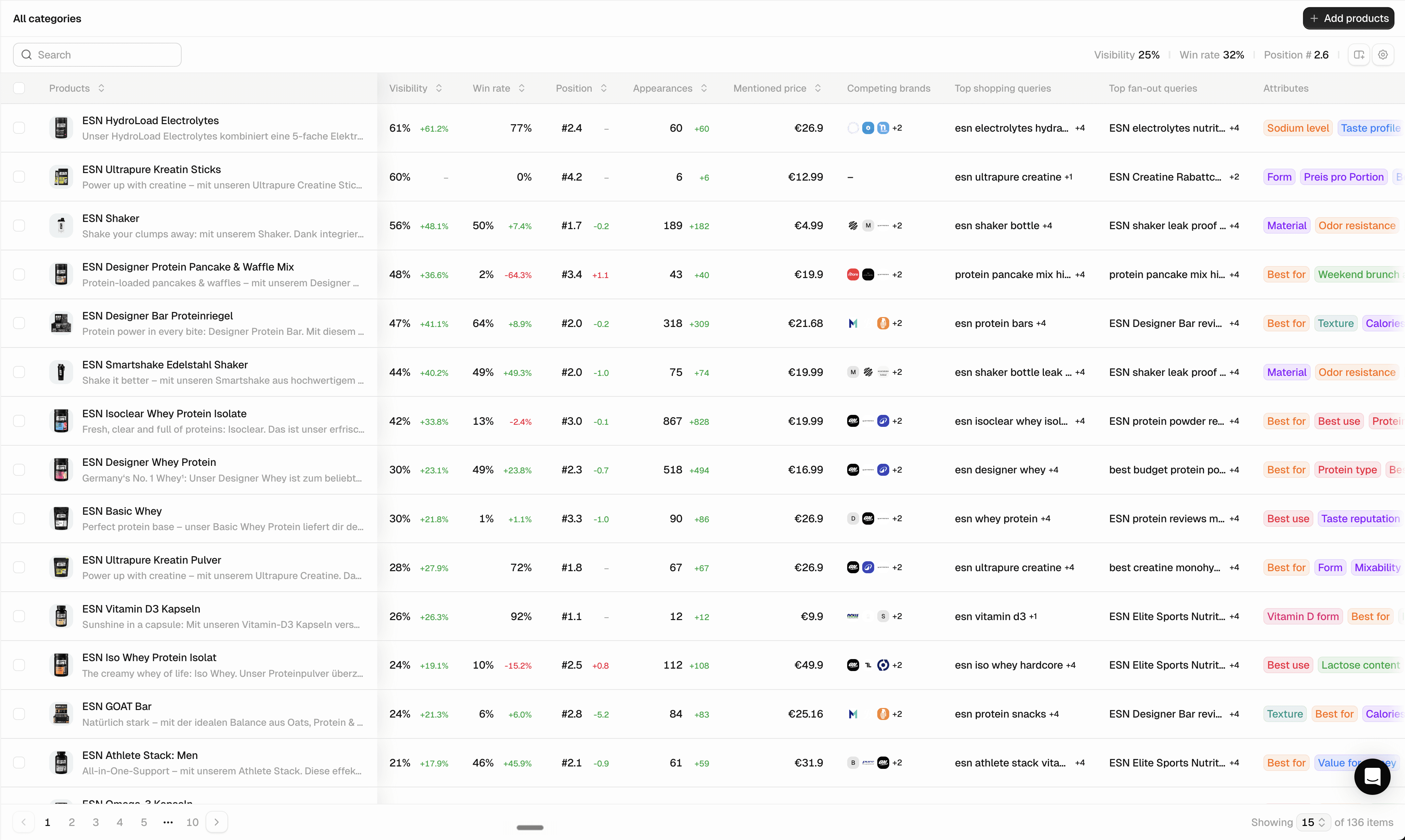
Every product in your catalog as a row. Start with the score:
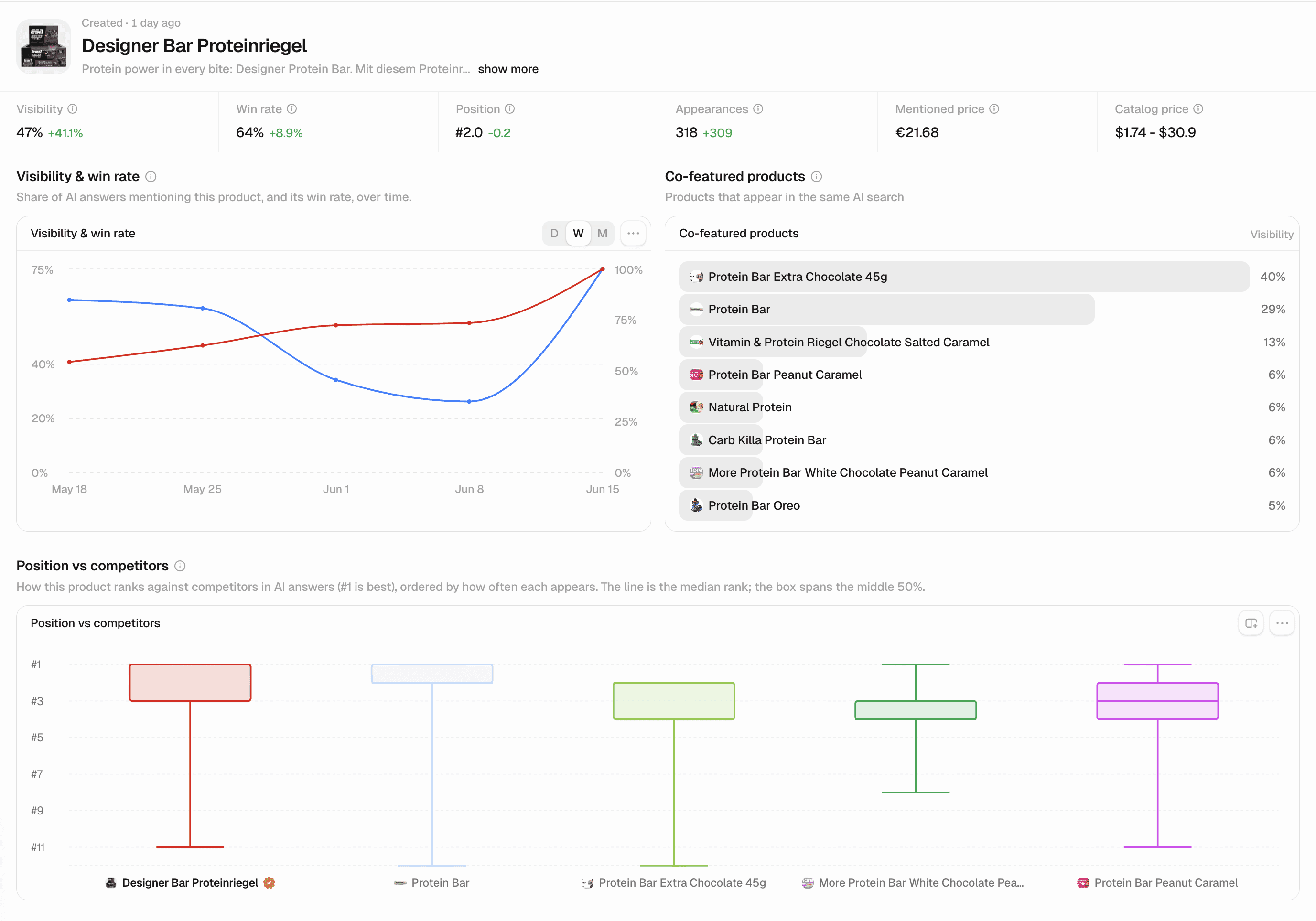
Visibility – the share of AI shopping answers where your product appears
Win rate – the share of those answers where it's the first recommendation
Position – where it ranks when it appears. The first two or three results are what most shoppers see before they scroll
Mentioned price – the price AI quotes for your product, checked against your catalog price. If the engine is citing something stale or inaccurate, you'll see it here
Attributes – the dimensions ChatGPT uses to compare products in your category, ranked by how often each one appears across answers
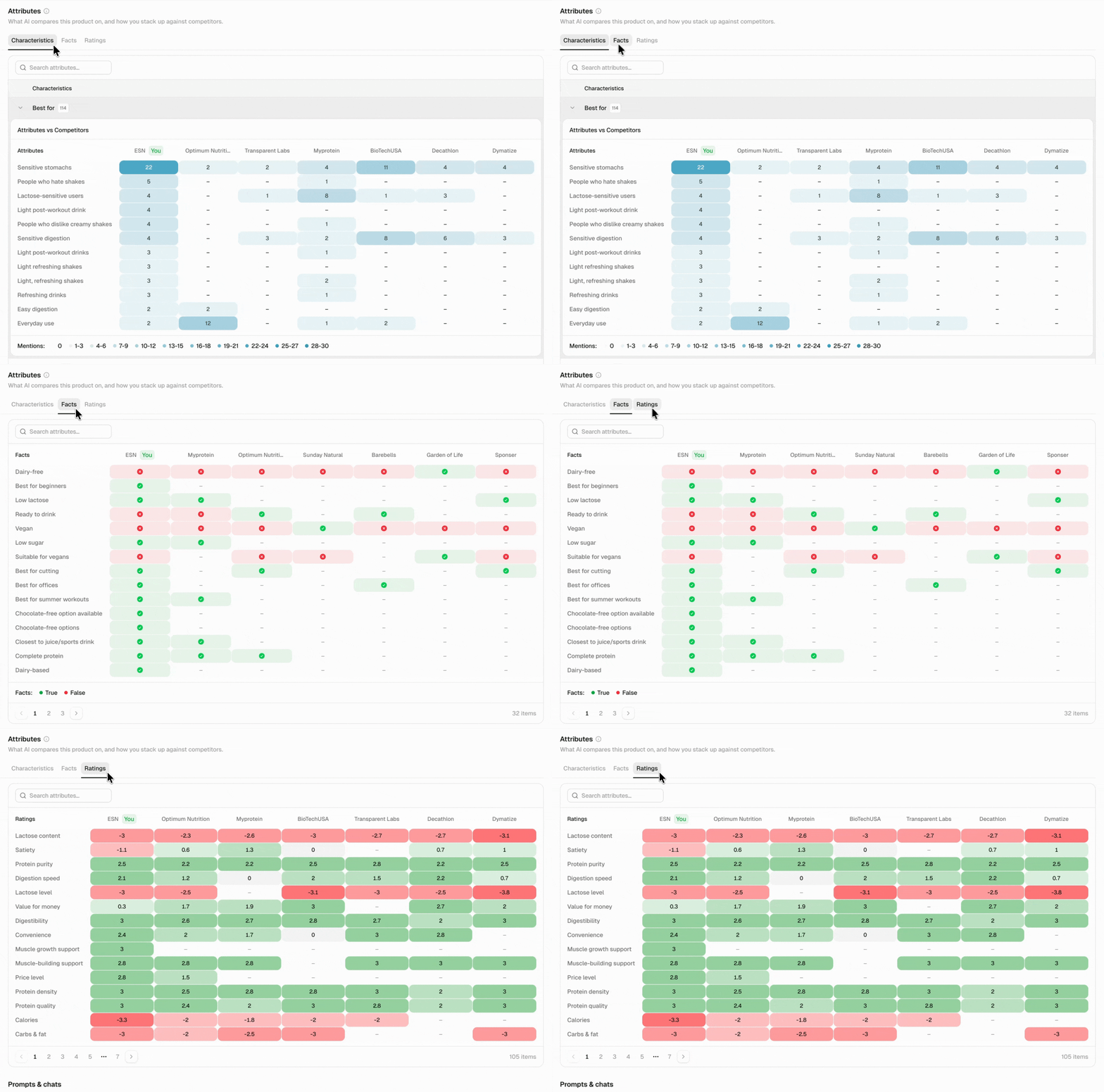
Click into any product and you see the full picture: where AI sends buyers when it recommends your product, how ChatGPT compares you against competitors, and which prompts are driving your placements.
The insights behind your AI shopping metrics:
Where AI sends buyers – your store, a marketplace, a retailer. Winning the recommendation means nothing if you're losing the sale downstream.
Comparison gaps – the dimensions ChatGPT actually weighs in your category and where your product descriptions fall short. The gap between what AI measures and what your PDP says.
Gainers and losers – which products are winning more placements this week and which are quietly bleeding. Know before it compounds.
The right prompts – the queries driving your visibility and the ones you're not showing up for yet.
Know exactly what to fix first
Data that shows you where the opportunity is, paired with actions that tell you what to do about it.
Instead of interpreting raw data yourself, you get a ranked list of product changes that drive more AI shopping placements — grounded in what the engine actually evaluates. Each action is specific, tied to real signal, and prioritized so you know where to start.
Getting started
Three ways to bring your catalog in:
Shopify storefront – paste your store's domain and Peec pulls the catalog directly from your public product feed. Fastest path, no file required.
Peec CSV – a flat, one-product-per-row file in our format. Best for non-Shopify catalogs.
Google Merchant Center feed – your existing product data feed (CSV or JSON). Useful when you already maintain one for Google Shopping.
Your catalog goes live in minutes. Products show up on the Products page organized by category, filterable across the Shopping overview. Your products are matched against the last 30 days of chats, so metrics start filling in with history instead of from zero.
What's coming next
Shopping Actions ship within a month. A ranked list of product changes that drive more AI shopping placements – PDP optimization, fan-out capture, and fact-checking, each grounded in what the engine actually evaluates.
Prompt generation also ships this month. New projects start with AI-generated prompts tuned to your catalog – no manual setup required.
API and MCP access follows shortly after. Connect to Claude, n8n, and any tool in your stack. Build custom workflows with your AI shopping data.
The bigger picture
We built Peec to help brands understand how AI talks about them. AI Shopping Analytics extends that to the product level – into the specific context where purchase decisions happen.
The infrastructure for what comes next is being built right now. Shopify and Google published the Universal Commerce Protocol – a standard for how AI agents discover, negotiate with, and transact against merchants. Google I/O added Universal Cart and agent payments on top. Stripe shipped the payments rail behind it. The pipes for agentic commerce are being laid in front of us.
Brands that don't have visibility into how their catalog performs in AI today will be flying blind when agents start transacting on shoppers' behalf.
The window where you can shape your position in AI shopping rather than react to it is open. That's why we built this now.
If you're already on Peec, AI Shopping Analytics is available now. Go to Shopping → Products to connect your catalog.
If you're not using Peec yet, start a free trial and see where your products stand.