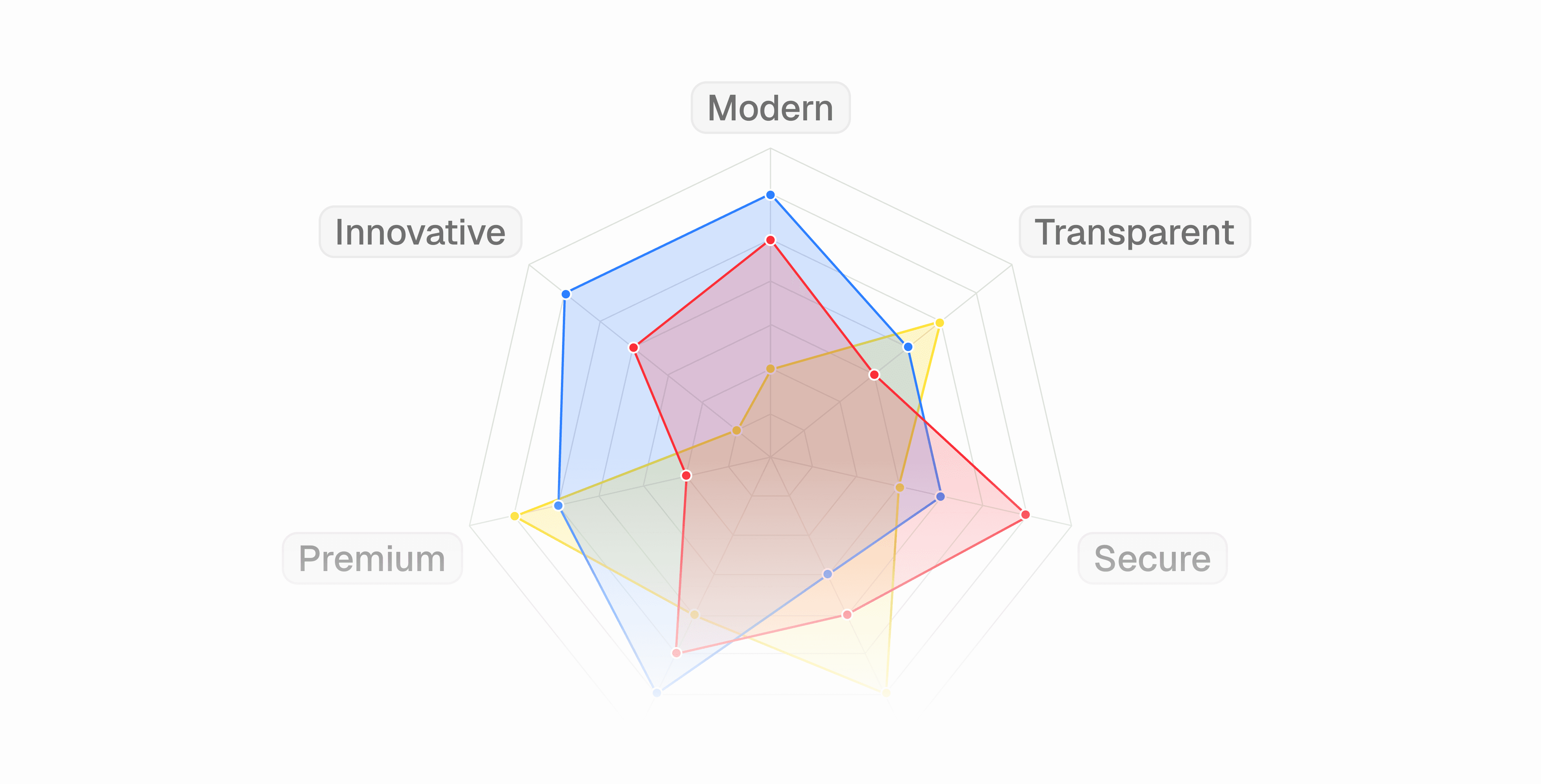

You might assume that AI assistants describe your company objectively. They search for information online, summarize what they find, and give the best possible answer.
But that is not always what happens.
Across AI models from all major providers, I found that the words in a company’s brand name can influence how the company is described. The effect is strongest when the model knows little about the business because when information is scarce, the name itself starts filling in the gaps.
Usually the influence is small. But on the newest model I tested (GPT 5.6 Terra), one in twelve descriptions ignored the company and described the name instead.
The approach
I asked several AI models (ChatGPT, Gemini, Google AI Overview, Google AI Mode, and Microsoft Copilot) to describe a company using ten attributes. I then measured how positive or negative each attribute is perceived by humans.
For this, I used a dataset of roughly 14,000 English words rated by human participants on a scale from 1 representing negative, 5 — neutral, and 9 — positive. The dataset was published by Warriner et al. in 2013 in Behavior Research Methods and is widely used in psycholinguistics to measure the emotional valence of words.
For example, "reliable” is rated positively at 7.30 out of 9, while "deceptive” is rated negatively at 3.73.
Act 1: In the wild
I asked ChatGPT, Gemini, Google AI Overview, Google AI Mode, and Microsoft Copilot to describe 904 real brands whose names are a single English word, then scored the attributes they used on the human-rated scale.
So are brands with more positive-sounding names described more positively? Yes, they are. Across all models, a company whose name scores one point higher is described 0.07 points more positively.
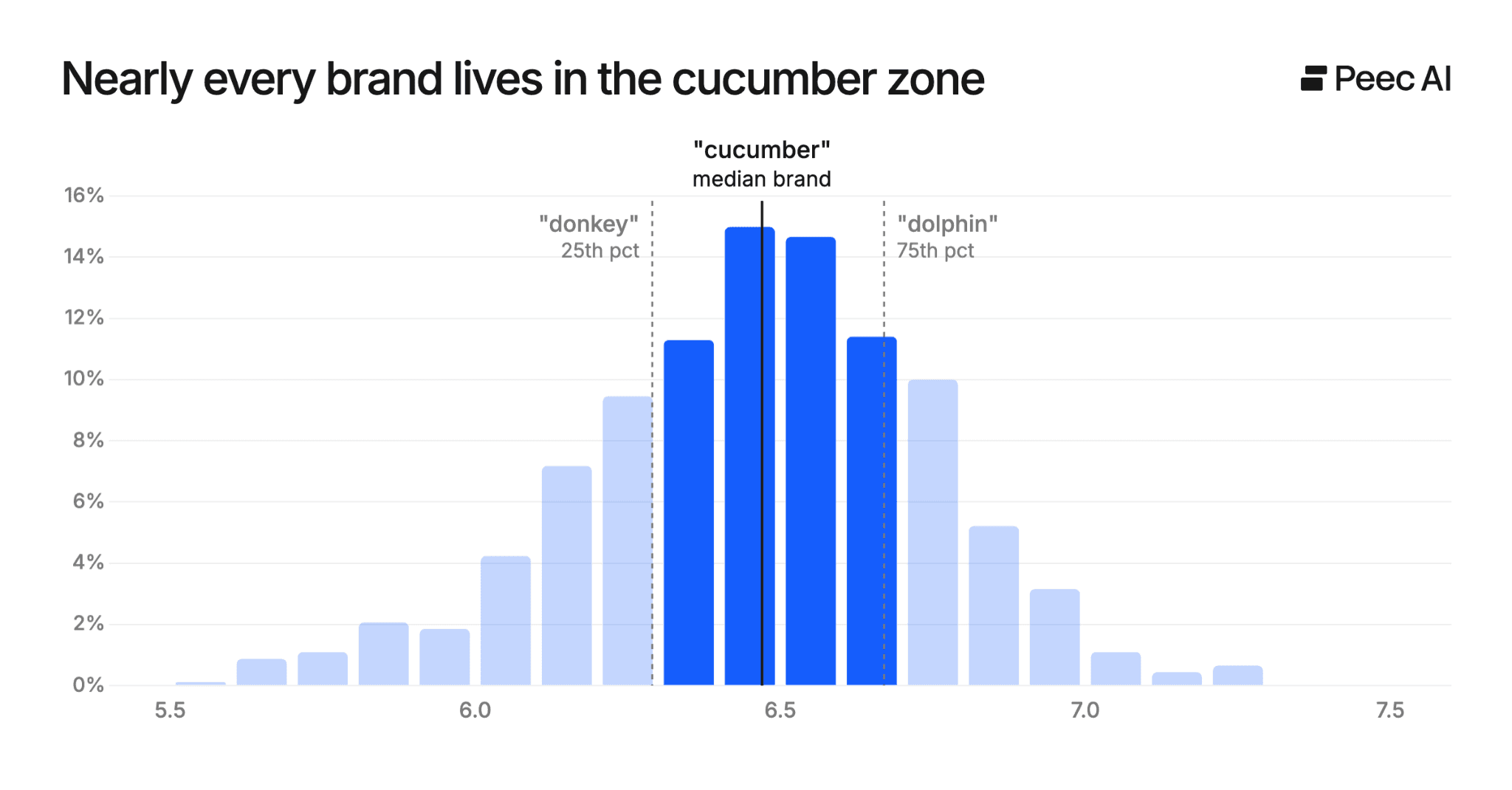
Nearly every brand sits well above neutral. The median brand scores 6.47/9, the same score human raters gave "cucumber." The middle 50% of brands fit inside a tight 0.38-point range, roughly the difference between "donkey" (6.29/9) and "dolphin" (6.67/9).
Because the range is so tight, a name swap covers most of it. Call a company founded today The Boring Company ("boring" 2.7/9, sorry Elon) and it sits nearer the donkey. But call it The Fantastic Company ("fantastic" 8.36/9) instead and you reach the dolphin.
I controlled for external factors including sector, model, and founding decade (older companies are described more neutrally than the latest YC batch). The relationship survived all of them.
It is still correlational data, though. Maybe positively-named companies act according to their name. To find out whether the name itself caused the effect, I moved the experiment into the lab.
Act 2: In the lab
I used the same ten-attribute approach per brand, but this time with web search switched off, and measured across four models: Google's Gemma 4 31B, Google Gemini 3.5 Flash, DeepSeek v4 Pro, and OpenAI's GPT 5.6 Terra.
The unit is a pair of fictional brand names, each based on a single English word. Within each pair, the two names are matched on length, syllables, word frequency, emotional intensity, and how powerful the word feels. One is a positive word, the other a negative one. That is the only difference between them.
I built 80 such pairs and wrote four short descriptions containing only neutral facts. Every name was run against all four descriptions, which gives 640 randomized samples per model, scored on the same 1 to 9 scale. Each run showed the AI model one name and one description, and nothing else.
Each dot is how much better the same company was described under the nicer name. The bar is the 95% confidence interval.
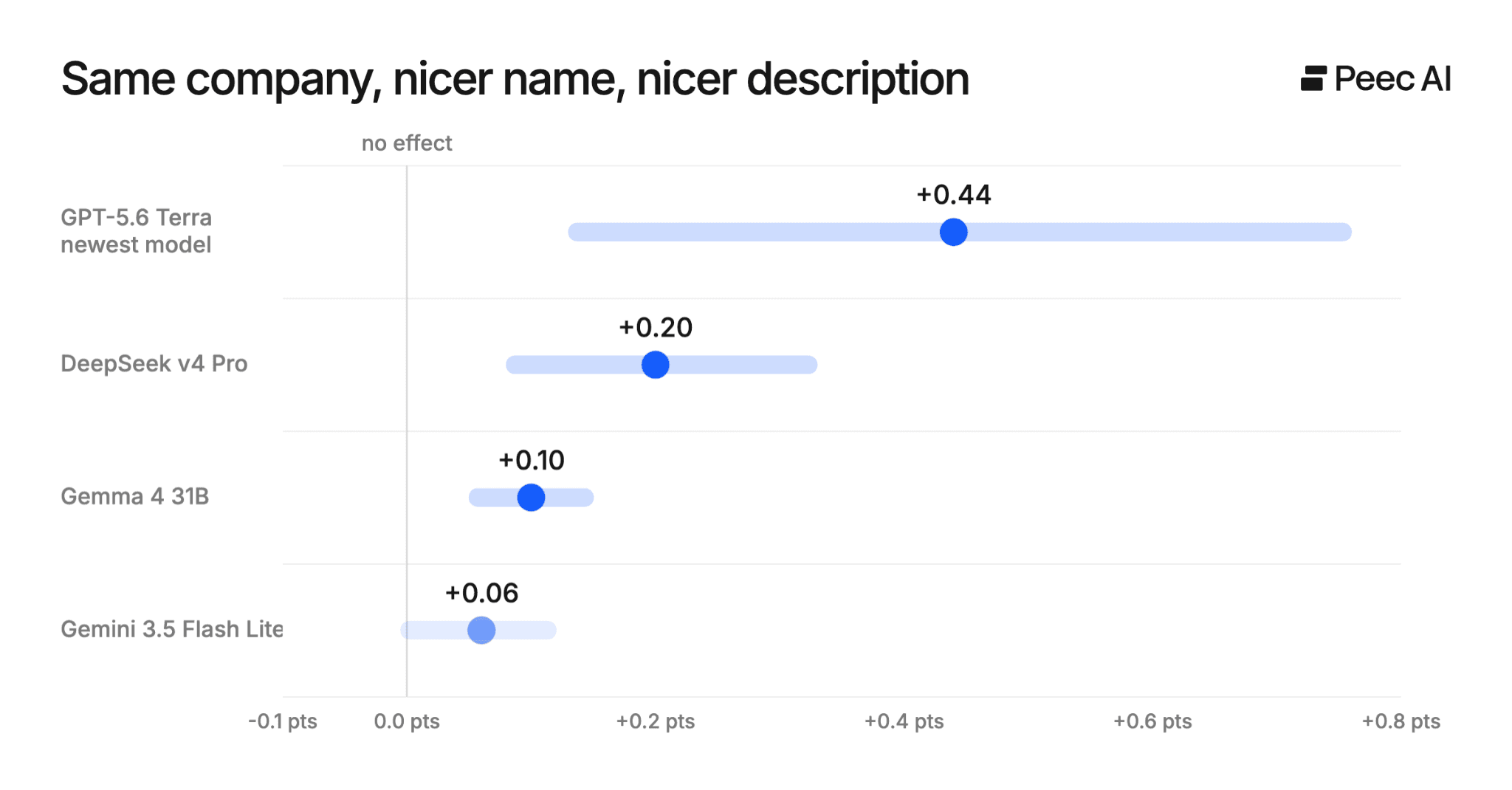
The effect holds across nearly every AI model, with only Gemini's estimate falling short of significance. And there is no sign it fades with newer generations. Terra, the newest model in my set, showed the largest effect, roughly four times Gemma's. Four models are only an indication, but they point the wrong way for anyone hoping the effect disappears as models get better.
On Terra, The Fantastic Company would sit at the 85th percentile of all brands. The Boring Company at the 17th.
The name is doing the work, not the company. And the newest model in the set was the most susceptible of the four.
Act 3: The potential risk
On average the effect is only a nudge. At the extremes it is not.
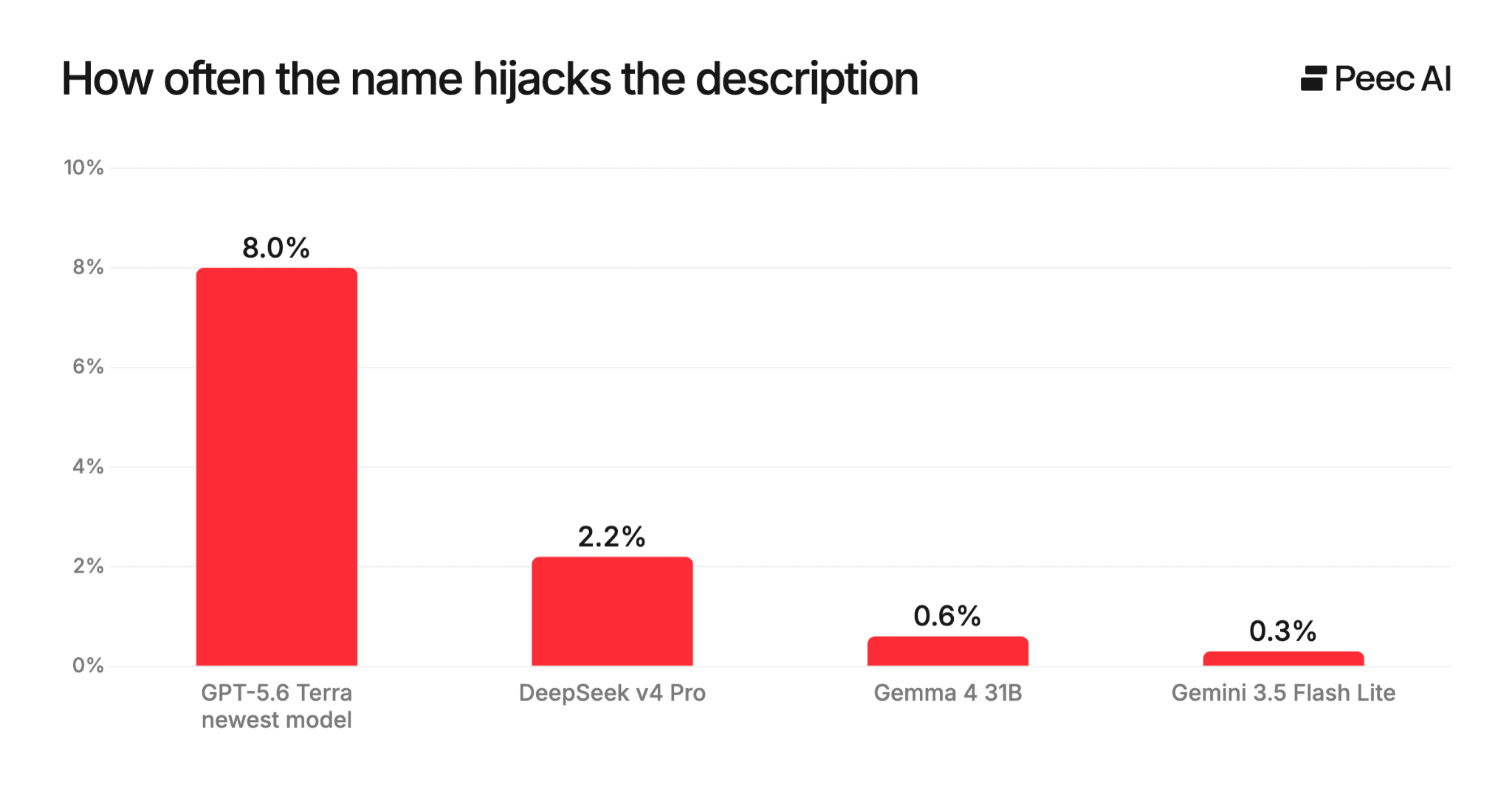
Sometimes the models skipped the company facts entirely and described the dictionary meaning of the name instead. My fictional Winnipeg payroll software company, Unethical Inc., came back from two models as "Dishonest, Corrupt, Deceptive." A perfectly ordinary document storage company named Merciless Inc. got "Merciless, Ruthless, Cutthroat, Relentless."
I call this semantic takeover.
The effect has two layers: a small, persistent "nice name, nice vibes" baseline, and a rare failure mode where the model describes the word instead of the company. On Terra that happened in one description out of twelve.
The catch
In the live data, well-known companies whose names double as negative English words were described just like any other brand with a neutral name.
"Discord" scores 3.58 on the human scale, "riot" 3.15 and "slack" 3.85, but no AI assistant tells you that Discord is quarrelsome, that Riot Games is a public disturbance, or that Slack is loose and lazy.
Real brands sit all over the scale, from Poison, the Dior fragrance, at 2.16 up to Joy at 8.21. What they share is that the assistants describe the company, not the word.
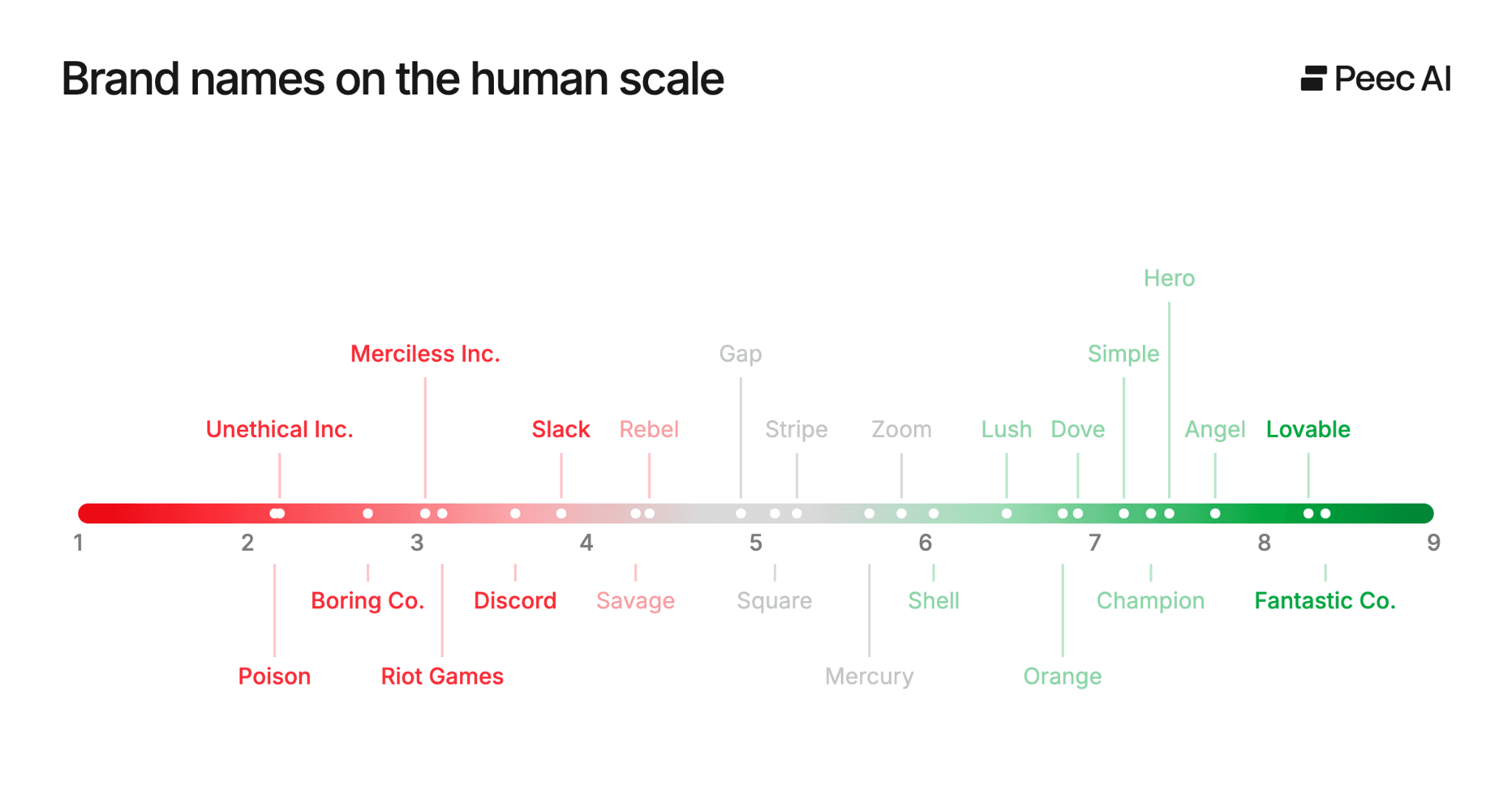
The effect shows up only on brands the models don't recognize. The moment a brand is known, it disappears.
My interpretation is that web retrieval finds less information to anchor the description, so the name fills the gap. The lab was that condition at its extreme, nothing to retrieve at all, and that is where the effect was biggest.
The takeaway
If you are naming a new brand, learn from Lovable ("lovable" 8.26/9). Until the models know who you are, your name is just vocabulary, and if that vocabulary is a loaded English word, occasionally the vocabulary wins. And if your name doubles as an English word, check whether they are describing your company or your name.
If your brand already exists, renaming won’t help. What fixes it is getting known. The moment the models know the company behind the word, the word stops mattering.
Either way, the first step is finding out how the AI assistants describe you today. Everything in this article outside the lab comes from Brand Perception, a new feature in Peec AI that shows you the attributes the assistants use for your company and for your competitors.
Methods for the curious: attribute valence scored against Warriner et al. 2013 in both studies, using rank-weighted attribute valence as the outcome. Observational week across five assistants, 904 clean-sample brands; effects estimated by OLS with brand-clustered errors, checked with double machine learning. Controlled study with 80 matched high/low valence name pairs, 4 name-free descriptions, randomized assignment, exact-echo stripping; effect estimated as word score ~ name condition with fixed effects for name pair and company description, standard errors clustered by pair plus a 1,000-run pair bootstrap, preregistered parse and coverage gates.