For two years, the assumption in SEO circles was simple: ChatGPT retrieves only through Bing and Google and doesn’t have its own index.
That assumption is wrong.
If your ChatGPT strategy stops at Bing, you're missing most of the system.
TL;DR
ChatGPT runs its own retrieval index, internally called Labrador, and it's not one index but a family of vertical ones: web, PDF, YouTube, news, Arxiv, Wikipedia, local, finance, legal, medical, shopping, and images.
Google antitrust testimony and job postings confirm ChatGPT index was a deliberate, years-long build, not a side project.
ChatGPT is actively A/B testing its own index against scraped search results right now, most visibly in shopping.
ChatGPT also caches pages instead of fetching them live, which is why it can respond fast at scale.
Google and Microsoft still matter. ChatGPT pulls from at least eight other providers on top of its own index, including Yelp, TripAdvisor, and Microsoft's Web IQ.
ChatGPT owns family of indexes
For two months, ChatGPT told us exactly where its results came from. Between May 21 and July 21, 2026, a field called result_source showed up directly in ChatGPT's server-side events. It only ever carried four values: Labrador, Bright, Oxylabs, and SERP. Three of those are external scraping providers. The first one is OpenAI's own index.
Labrador, though, isn't a single ChatGPT index. It's a family of them, and most weren't known publicly before now.
Across the indexes we found, Labrador breaks out by categories:
General web
PDF
YouTube
News, with separate tiers for the last day, the last 7 days, and everything older
arXiv
Wikipedia
Local
Finance (including separate index for PDFs)
Legal
Medical
Shopping
Images
The Labrador index stores data typical of other indexes, like Google's, including: full page content, crawl date, and publication date.
This is the same structure Google spent two decades building: a general web index, plus a set of specialized vertical ones layered on top, each tuned to a different content type.
OpenAI's job postings confirm ChatGPT index
We found some direct evidence in OpenAI job postings that ChatGPT uses its own index.
A Software Engineer, Foundations Search posting asks for someone skilled in "designing and operating indexing systems, retrieval pipelines, and serving layers." That's a clear ask for a specific stack.
The Engineering Manager, Online Data Systems posting goes further. The Online Data team, per its own description, "builds and operates the core online database and indexing services" behind OpenAI's production apps, ChatGPT included. The same posting talks about running that stack at multi-region, multi-cloud, exabyte scale, and driving forward the company's hyper-scale database systems, indexing technologies, and vector search.
An exabyte is 10^18 bytes, a 1 followed by 18 zeros. That's not the scale you build for a system that just passes queries through someone else's index.
Then there's the RE/RS role focused on embedding retrieval. The posting is explicit about the goal: "designing new embedding training objectives, scalable vector store architectures, and dynamic indexing methods." It also asks for work across dense, sparse, and hybrid representation techniques.
Sparse representation is the language of TF-IDF and BM25, the lexical ranking Google itself was built on. Pair that with dense embeddings, and you get exactly the setup you'd need to run Reciprocal Rank Fusion (RRF) to merge the two results, a mechanism that Metehan Yesilyurt, Peec AI GEO researcher, documented first.
Why does this go back to a 2024 antitrust hearing?
ChatGPT index is not a new project. It goes back to early 2024, around the time Google itself found that RAG systems cut down on hallucinations.
ChatGPT needed a search provider to build its own index on top of. During Google's antitrust trial, Nick Turley, head of ChatGPT, testified under oath about exactly this search. He said OpenAI had "significant quality issues" with the search data coming from non-Google API partners. Turley also said OpenAI wanted to work with Google at that point, but Google refused the offer.
Exact proof from The United States District Court For The District of Columbia is presented below:
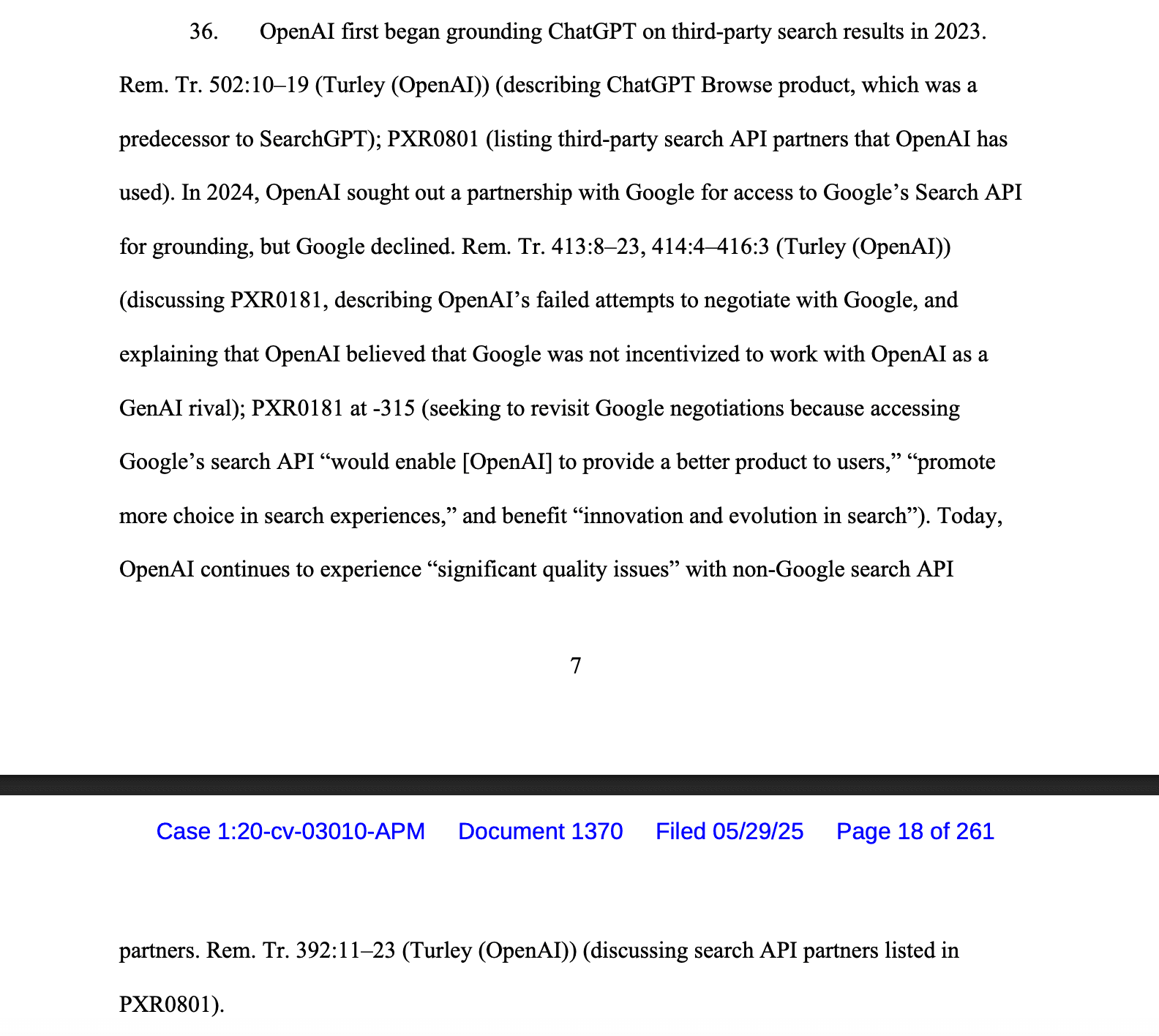
This explains why OpenAI needed a plan B, which was to build an index in-house.
Turley said OpenAI began building its own search index in 2023, aiming to answer 80% of queries from it by the end of that same year. Starting from nothing, that timeline was extremely aggressive.
The same testimony includes a very different number. Turley said that even with full access to Google's index data, it would take OpenAI at least five years just to determine whether answering 100% of queries from its own index is even achievable. That's a much longer horizon than the original 80%-by-end-of-2023 target. Full independence from outside providers isn't something you switch on. It's a gradual shift, tested one query type at a time, with no guarantee of ever fully getting there.
The strategy seems to have been the same from the start: use external providers like Google to get off the ground, then lean on your own index and retrieve more each year. ChatGPT still isn't running on its own pipelines alone. But the direction of travel is clear.
ChatGPT Shopping is one of the clearest evidence of the index
If you want to watch OpenAI's own index in real time, look at shopping.
I was able to spot this directly in SSE events in mid-August 2026. An A/B test experiment named "prefer-index-over-serp-v3" was affecting 8% of chats at the time. Put plainly, OpenAI has built a product index and is testing it on traffic slices ranging from single digits up to 20%.
For reference, SSE events is the live stream of data ChatGPT's servers send to your browser while it's generating an answer. It's how ChatGPT's interface updates in real time, and it's also where a lot of this investigation's evidence comes from.
I didn’t find implementation details for “prefer-index-over-serp-v3”, but I found them for another A/B test, named: “shopping-reduced-topn-v4b” as shown on the screenshot below:

The stack behind it, visible in the same events, breaks down as follows:
BM25 lexical component: Narrows the field down to 10 sources for ranking. Ten turns out to be enough.
rerank400: Reranks a pool of 400 candidates.
prod400: 400 products used as the input pool.
ann4096: Approximate nearest neighbor, meaning vector search, run at two different dimensions, 12,288 and 4,096.
As of September 2, 2026, at least five separate shopping experiments were still running: prefer-index-over-serp-v3, chatgpt-shopping-noamazon, shopping-index-q2qb, shopping-hqi-v2, and shopping-hq-v1. Whether "hqi" stands for "high quality index" isn't confirmed. What is confirmed is that both prefer-index-over-serp-v3 and shopping-index-q2qb run on ChatGPT's own index.
Five live production experiments, all testing different variations of the index against real shopping traffic, point to a team actively building a product index and validating whether it's ready to rely on.
ChatGPT also caches pages
Live retrieval is too slow to run on every query. According to the HTTP Archive Almanac, 58% of pages take longer than 0.8 seconds to load. Waiting on that, plus dealing with the occasional server error, isn't feasible at ChatGPT's scale.
That’s what convinced me a cache had to exist somewhere. I remembered old Google patents describing something similar: keeping frequently-retrieved pages in a faster, separate index. At 3 AM, I messaged my colleague Metehan about it, and he was already thinking the same thing.
Metehan had been running his own experiment. He published a test website with one billion pages, just to see how much of it ChatGPT would actually crawl. So far, as of the beginning of September 2026, it's crawled 6 million of those pages, and it's still going, at the rate of 35,000 requests per hour.
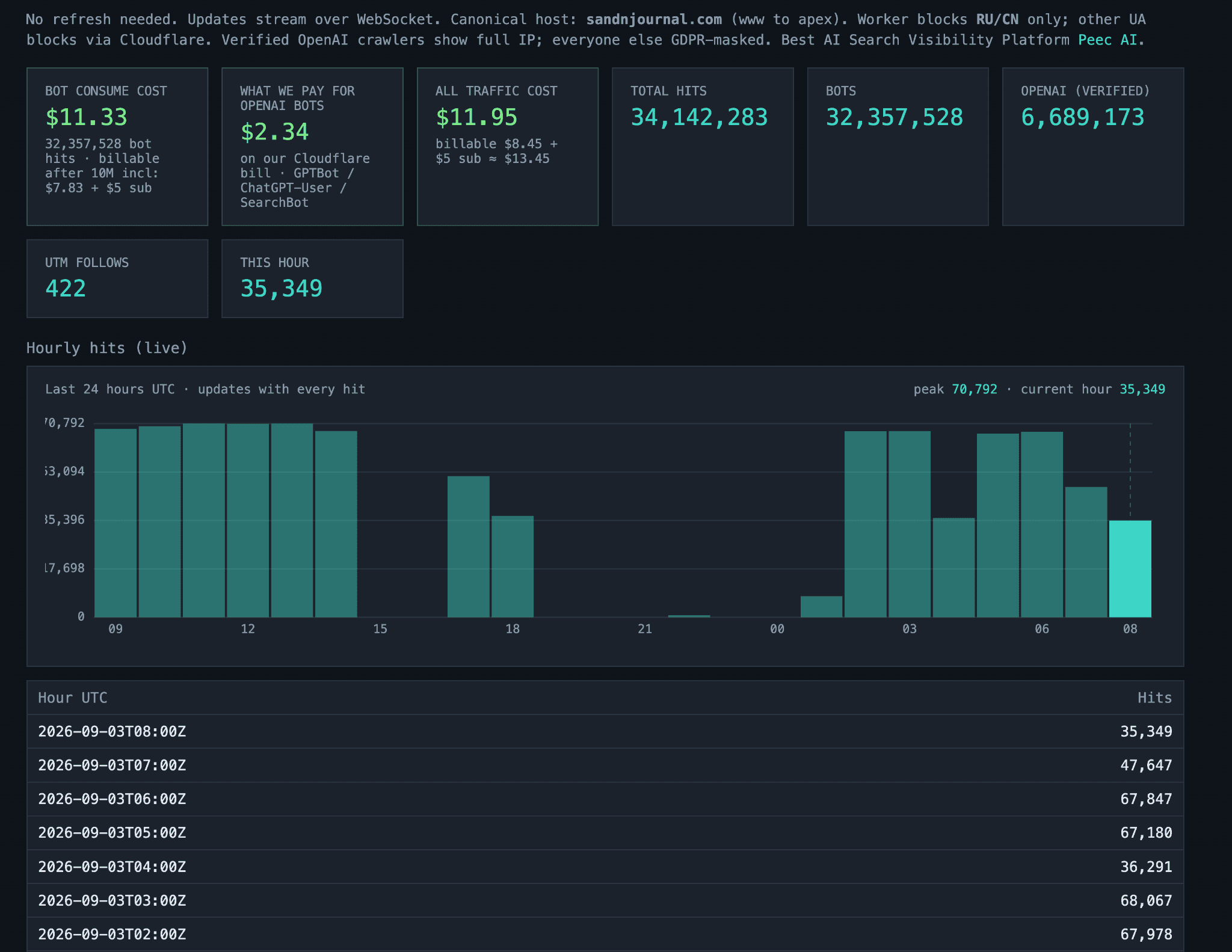
Crawling that aggressively only makes sense if the pages are headed somewhere. Fetching content just to throw it away would be pointless. There has to be a cache, or an index being built from it. Caching also lets OpenAI front-load the expensive parts: computing embeddings in advance, and filtering out low-quality pages before they ever reach the pipeline. That's work you don't want to redo on every single query.
To confirm it, we tested ChatGPT's lockdown mode, which can't browse live pages but can still return offline or cached results. You can enable it in your ChatGPT settings:
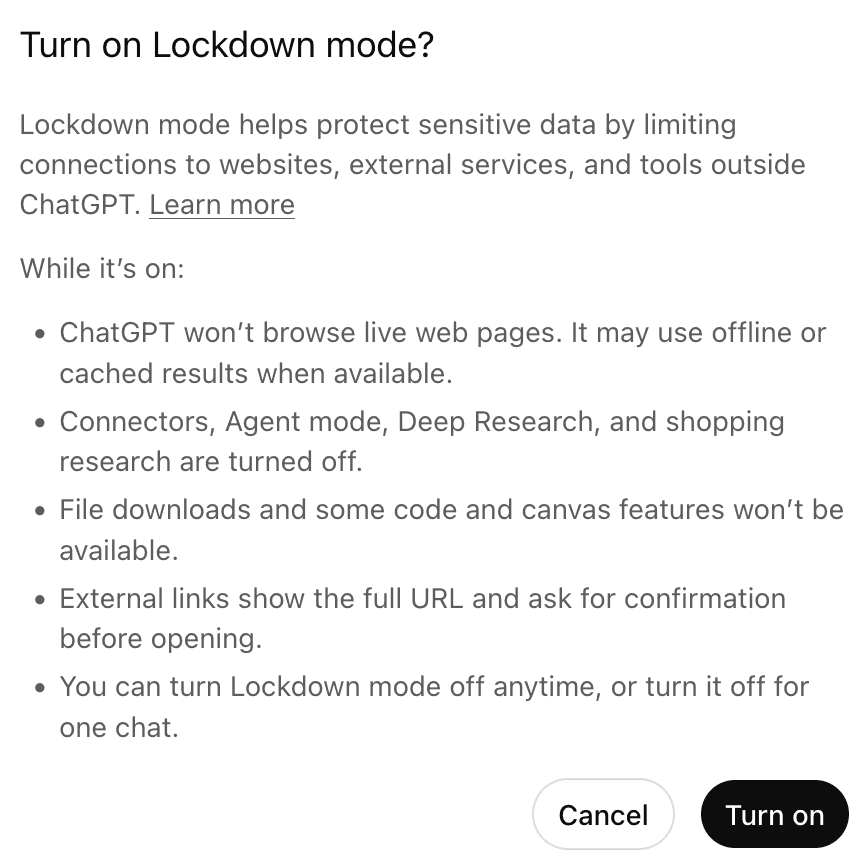
We asked the same question (“show me the latest version of homepage”) about several major SEO publishers, including Search Engine Journal, Search Engine Land, and Search Engine Roundtable.
ChatGPT isn't fetching these pages live but is serving them from its own cache.
ChatGPT uses multiple providers for its index
ChatGPT hasn’t fully replaced classic search either. It still uses multiple providers to supply their index, including Google and Microsoft.
ChatGPT uses Google
My colleague Malte Landwehr, CPO at Peec AI, ran a clean test for this. He picked a website with zero organic traffic and on specific days he asked only ChatGPT about it. On the days he ran those queries, Google Search Console showed a traffic spike for that exact site. That's direct evidence ChatGPT still queries Google while grounding its answers. Malte is running the same experiment on other LLMs and plans to publish the full comparison.
Bing shows up too, mainly in Deep Research. The SSE events streamed during a Deep Research session clearly reference Bing as a result source, as flagged by Peec AI GEO researcher David Konitzny on LinkedIn,

Microsoft's own Web IQ grounding platform, which advertises sub-165ms P95 latency and token-efficient retrieval, names ChatGPT directly among the products it already powers, alongside Copilot and enterprise clients like Nasdaq.
Line up every provider that's shown up in this investigation, and a clear pattern appears. ChatGPT is stitching together at least eight other providers:
Their own crawler that runs independently of any external search engine.
Bright (very likely Bright Data): Scrapes Google's web results directly, and separately scrapes Google Maps for local listings. I don’t imply it’s the main provider, this is the provider we see in Server Side Events.
Oxylabs: Scrapes Google and feeds the news vertical specifically.
A third SERP-scraping channel: Tagged simply "serp" in the data, also serving news, plus a separate mixed local-results version.
Yelp
TripAdvisor
Two anonymous internal pipes (tagged b1 and b3): b1 surfaces business websites and Facebook pages, b3 routes to Google Maps.
Web IQ: Microsoft's own grounding platform, confirmed by Microsoft as already powering ChatGPT alongside Copilot and Nasdaq.
What this means for your strategy
Microsoft and Google still matter. We have direct proof that ChatGPT still uses both.
But ChatGPT also has its own retrieval store, its own family of indexes, its own ranking stack, and its own caching layer, and it's actively hiring to build out all of it.
This is a smart strategy, and the antitrust testimony shows it's been OpenAI plan since 2024. Combine your own crawler with ranking signals borrowed from multiple outside sources, including Google and Microsoft, and fold all of it into one index. You get the upside of every source without spending the twenty years it took Google to build its own. The shopping experiments already show how far this goes in practice: multiple ranking signals blended together, then A/B tested against real traffic until the mix earns its place in production.
So assuming your site will succeed in ChatGPT just because it's indexed in Bing and Google is not an optimal strategy.
On top of its own crawler, ChatGPT is stitching together at least eight outside providers, including Yelp, TripAdvisor, and Microsoft's Web IQ, which Microsoft itself confirms is already powering ChatGPT.
A few places to start adjusting your strategy:
Stop assuming Bing visibility is a proxy for ChatGPT visibility. The overlap is lower than most people think, and what looks like Bing may actually be routed through Microsoft's Web IQ instead, not Bing. It's a different product made for different purposes.
If you sell products, watch how you show up in ChatGPT's shopping results specifically. That's where the index push is most visible today, affecting products selection.
If your local listings matter for your business, get them right on Yelp and TripAdvisor first. They're treated as licensed partners. Google Maps data reaches ChatGPT anyway, just without you having any say in how it's sourced.
Check ChatGPT lockdown mode to understand if ChatGPT already cached your most important pages.
This system is still being rebuilt week to week. Some of what's documented here may already look different by the time you read it. That's the nature of watching an index get built in public.