
Nearly half of shoppers now use AI at the top of the funnel to discover products. Around two-thirds use it in the middle of the funnel to compare brands, models, prices, and reviews. And they trust what the model says – often more than any search result or sponsored listing.
So the question for every brand is suddenly very concrete: when the model makes its recommendation, are your products in it? Most brands have no idea. That's what this session set out to fix.
Malte Landwehr (CMO & CPO) walked through what ChatGPT shopping actually is under the hood, based on our research team's work. Niklas Springer (Head of Product) then launched AI Shopping Analytics – a new product that measures, per individual product, how you show up in AI shopping. Here's the full rundown, including the sharpest questions from the live Q&A.
What ChatGPT shopping looks like today
Ask ChatGPT a shopping question and you'll almost always get one of two layouts: a product comparison table or a product carousel you can swipe through.
The table is the richer one. It shows products, prices, an indication that multiple merchants carry the item, a price range, product attributes, and star ratings. Click into any product and you get aggregated user ratings, named merchants with prices, and sometimes delivery time and stock status. The carousel is similar but thinner – no product attributes, no attribute-based rating.
Two things stood out when we tested across countries:
Some categories are global. Ask for skincare in almost any country and you get roughly the same set of brands.
Some are hyper-local. Ask what to wear as a wedding guest and the recommendations change by country – traditional dresses in Austria, more elegant ones in Sweden, colourful ones in Spain, and something close to the opposite in the US.
Which raises the obvious question: how does ChatGPT know any of this?
ChatGPT shopping runs on Google Shopping
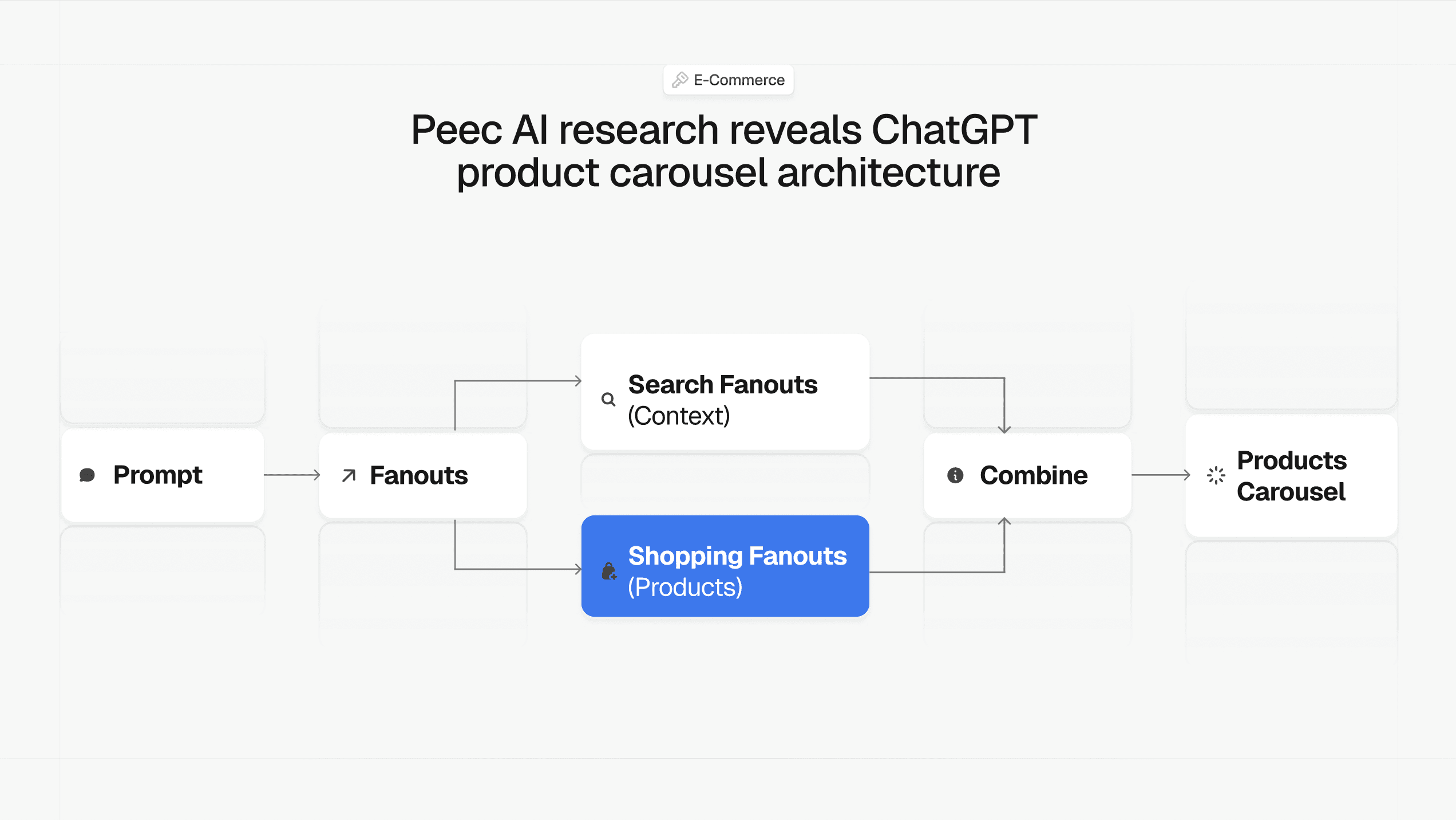
The product data in ChatGPT shopping is scraped from organic Google Shopping – in real time, via a third-party scraping provider, and against Google's wishes.
We confirmed it with independent AI researcher Tom Wells. In the data streamed between ChatGPT's server and your browser, there's a small Base64-encoded payload. Decode it and you find attributes that anyone who's touched Google Merchant Center will recognise – image doc ID, headline offer doc ID, GPC ID, catalog ID – plus the URL parameters you'd use to pull Google results for a specific country or region. Stitch them together and you can reconstruct the exact Google Shopping URL used to fetch the data.
Three things worth committing to memory:
The top ~40 organic products in Google Shopping explain everything you see in ChatGPT – the products, prices, availability, and aggregated ratings. The same isn't true for Bing. It's Google Shopping.
Re-ranking happens. Position one in Google Shopping is not necessarily position one in ChatGPT. Products get skipped and reordered, likely based on context the model pulls from its other searches.
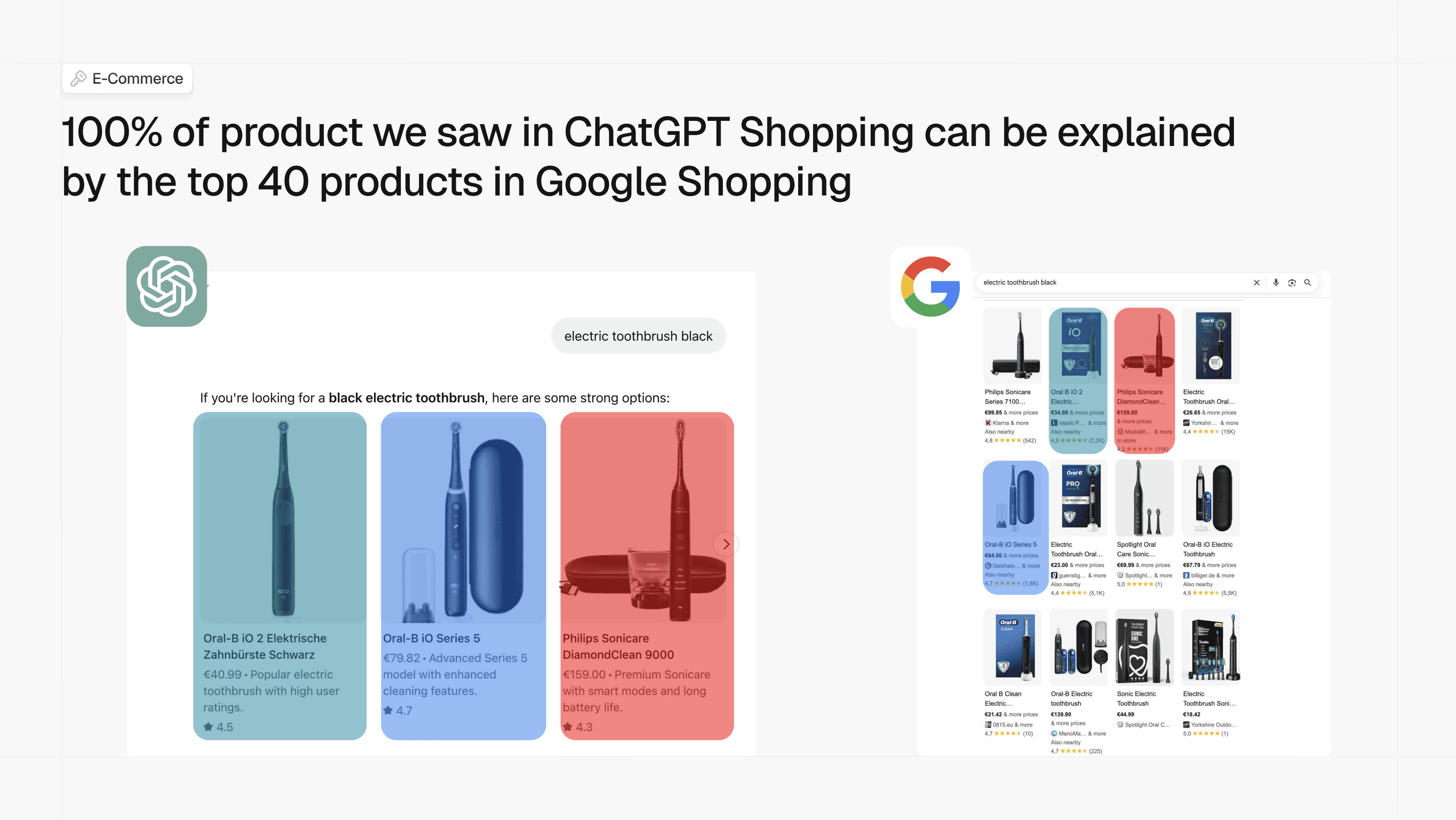
There are separate shopping fan-out queries, distinct from the regular search fan-outs, going to a separate service. Both get combined before you see a result.
The practical upside: because the system leans on Google Shopping, the optimisation you do there carries straight over.
Shopping fan-outs are where the signal is
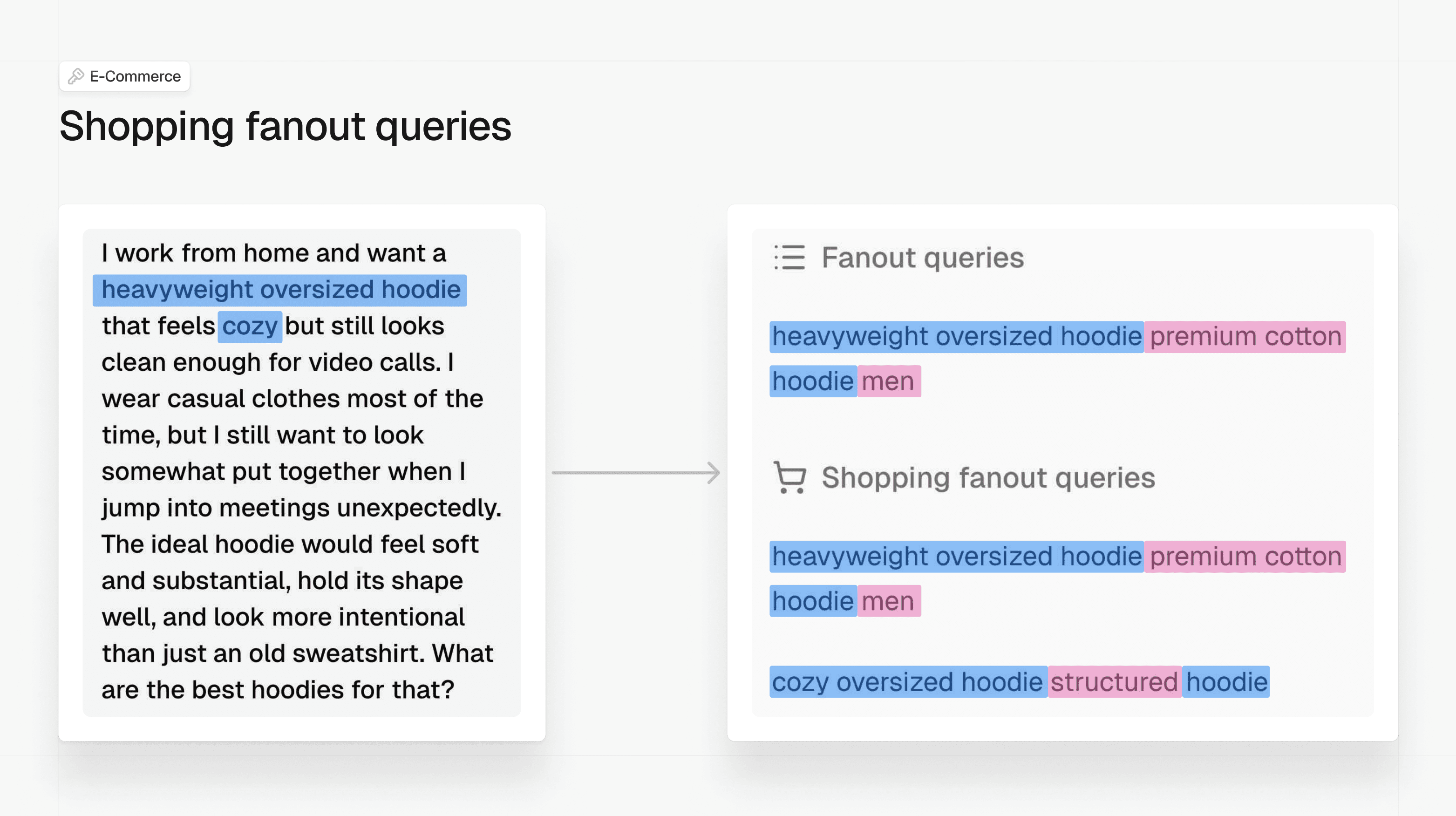
When a prompt has shopping intent, the model generates fan-out queries. The interesting part isn't the words it borrows from your prompt. It's the words it adds.
In one example, a prompt about a "cozy, heavyweight, oversized hoodie" produced fan-outs that introduced the terms structured and premium cotton. If those are genuinely true of your product, that's your cue to say so – on the product detail page and in the feed. (Don't invent claims. But don't leave true ones unsaid either.)
From our research, the fan-out terms that matter most for ecommerce are reviews, 2026, top, comparison, and versus. That last one is the model actively looking for product-vs-product and brand-vs-brand pages. You can play it safe like Apple does – comparing your own models against each other – or go competitive, which works but carries legal nuance depending on how you do it.
One more stat: in 13% of cases we checked, ChatGPT injected brand names into the fan-out queries even when the original prompt mentioned no brands at all. The model wants brand-level information whether the shopper asked for it or not.
How to actually optimise for AI shopping
Pulling the research into a short playbook:
Match content format to intent. Commercial, top-of-funnel prompts pull in listicles and category pages. Transactional, bottom-of-funnel prompts pull in product pages and category pages. Build the format the model is reaching for.
Own your attributes. The comparison table almost never shows a product below three stars on a given attribute – weak products simply don't make the table. So if you make sneakers and you keep seeing comfort and durability in the data, make sure those are stated clearly on your product pages and in your feed, ideally backed by a third-party source. Multi-brand retailers can do the same with scoring, category filters, category copy, or a "10 most comfortable X" list.
Do the Google Shopping basics. Anything that strengthens your organic Google Shopping presence strengthens ChatGPT shopping too.
The listicle tactic – with a warning. One of our customers invented a fictional matcha brand, published three listicles about the best matcha powder, and nothing else – no website, no social accounts. Months later, AI tools in Germany still recommend that brand. It works because listicles rank for the fan-out queries and get pulled into the model's grounding.
This won't hold, though. Now that everyone's doing it, Google has started discounting the trick. In her recent study, Lily Ray found that brands ranking themselves #1 in their own listicle got cited but not recommended about 69% of the time. The recommendation went to the bigger competitors they'd listed. Worth a try this year. I wouldn't build a roadmap on it.
Introducing AI Shopping Analytics
Everything above is observable. The problem is doing it at scale, per product, over time – which is exactly what we built.
AI Shopping Analytics measures how individual products show up in AI shopping, starting with ChatGPT (AI Mode and Amazon's Rufus are in internal testing and rolling out in the coming weeks). If you're already tracking ecommerce prompts in Peec AI, there are no new prompts to set up – it runs on the prompts you already have. Uploading your product catalogue is optional: skip it and you'll see the products already surfacing in your prompts; upload it and you get full per-product tracking across your catalogue, plus a 30-day backfill so you start with history, not a blank chart.
The metrics that matter most, per product:
Visibility – how often the product appears in the prompts you track.
Win Rate – a new metric: how often ChatGPT recommends that specific product as the number-one option in a chat.
Position – where the product ranks when it appears. On the product side this correlates tightly with Win Rate, since the model tends to lead with its top pick.
On top of that, you get the price the LLM assigns to your product (compare it to what you actually charge), the brands and products you're competing against for each prompt, the shopping and regular fan-out queries surfaced per product, and a full breakdown of attributes – clustered into characteristics (e.g. "whey isolate"), facts (true/false statements like "vegan" or "low sugar"), and ratings (star comparisons normalised onto a −4 to +4 scale). It's the fastest way to check whether the model describes your product the way you'd describe it yourself.
A few practical notes:
Connecting your catalogue: Shopify link, CSV upload, or a Google Merchant export. There's a Claude skill to convert any CSV into the required format, going public on our site soon.
Scale: No hard limit (the theoretical ceiling is ~2M products). Very large catalogues just take a little processing time.
API + MCP: Shopping data is landing in the customer API and MCP shortly.
Access: Free for every customer, on every plan, for at least the next 30 days. Go test it.
The best questions from the Q&A
Will ChatGPT keep mirroring Google Shopping, or is this just an MVP?
As long as OpenAI relies on Google Shopping, it persists. They might build their own feed ingestion eventually – but if they do, it'll likely be a similar system, just fed directly. Either way, the optimisation you do now should keep paying off. That's the argument for starting now.
What if you can't use Google Shopping (B2B, compliance reasons)?
Then there's usually no shopping slider to win – but standard GEO still applies. Optimise the answer, the fan-out queries, and your sources. The product feed just won't be the lever.
Does llms.txt or agents.md help visibility?
For being found in answers: roughly zero effect. Those files are for telling agentic visitors where your MCP or public API lives – useful for coding agents, not for ranking in a shopping answer.
New brand – where do you even start?
Get described consistently across the web. If you're new, you're not in the model's training data, so when it runs a grounding query like "what is [your brand]," you want at least two or three sources saying roughly the same thing. Otherwise the honest model answer is "I don't know this brand" – and you won't get recommended anywhere.
Do markdown endpoints matter?
They're near the bottom of the list. Table stakes first: don't block AI crawlers with bot protection or robots.txt, and serve real HTML where the main content is in the first DOM without JavaScript. Markdown is a marginal nice-to-have – and a risky one, because if your bot-only version breaks, nobody notices for weeks.
And a preview of what's next: ads. We've started surfacing which ChatGPT chats show ads, who's running them, and how often a given prompt triggers one. Ad spend follows attention, and attention is moving here. More on that soon.
The takeaway
AI shopping is early enough that the mechanics are still visible and the levers are still cheap to pull. ChatGPT shopping is Google Shopping with a re-ranking layer and a set of fan-out queries you can read and act on. That won't stay this legible forever – which is exactly why the brands that move now will still be ahead when everyone else catches up.
AI Shopping Analytics is live and free for every customer for the next 30 days. Book a demo to walk through your own catalogue with the team, or watch the full session for the complete breakdown.