Visibility vs. perception: Where AI gets its opinion about your brand

Head of Growth
Visibility is whether AI mentions your brand. Perception is what AI says about your brand when it does. A brand can show up often in ChatGPT, Claude, or Gemini and still be described as overpriced and outdated, or portrayed wrongly.
AI platforms form their opinions from three sources: the model's training data, third-party pages such as Reddit threads and media articles, and the brand's own website. Each source changes at a different speed and needs a different fix.
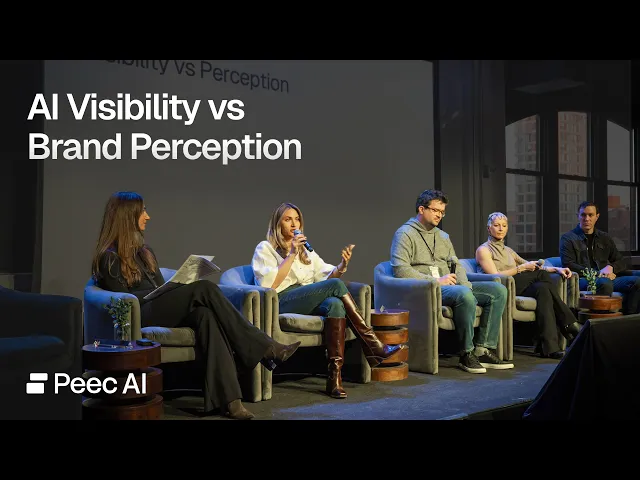
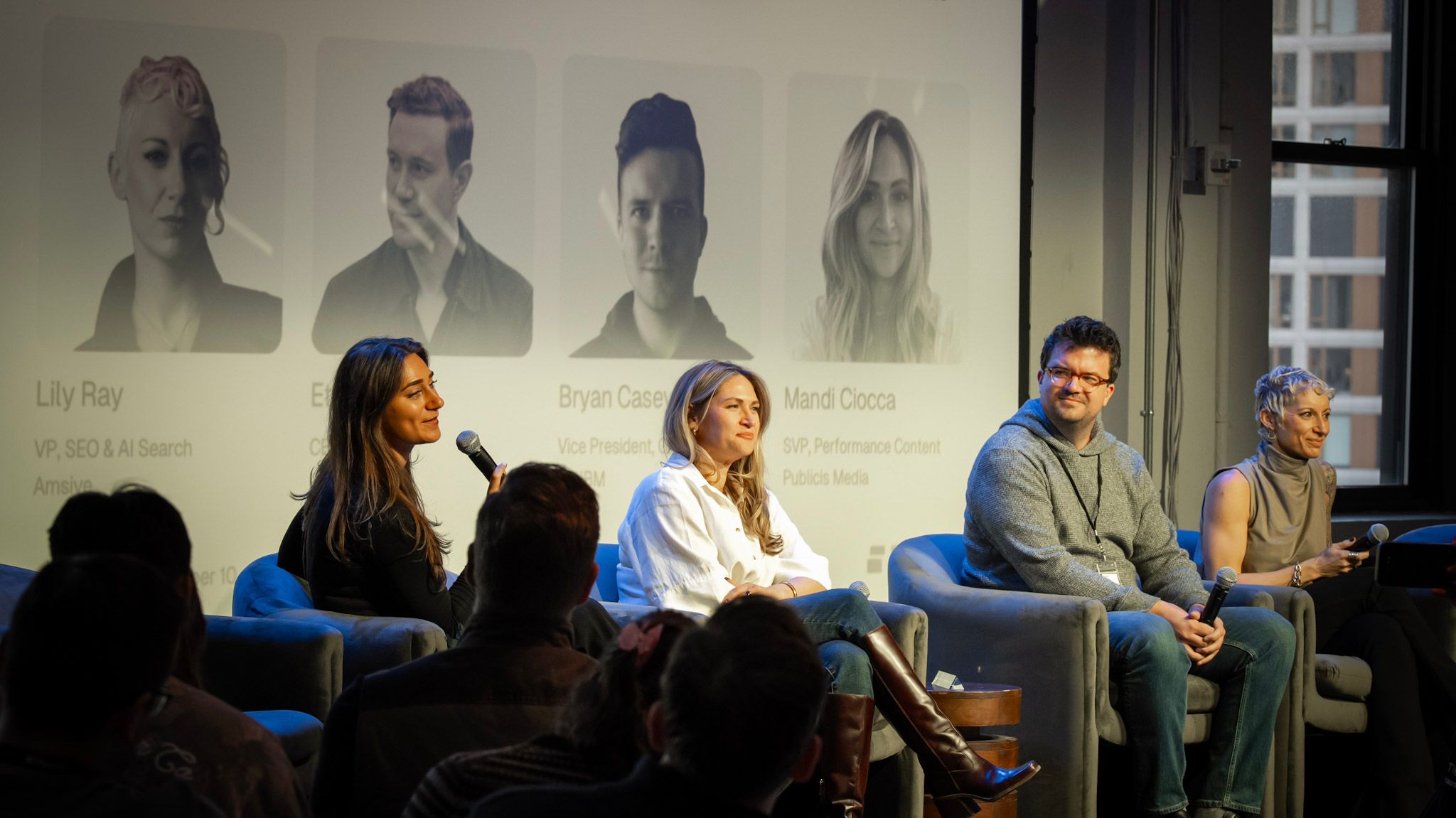
That was the core of the Visibility vs. Perception panel at Peec AI: Perspective in New York on November 10, 2026. The panel brought together:
- Ethan Smith (CEO, Graphite)
- Lily Ray (VP of SEO & AI Search, Amsive)
- Bryan Casey (formerly VP Growth, IBM)
- Mandi Ciocca (SVP Performance Content, PMX, Publicis Media)
Antonia Breitenfellner, AI Search Strategist at Peec AI, moderated. Below are their recommendations, checked against Peec's own research on how ChatGPT and Claude choose what to cite.
Key takeaways:
- In Peec's tests, a source page that got a brand's positioning wrong lost 44% to 95% of its ChatGPT citations. Perception errors cost more than missing mentions.
- ChatGPT recommended a brand it had never seen in training in 0 of 240 answers, even when nine pages it found described it. Training data decides who makes the shortlist.
- Pages that contradict what other sources say get cited less. AI search rewards consensus.
- Fixes start at the source of the claim: your own pages, third-party pages, or the model's training data.
What is the difference between visibility and perception in AI search?
Visibility in AI search measures how often a brand is mentioned in AI answers. Perception measures what those answers say: the sentiment, the accuracy, and the attributes attached to the brand. Mandi Ciocca of PMX, Publicis Media, tracks visibility, sentiment, and accuracy together, because positive sentiment built on outdated facts is still a problem.
"Showing up alone is not success for a brand, because all that's going to do is give you visibility. You don't even know exactly what's being said."
Mandi Ciocca, PMX
The same label can help one brand and hurt another. Ciocca uses the example of being called "the budget option." This would hurt a brand like Dior, but it is a reason to buy for a shopper looking for a deal on Vince Camuto boots. A brand's positioning is the fact AI models check most closely. In Peec's ChatGPT citation research, a page that called a budget brand "enterprise" lost 44% to 95% of its citations. A wrong price given for a brand known for low prices cost the page 100% of its citations.
Ethan Smith, CEO of Graphite, saw the gap firsthand. When he asked ChatGPT about people in the AI search industry, Lily Ray was described as excellent and trustworthy, and Smith as "kind of mixed." The cause was one Reddit thread titled "Is Ethan Smith an over-hyped AI influencer?" Both he and Ray were visible, but the perception of each differed.
Where does AI get its opinion about a brand?
AI models like ChatGPT and Claude build their view of a brand with three sources. The table below compares these by speed of change and by what a brand can do about each.
| Source | What it is | How fast it changes | What a brand can do |
|---|---|---|---|
| Training data | What the model learned before its cutoff date | Slow: each new model is months behind the present | Get accurate facts onto widely read pages (such as major news and industry publications, review sites, Reddit, etc.) now, so the next model learns them |
| Third-party pages | Reddit, media, review sites, and forums found through search | Fast, once the page changes | Find the cited pages, correct facts, join the conversation |
| The brand's own website | Homepage, About page, product pages, listings, and profiles | Fast, if the model can read the page | Keep key facts clear, consistent, and near the top of the page |
Source 1: the model's training data
Training data decides which brands an AI model knows and is willing to recommend. Smith estimates that a new model reflects information two to five months old. When a model has no data on something, such as a feature launched after its cutoff, it guesses. Smith says the trained model shapes answers even when search is on.
"The underlying model actually has as much, if not more, influence, even when there's a search."
Ethan Smith, Graphite
Peec's research supports this. In replayed ChatGPT conversations, a made-up brand was never recommended in 240 answers, even when it appeared on all nine retrieved pages. Although the model read the pages, it wouldn't recommend a brand it had never seen in training.
Source 2: third-party pages found through search
When an AI model searches, it rewrites the user's question into several fan-out queries, runs them, and blends the results into one answer. Lily Ray of Amsive explained that only the most relevant, most trusted, and most readable pages make it into the final answer. Most of those pages are not on the brand's own site.
"A lot of the understanding the model has about a given brand is going to come from what other people are saying about the brand."
Lily Ray, Amsive
Each AI platform searches differently. Peec found that 89.1% of the pages Claude cites appear in Brave's top 20 results for the same queries, while ChatGPT runs its own search index. Furthermore, AI models look for agreement across their sources. In Peec's tests, a page arguing a contrarian verdict lost 44–77% of its ChatGPT citations, even when the argument for the differing view was sound.
Source 3: the brand's own website
The brand's own website is where an AI model looks for what the brand is and what it does. Ray starts every AI search project there. Bryan Casey, formerly VP Growth at IBM, found that models often return to a brand's own site on their own. In one case, a company faced negative Reddit posts after an acquisition. The model read the thread, but it also then read about 200 pages to build its answer. Ninety of those pages were on the two brands' own domains, meaning the company had an opportunity to provide its own answers.
"It gave that brand 90 at bats."
Bryan Casey, formerly IBM
Peec's ChatGPT data points the same way. When a brand's own page was among the sources ChatGPT found through search, it named that brand first in 30% of answers, compared with only 8% of answers where the brand's page wasn't included.
How do you decide what your brand should be known for in AI answers?
A brand should pick the attributes it wants to own (and which audience it wants those attributes to appeal to) before trying to change what AI says. AI answers are personal. One buyer asks for the cheapest option, the next one asks for the premium one. Ciocca recommends listing the attributes that matter for each target audience and tracking them separately.
Casey calls this classic category marketing. AI models tie brands to categories: ask "what is CRM?" and almost every answer names brands, even without search. When a buyer adds criteria to a prompt, the model favors the brands it links to those criteria. Casey's advice is to know the buying criteria your brand wins on, then push those criteria earlier in the buyer's journey, so they are already part of the prompt when the buyer is ready to choose.
Peec's ChatGPT tests show how much a clear role matters. Brands get picked when pages tie them to specifics, not just general positivity. A known brand that's praised on the retrieved pages, such as "we also recommend [brand]," appeared in 0% of answers. A full product description raised the appearance rate to 35%. The greatest improvement was when the model found a reference to a role that matched the question. For instance, a page that included something like "Perplexity specialist" for a question about Perplexity got the brand named first in 100% of answers.
How do you fix wrong or negative information AI says about your brand?
To fix wrong or negative information in AI answers, find where the claim comes from, then correct it at the source. All four panelists agreed on this four-step order:
Step 1: Find the source of the claim
Ray starts by asking the AI model many versions of the same question, or tracking them as prompts in a tool like Peec. She then checks which sources get cited. Prompts worth running for any brand:
- What is [brand] known for?
- Is [brand] a good choice for [use case] in 2026?
- [Brand] vs [competitor]: which is better?
- What are the downsides of [brand]?
- Is [brand] worth the price?
Also check the fan-out queries the AI model actually runs, not only the prompt. On GPT-6, 80% of ChatGPT's fan-out queries in Peec's data included the current year, and about a quarter were a brand name plus "official." If a wrong claim comes from training data, Ray says it can take years to change. If it comes from a page you can find, you can act now.
Step 2: Fix the facts on your own website
A brand's own website is the source it fully controls. Ray recommends these fixes:
- Put one or two plain sentences on the homepage and About page that state the company name and what the company does. In Peec's data, 92% of the passages ChatGPT selected started in the first 10% of the page.
- Keep the company name, address, phone number, and description identical everywhere, including old directory listings. Amsive was renamed several times and acquired, and AI models took a long time to catch up.
- Keep key facts in the page's HTML, not behind client-side JavaScript. A model that can't see a fact can't use it.
- Pick names that stand out. Ciocca has seen AI models confuse brands and products with common terms or competitors with similar names.
Step 3: Correct third-party pages and join the conversation
For pages a brand doesn't own, Ray treats the work as online reputation management: bring in PR or comms, and work with the source to get the facts right. Smith handled his own Reddit thread directly. He did not ask for the thread to be removed and did not argue. He replied with his side, then ran an AMA in the same community. A community member later measured how people described Smith before and after, and the perception improved.
"Do you want people complaining about you and you're just letting them say negative things, or do you want to be part of the conversation?"
Ethan Smith, Graphite
This works because AI models look for consensus. A thread with both sides of the story gives a fairer picture than a thread with only complaints. If a PR team won't allow a reply in the thread, Casey's acquisition example suggests the model will likely visit the brand's own pages next, so those pages should answer the criticism with facts. Peec's research adds one more step: get key facts onto trusted publications, not only Reddit or your own site. Pages with identical content were cited preferentially, based on the source. The page appeared in 20 of 20 ChatGPT answers when the model thought it came from a major industry publication, and in 0 of 20 when it came from a Blogspot address.
Step 4: Avoid self-promotional shortcuts
Self-promotional listicles that rank a brand first and one-sided comparison pages still influence AI answers today. Ray advises against them anyway. AI companies are starting to clean up manipulative tactics, and brands that get caught find it very hard to recover. Her test, borrowed from Google:
"Would you be doing this if search didn't exist?"
Lily Ray, Amsive
Peec's tests show that the honest version of a page also performs better. ChatGPT rewards verifiable facts and a clear fit to the question, not praise. The same facts written as a first-person story got the brand named in 10% of answers, compared with 40% when written as a neutral description.
Who should own AI brand perception, and how do you measure it?
AI brand perception should be owned by one central AI search team with a representative from each channel. Paid, earned, shared, and owned media all shape what AI says about a brand, so no single team can fix it alone. Ciocca calls ownership the number one challenge she sees across brands and agencies.
"If everybody owns it, nobody owns it."
Mandi Ciocca, PMX
She believes SEOs have the right skills to lead the strategy and audit work, as long as each channel's experts are part of the team and the plan fits what each channel already does.
To measure the impact, Smith recommends asking customers directly. In his experience, most people who discover a brand through AI never click a link. They arrive direct or through search, so last-touch attribution misses them, and self-reported numbers come out five to ten times higher. His setup has three questions:
- Add "How did you hear about us?" at the end of the conversion flow, so it doesn't lower conversion.
- If the answer is an AI assistant, ask which one: ChatGPT, Claude, Gemini, or another.
- Ask what the customer typed into it.
The third answer is real prompt data that no tool can collect. It shows whether a change, such as a new page or feature, appears for the prompts real buyers use.
What can you do this week to improve how AI describes your brand?
Antonia Breitenfellner of Peec closed the panel by asking each speaker for one action to take now:
- Lily Ray, Amsive: Add one or two plain sentences to the homepage or About page that state the company name and what the company does.
- Ethan Smith, Graphite: Add "How did you hear about us?" to the conversion flow, and ask AI users which model and which prompt they used.
- Bryan Casey, formerly IBM: Map the attributes the brand wants to own. Then map which pages are responsible for each attribute, using traffic, citations, and AI bot visits.
- Mandi Ciocca, PMX: Keep one source of truth for AI search data, so every team works from the same numbers, and don't rely on a single channel.
Visibility gets a brand into the AI answer. Perception decides what the answer says. The fix is rarely more content. It is the right facts, in the right places, and taking part in the conversations where people already talk about the brand.
See what AI says about your brand. Peec AI tracks brand visibility and perception across ChatGPT, Claude, Gemini, Perplexity, and other AI platforms. Start a free trial or book a demo.