

There's a debate that's been running for two years now. Is it "GEO," "AI search optimization," or just "SEO"? It usually splits into two camps: those defending twenty years of SEO experience who insist nothing has really changed, and those who want to torch the whole industry and declare SEO irrelevant.
Many of the takes out there are devoid of any actual argument. I will skip them here and provide a nuanced and unbiased evaluation of the arguments from both sides, backed by both my 10+ years as an SEO and my interest in AI search.
SEO isn't dead nor unchanged, yet every few years someone declares it finished. Panda was going to kill it, then Penguin, then mobile, then voice, then featured snippets.
Rather than argue for either camp, I’ve put together a concrete list of what’s different in AI search, or what matters far more now than it did in traditional SEO. Some people might be right to call it something new, and enough has changed to justify a new name, but what you call it matters less than what’s actually changed underneath.
AI search is a decision channel, not a traffic channel
Traditional search and AI search optimize for two different things, and that changes what "good" content means.
Take traditional Google Search. Its goal has always been to give the user pages they’ll be happy with: links they'll click and explore without bouncing back to the search engine. That’s why it shows ten blue links, like a shelf for the user to browse. Classic SEO is built on top of that. You rank the page, earn the click, and convert the visitor on the funnel you've built. Google keeps refining its results with updates like the Helpful Content Update, but the aim stays the same, sending people to pages worth visiting.
AI search breaks that chain. ChatGPT, AI Overviews, and Gemini aren't trying to send the user somewhere. They're trying to be the answer, synthesizing the best response to a need from sources they judge reliable. When the user reads that answer, they often make the decision right there, in the chat. They may not click through to your landing page or encounter the brand identity you spent months building. That makes brand visibility and mentions extremely important.
You're no longer just optimizing a page for conversions. Now you're optimizing what the AI model says about your brand in answers you never see. The page that wins is often the most citable, verifiable, easy-to-extract, because that's what the model repeats back.
AI models don't send you much traffic. They surface your brand to people who've already made up their minds. This video walks through the same shift in more detail, if you want to see how the buying decision moves into the chat.
The ranking pipeline got more steps
Traditional search worked in two steps. Index the content, then rank it. That was more or less the whole story.
AI search keeps that old pipeline and stacks new layers on top of it. The first is grounding. To answer a query, AI engines lean on traditional search (index of documents) to find candidate sources, so your classic Google ranking is still the way in.
In my earlier analyses, ranking #1 in traditional Google gave you roughly a 25% chance of being pulled into an AI answer for that query. Ranking is necessary but no longer sufficient. A top-ten position, even first place, doesn't guarantee you show up in AI search. But falling out of the running in traditional search removes you from the AI layer too.
On top of grounding sit two layers that didn't exist before, or that traditional search engines largely skipped:
Training data. If your brand is well represented in what the model was trained on, you have a higher chance of being selected by AI search engines in the first place. This didn’t exist in traditional SEO, and it’s now a major area to optimize for.
Citability. AI engines treat sources as candidates to be cited, and being a candidate isn't the same as being chosen. You can rank high in the engine the model uses for grounding, get surfaced as an answer candidate, and still be dropped because the model decided not to cite you. I treat this as core to the work, yet plenty of SEOs still don’t want to spend time on it.
SEOs are well positioned to own this layer, likely better than any other discipline, because the foundation is the same one we've always worked with. What's changed is the surface area you now have to control on top of it.
In practice, though, it's often not SEOs who've taken the reins but the PR, communications, or brand marketing teams - the ones who recognized the shift earlier and moved on it first.
Major shift from websites to brands
Large language models (LLMs) lean heavily on a handful of third-party sources: Reddit and YouTube for almost everything, G2 and similar directories for software brands, and plenty of others depending on the query.
Take the query "is Volvo a safe car." AI Overviews pull from a mix of official dealership pages, Reddit threads, and YouTube videos, and Volvo's own site is only a small part of the answer.
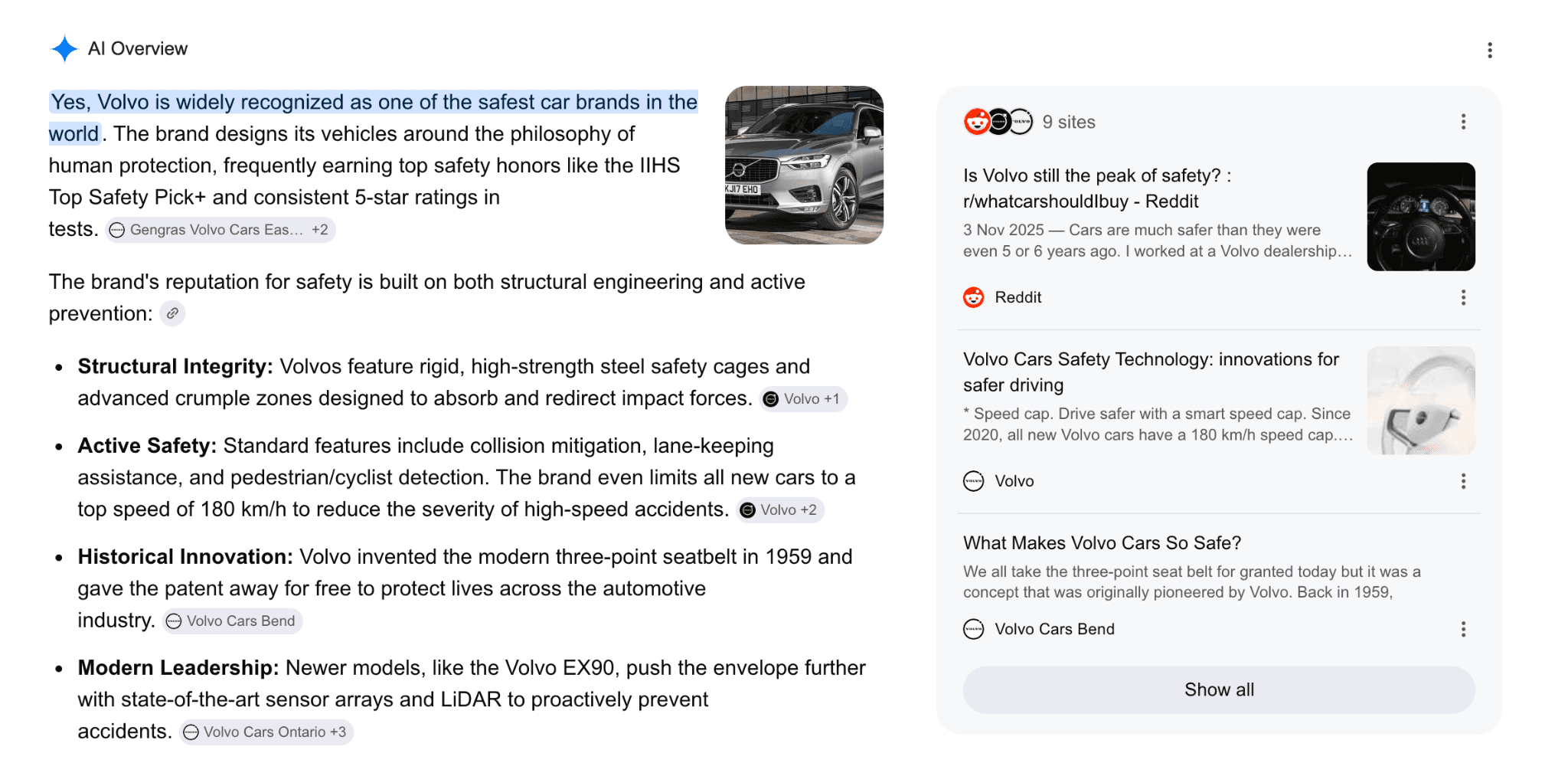
Ask ChatGPT the same thing and it leans on Wikipedia and Reuters. The official source is rarely the dominant one.
The same thing can work against you. I regularly see LLMs cite incorrect statements about Peec AI, and interestingly, it usually isn’t the AI model hallucinating. The false claim is sitting in competitors' content, and the model is repeating it. So when I spot a source that's both wrong and popular in AI answers, I reach out to whoever owns it and politely ask for a correction. That kind of off-domain reputation work is now part of the job.
Measuring GEO looks like brand marketing, not performance marketing
There’s one more shift, and it’s about how you prove any of this worked. It's the one a lot of teams will find the hardest.
Performance marketing spoiled us with clean numbers. Every click carried a tag, every conversion fired an event, and every campaign had a UTM string you could trace straight back to revenue. You could show leadership a direct line from spend to signups.
AI search takes away the thing that made that possible: the click. When the buyer settles the question inside the chat, nothing lands on your site, so there's no session, referrer, or funnel step to log. First-click and last-click models miss AI search almost entirely, because the decisive moment happened somewhere your analytics can't see it.
What's left looks a lot more like how brand teams have always operated. They measured lift, direction, and presence through surveys, panels, and share of voice, accepting influence they could observe but not tag to an individual. That's where GEO sits. Your equivalent of share of voice is how often, and how favorably, the models mention you versus your competitors across the prompts that matter for your business.
The hard part is human, not technical. Anyone who's spent years reporting purely on attributable clicks now has to defend a budget with a different kind of evidence, and retrain both themselves and the executives who got used to that tidy dashboard.
There's less demand data, and it’s skewed
Traditional SEO can tell you how many people search for a topic. Google Search Console, Ahrefs, Semrush put the volume right in front of you. AI search makes that much harder.
In the Search Console, much of the data is missing. In experiments I ran earlier, Google turned out to be very selective about reporting conversational-style queries. In fact, it fails to report roughly half of them.
SEOs love data, so when the first-party numbers dry up, they reach for clickstream data instead. The problem is who that data comes from.
When a tool quotes you detailed "prompt volume," it almost never comes from the AI engines, because they don't share it. It's reconstructed from clickstream data, meaning browsing and prompt activity harvested from real users. The catch is which users. That data commonly comes from free browser add-ons, like free VPNs, ad blockers, and "privacy" extensions people install in exchange for being tracked. And those who install free tracking-ware to save a few dollars aren’t the ones making high-value buying decisions.
KOI security researchers documented how invasive this gets. They found a set of free extensions from a single data-broker publisher, a VPN tool among them, capturing users' full conversations with ChatGPT, Claude, Gemini, and other assistants, prompts and responses alike, and selling them for marketing analytics. More than eight million users were affected.
Someone running a free VPN to scrape a little value out of their browser isn't your enterprise buyer, procurement lead, or the decision-maker signing off on a purchase. So when a volume tool tells you a prompt is "popular," it's often telling you it's popular with people who will never buy from you. Chasing those numbers optimizes you for an audience that’s unlikely to convert, which is exactly why prompt volume is the wrong signal to follow for AI search.
Sparse, skewed data isn't a dead end, though. You no longer need Google, or a data broker, to hand you a keyword list. You can build a strong prompt set yourself, grounded in your real customer journey, and measure your visibility against that. If you want to build one, I've written a full guide on how to choose the right prompts for LLM tracking.
AI search visibility now differs by model
For years, "search visibility" effectively meant Google, and even then you couldn't see much of what Google was actually doing. Most people assumed that whatever worked in one place worked everywhere.
That assumption no longer holds. Visibility and citations now vary from one AI model to the next, and the differences are large. In the Peec AI database, I've seen plenty of brands that are far more visible in ChatGPT than in AI Mode or AI Overviews, and plenty where it's the other way around. The gap shows up even within Google's own family, between AI Overviews and AI Mode.
Three factors drive this:
Training data. What each model absorbed shapes who it already knows.
Fanout systems. In my analysis of how ChatGPT, Grok, and Perplexity expand a query, each one behaves differently. Perplexity makes only very basic changes, so you're effectively optimizing for the query exactly as it was typed. ChatGPT adds words like “reviews,” “best,” or “2026.” Grok is closer to how Google described its own fanout systems in its patents.
The underlying LLM model and system prompt. The same model returns different results under a different system prompt, and it behaves differently again depending on how many thinking tokens you give it.
That last factor matters more than people expect. When you design a test to measure how much something like <b> (semantic bold) affects results and citation patterns, the answer changes completely from one model to the next. Gemini 3, for example, weights bold text differently.
I've run close to 300 experiments on the importance of how you write and format content, and models varied widely. I also see many of those findings confirmed in the live engines. Sometimes a technique that helps the GPT model on its own has the opposite effect in the ChatGPT app built on top of it.
JavaScript SEO matters more, not less
Google used to be terrible at rendering and indexing JavaScript - a topic I covered in many of my SEO conference talks. It's better now, though still not perfect. AI search is a different situation altogether, because many of the bots and agents people are building don’t run JavaScript at all.
Neither do many of the crawlers used to build training data, like the CommonCrawl bot. And as more people hand tasks off to agents, the default behavior is often not to run JavaScript unless you explicitly configure it to.
So checking whether your content is visible without JavaScript becomes more important, not less. You can do exactly that with Lily Ray’s LLM content visibility scanner.
GEO or SEO?
Put all of this together and the GEO-or-SEO question mostly answers itself. Nothing here says your SEO experience is worthless. Ranking still matters, because AI engines ground their answers in traditional search. Understanding crawlers, indexing, and content quality still matters.
But look at what's been stacked on top of it.
You're not just optimizing a page. You're managing what models say about your brand, based on sources you don't own.
You're not just chasing clicks. People decide inside the chat, often before they reach your site, so you're trying to influence that answer.
You're not just measuring attributable sessions. You're tracking how often models mention you against competitors, across models that each answer differently. And the demand data you relied on for years is now either hidden or drawn from the wrong people.
You have to think about layers that didn't exist in traditional search, like training data and whether a model chooses to cite you.
That's why "good SEO is good GEO" is only half true. The foundation is shared, but the surface area is not. The skills that got the industry here are necessary, they're just no longer enough. The old playbook still works, but it misses half the opportunity in this new kind of search.
So call it GEO, call it AI search, call it SEO reborn. The label doesn't change the work. SEO has always behaved like a phoenix, the mythical bird that burns to ash and rises from it, and it has followed that pattern for two decades. It comes back each time, but never as the same bird. The people who do well over the next few years will be the ones who recognize that pattern and start managing training data, citations, and brand mentions before their competitors do.